


“Seat Count Doesn’t Matter: BJP Will Prevail Regardless of Delimitation, Says Pralhad Joshi”
Union Minister Pralhad Joshi defends Centre’s stance, asserts electoral confidence while Opposition questions intent behind seat expansion.
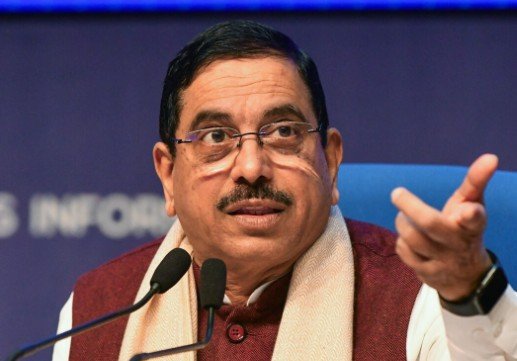
New Delhi, April 18: The delimitation debate in India took a sharp political turn after the 131st Constitution Amendment Bill, 2026, linked to women’s reservation and parliamentary seat expansion, failed to pass in the Lok Sabha. The development has triggered a fresh exchange of accusations between the ruling government and the Opposition, with Union Minister Pralhad Joshi strongly defending the Centre’s approach.
Speaking to reporters outside Parliament, Joshi dismissed Opposition concerns over the proposed delimitation process, asserting that electoral outcomes are driven by public support rather than the number of constituencies. He maintained that whether Parliament has 543 seats or expands to 800 or more, the ruling party’s electoral prospects would remain unaffected.
According to the minister, delimitation is not a new exercise but a constitutional necessity that has been undertaken periodically in India’s democratic history. He argued that the current push to delink the census from delimitation is aimed at facilitating women’s representation while accommodating India’s significant population growth.
Joshi highlighted that when the parliamentary seat count was originally determined, India’s population was significantly lower. With the country now home to over 1.4 billion people, he said increasing the number of constituencies is both logical and necessary to ensure proportional representation.
The minister also emphasized that the Centre’s decision to separate delimitation from the census process is intended to expedite the implementation of women’s reservation. He stated that the move would allow a greater number of women to enter Parliament without being delayed by procedural constraints tied to census data.
However, the Opposition has sharply criticized the government’s stance, alleging that the delimitation exercise could be politically motivated. Responding to these allegations, Joshi rejected claims that the process would disproportionately benefit the ruling party, arguing instead that voting patterns are determined by governance, policies, and public trust.
In a pointed attack on the Congress, Joshi accused the party of lacking credibility among voters and claimed that its opposition to the amendment bill had effectively blocked opportunities for increased women’s representation in Parliament. He argued that public confidence currently rests with Prime Minister Narendra Modi and his administration, which, according to him, explains the BJP’s electoral success.
The minister further stated that electoral outcomes would remain consistent regardless of the number of constituencies, reiterating that voter sentiment, rather than structural changes, determines political success. He described the Opposition’s arguments as misplaced and suggested they were an attempt to divert attention from their own political shortcomings.
The debate also saw regional dimensions emerge, particularly after Tamil Nadu Chief Minister M. K. Stalin called for postponing the delimitation process by another 25 years. Stalin argued that such a delay would prevent potential imbalances and ensure fairness across states.
Responding to this demand, Joshi said that any future decision regarding delimitation would be taken by the party leadership, while accusing Opposition leaders of attempting to create a divide between northern and southern states. He described such narratives as harmful to national unity and rejected claims that delimitation would disproportionately benefit certain regions.
Stalin, meanwhile, termed the defeat of the amendment bill a significant political moment, describing it as a “hammer blow” to what he alleged were attempts to divide the country. He also highlighted the vote as a sign of growing unity among Opposition parties, noting that it marked a rare instance where a constitutional amendment introduced by the government failed to secure passage.
The numbers in the Lok Sabha reflected a closely contested vote. While 298 members supported the bill, 230 opposed it, leaving the government short of the two-thirds majority required for constitutional amendments. The outcome underscores the increasingly competitive nature of parliamentary politics and the challenges faced by the ruling coalition in pushing through major legislative changes.
The delimitation debate in India is now expected to remain a key political issue in the coming months, with both sides likely to intensify their campaigns around representation, federal balance, and electoral fairness. As discussions continue, the issue has the potential to shape not only parliamentary dynamics but also broader political narratives ahead of future elections.
With strong positions emerging from both the government and the Opposition, the question of how and when delimitation should be implemented remains unresolved. What is clear, however, is that the debate has moved beyond technical considerations and into the realm of political strategy, public perception, and the evolving structure of India’s democracy.

