


Asian Stocks Slip as Korean Chip Selloff Weighs on Markets, Oil Prices Ease
A sharp selloff in South Korean chipmakers dragged Asian equities lower on Thursday, reviving concerns that the AI-fueled tech rally has overheated, while easing oil prices and softer inflation signals from the US Federal Reserve offered some relief to global investors.
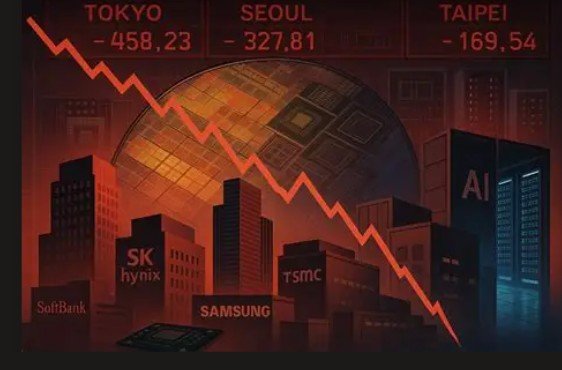
Asia, July 02 : Asian equity markets retreated sharply on Thursday as a heavy selloff in South Korean semiconductor stocks rattled investor confidence and reignited concerns that the artificial intelligence driven surge in global technology shares may have run ahead of fundamentals. The decline, led by steep losses in major chipmakers such as SK Hynix and Samsung Electronics, pulled broader regional indices lower and added to the cautious tone already building across global markets after a weak session on Wall Street.
The selloff marked the first decline in Asian equities in four sessions and underscored how sensitive global markets remain to any sign of cooling momentum in the semiconductor trade, which has been at the heart of the AI investment boom. South Korea’s Kospi index, which hosts several of the region’s most important AI hardware and memory chip manufacturers, fell nearly 6%, one of its sharpest declines in recent months. The broader MSCI Asia Pacific Index also slipped 1.2%, reflecting the extent to which the weakness in Korean technology shares spread across regional bourses.
At the center of the market turbulence were SK Hynix Inc. and Samsung Electronics Co., both of which have been among the biggest beneficiaries of the AI-led surge in demand for advanced memory chips and data-center hardware. Shares of both companies dropped more than 8% in Seoul, wiping out a significant chunk of recent gains and signaling that investors are reassessing valuations after a blistering run-up in semiconductor stocks this year.
The pressure was not limited to South Korea. In Japan, Kioxia Holdings Corp. plunged 14%, extending volatility in a stock that had surged more than 650% so far this year. The dramatic reversal highlighted the increasingly fragile mood around semiconductor names, especially those closely tied to the AI narrative. Investors who had poured money into chipmakers on expectations of relentless demand for AI infrastructure are now beginning to question whether the rally has become overextended.
The weakness in Asian technology shares followed a bruising session in the United States, where Wall Street benchmarks fell and a semiconductor stock gauge sank 6.3%. US equity-index futures were down another 0.2% in Asian trading, suggesting the risk-off mood was likely to carry into the next US session and potentially weigh further on the S&P 500 and Nasdaq 100.
The renewed pressure on chip stocks came amid a series of developments that added to uncertainty in the sector. One of the biggest concerns for investors was news that Apple Inc. is in talks to purchase chips from two Chinese semiconductor makers. The development raised questions over whether Samsung Electronics and SK Hynix could face increasing competition in supplying high-end components for global consumer electronics and AI-linked devices. For Korean chipmakers, which have been key pillars of the AI supply chain, the prospect of Apple diversifying its supplier base has created fresh anxiety about pricing power, market share and future earnings momentum.
At the same time, reports that Meta Platforms Inc. is exploring plans for a cloud infrastructure business focused on selling access to AI computing power and AI models also unsettled investors. The concern in the market is not simply that Meta is expanding deeper into AI infrastructure, but that the company may have overbuilt its own capacity. If large technology firms are beginning to build more computing resources than they can efficiently monetize, that could raise broader doubts about the sustainability of the spending boom that has powered semiconductor demand over the past year.
Together, these developments fed into a wider market narrative that the AI trade may be entering a more volatile phase. For much of the past year, investors have aggressively chased semiconductor and technology stocks on the assumption that demand for AI chips, servers, memory and cloud infrastructure would continue to rise at an extraordinary pace. That trade helped lift valuations across the sector to levels that increasingly required flawless execution and uninterrupted demand growth. Any hint that customers may diversify suppliers, slow spending, or overinvest in infrastructure has the potential to trigger outsized reactions in share prices, as Thursday’s selloff demonstrated.
Despite the sharp equity weakness, there were pockets of stability elsewhere in financial markets. Crude oil extended its decline, with Brent falling 0.8% to around $71 a barrel, its lowest level since late February. The drop in oil prices was linked to improving flows through the Strait of Hormuz, a critical route for global energy shipments. The easing in oil prices offered some relief to investors worried that geopolitical tensions in the Middle East could once again ignite inflationary pressures and complicate the outlook for global central banks.
The fall in oil also helped temper broader market anxiety by reducing immediate fears of an energy shock. Over recent weeks, concerns about disruptions in the Strait of Hormuz had supported crude prices and revived debate over whether higher energy costs could spill into global inflation. Thursday’s move lower in Brent suggested traders were becoming more comfortable with the geopolitical backdrop, at least for now, as energy shipments continued to move and the risk of a major supply interruption appeared contained.
Gold, meanwhile, rose for a second consecutive day as investors sought some defensive positioning amid the selloff in equities and digested comments from Federal Reserve Chairman Kevin Warsh. Speaking at the European Central Bank’s annual forum in Sintra, Portugal, Warsh said price risks in the United States had eased in recent weeks and that inflation expectations had moderated over the past month. He reiterated the Fed’s commitment to bringing inflation back to its 2% target, but his tone was interpreted as less alarmist than some investors had feared.
Warsh’s remarks were closely watched because markets have been trying to gauge how quickly the Fed may move on interest rates in the second half of the year. His comments reinforced the view that policymakers are not under immediate pressure to raise rates again and that the central bank remains focused on restoring price stability without overreacting to short-term fluctuations. Treasury yields held onto recent losses after the remarks, while traders pared back speculation that the Fed could deliver a near term rate increase as soon as July.
Analysts said Warsh’s comments offered at least a partial cushion for markets at a time when sentiment toward technology stocks had turned fragile. Krishna Guha of Evercore said the Fed chair’s remarks did not provide any fresh support for the idea of a July rate hike and instead suggested that policymakers remain data dependent and in no rush to tighten further. In a market already dealing with a sharp rotation out of semiconductor stocks, the absence of a more hawkish message from the Fed helped prevent a broader cross-asset panic.
Investors are now turning their attention to the upcoming US jobs report, which is expected to provide the next major clue on the strength of the economy and the likely direction of monetary policy. A strong labor-market reading could reinforce the narrative of economic resilience and potentially keep rate-cut hopes in check, while a weaker number might strengthen the case for a more accommodative Fed later in the year. For now, however, the jobs data is being viewed through the lens of a market trying to determine whether growth is strong enough to sustain corporate earnings without reigniting inflation.
There were signs on Thursday that the US economy continues to show resilience beneath the surface of market volatility. Fresh data indicated that US manufacturing expanded for a sixth straight month in June, with input cost pressures easing even as production activity remained firm. Gains were led by sectors such as printing, electrical equipment and textiles, while paper products, furniture and wood products lagged behind. The data added to the evidence that the US economy is still on a solid footing, despite concerns over rates, inflation and global uncertainty.
Economists said the manufacturing numbers support the view that growth in the world’s largest economy remains durable. Raymond James chief economist Eugenio Aleman said the latest report pointed to continued resilience in the manufacturing sector and was consistent with an economy that may be reaccelerating rather than slowing materially. Such a backdrop is generally supportive for risk assets over the medium term, but in the near term it also complicates the Fed’s task by making it harder to justify aggressive easing unless inflation continues to cool.
Beyond the economic data, investors also kept a close eye on geopolitical developments, particularly in the Middle East. According to a senior US administration official, American negotiators Steve Witkoff and Jared Kushner held constructive discussions in Qatar and progress is being made in technical talks involving Iran. The negotiations are aimed at turning an interim peace arrangement into a more durable end to the conflict, offering some hope that tensions in the region may continue to ease.
Iranian officials have also signaled movement on the diplomatic front. State media reported that working groups have been formed in Tehran to discuss implementation of the current agreement and work toward a final peace settlement, though formal talks have not yet begun. For financial markets, any progress toward stabilizing the region is especially important because it reduces the risk of disruptions to oil flows and helps keep a lid on crude prices.
Strategists said the market is gradually becoming less reactive to geopolitical headlines as long as the basic energy-supply picture remains intact. Mohit Kumar of Jefferies said investors remain cautiously optimistic on geopolitics, not because they expect a sweeping breakthrough, but because even a partial arrangement that keeps the Strait of Hormuz open and oil moving would be enough to calm markets. In that environment, geopolitical risk may fade into the background unless there is a fresh escalation.
Still, the dominant story for investors on Thursday remained the abrupt reversal in semiconductor shares and what it says about the next phase of the AI trade. Over the past year, AI enthusiasm has driven one of the most powerful market themes in recent memory, lifting everything from chipmakers and cloud providers to data center suppliers and power infrastructure firms. But the sheer speed of the rally has left valuations vulnerable, especially in companies whose share prices have come to reflect years of future growth.
The fall in Korean and Japanese chip stocks may not by itself mark the end of the AI boom, but it does serve as a reminder that markets periodically pause to reassess whether expectations have become too aggressive. Investors are increasingly asking whether earnings growth can keep pace with share-price gains, whether AI infrastructure spending can remain at current levels, and whether competition among chip suppliers could intensify just as valuations peak.
For Asian markets, the immediate concern is that South Korea’s semiconductor giants are deeply embedded in regional equity benchmarks and investor portfolios. When SK Hynix and Samsung decline sharply, the impact is not confined to one country or one sector; it reverberates through broader Asian risk sentiment, exchange traded funds, and global allocations to emerging and developed Asia. Thursday’s losses therefore had an outsized psychological effect, reinforcing caution across the region.
The coming days are likely to test whether the current selloff is simply a healthy correction after an overheated rally or the start of a more prolonged repricing in the AI-linked technology space. Much will depend on how US markets respond, whether incoming economic data supports the soft-landing narrative, and whether major technology companies can continue to justify their enormous capital expenditure plans with clear earnings visibility.
For now, investors are navigating a market caught between two competing forces. On one side is a still resilient global economy, easing oil prices, and central bankers who appear less inclined to tighten policy aggressively. On the other is a technology sector facing valuation fatigue, intensifying competition, and growing scrutiny over whether the AI buildout has become too exuberant. Thursday’s trading in Asia showed just how quickly sentiment can shift when one of those pillars starts to wobble.
As the dust settles, the message from markets is clear: the AI trade remains powerful, but it is no longer unquestioned. Semiconductor stocks that were once treated as near one way bets are now facing a more demanding environment in which every earnings update, supply chain development and policy signal can move prices sharply. That shift does not erase the long-term promise of artificial intelligence, but it does suggest that the next stage of the rally may be less forgiving and far more selective than the one that came before.

