


PM Modi Set to Flag Off India’s First Hydrogen Train from Haryana’s Jind on July 17
Hydrogen-powered rail service set to mark a major step in India’s clean mobility push, with commercial operations planned on the Jind–Sonipat route after the inaugural run.
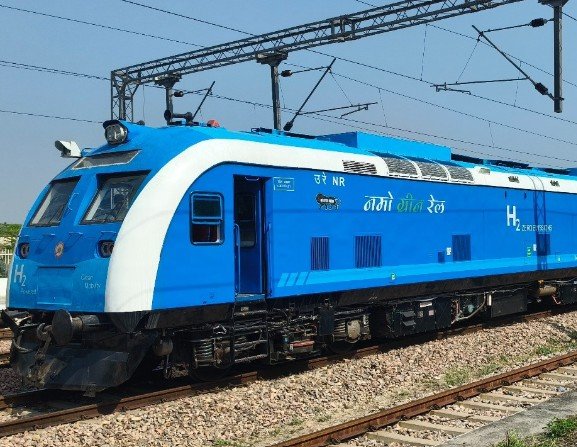
India, July 09 : India is poised to take a major leap in green transportation with Prime Minister Narendra Modi expected to inaugurate the country’s first hydrogen powered train from Haryana’s Jind railway station on July 17. Railway ministry sources indicated that preparations for the launch are in the final stages, and the project is being seen as a landmark move in India’s transition towards cleaner and more sustainable public transport systems.
According to officials familiar with the development, the Prime Minister’s Office has conveyed its approval for the proposed launch event, which will place India among the countries experimenting with hydrogen-powered railway operations as part of a broader clean energy strategy. The new train, which has been undergoing trial runs for the past several weeks, is expected to begin passenger operations soon after the formal flag off.
The hydrogen train has been designed as a modern, energy efficient rail service aimed at reducing the carbon footprint of conventional railway operations. Railway authorities say the service has completed extensive testing over the past two and a half months on the Sonipat–Jind–New Delhi section. During these trials, the rake was tested at varying speeds and under different operating conditions to assess its performance, safety, stability and energy consumption.
Officials said the train has two driving power cars and eight passenger coaches, giving it a substantial seating and carrying capacity. Once commercial services commence, the train is expected to run on the Jind–Sonipat route in Haryana, covering a total of 356 kilometres every day. The daily schedule has been planned in a way that the train will complete two round trips of 89 kilometres each in both directions. Railway authorities believe this route will serve as the first real-world operating corridor for India’s hydrogen rail experiment and will provide valuable data for future expansion of similar services.
The train has a seating capacity of 682 passengers, while its total carrying capacity is around 2,600, taking into account standing passengers and operational load norms. Officials involved in the project said the train has been built to handle regular passenger movement efficiently while also demonstrating the practical viability of hydrogen as an alternative railway fuel.
Experts from the railway mechanical department explained that each of the two driving power cars is capable of producing 1,200 kilowatts of traction power. Together, the train has a total installed traction output of 2,400 kilowatts, which translates to roughly 3,200 horsepower. This power configuration, according to engineers, is adequate for hauling the train’s full coach composition, achieving the required acceleration and maintaining stable movement across the designated route.
What makes the project particularly significant is the use of hydrogen fuel cell technology. Unlike diesel locomotives, which emit carbon dioxide and other pollutants, hydrogen-powered systems generate electricity through a chemical reaction between hydrogen and oxygen. The by-product of this process is water vapour, making the train far cleaner from an environmental standpoint. Railway engineers say the hydrogen train represents an important pilot in India’s effort to integrate low-emission technology into one of the world’s largest rail networks.
Officials said the train carries around 440 kilograms of compressed hydrogen in specially designed storage systems. The onboard fuel cell setup converts the hydrogen into electrical energy, which then powers the traction and other train systems. Railway experts estimate that under maximum passenger load and standard operating conditions, the train could consume around 300 kilograms of hydrogen in a day. This figure will be crucial in determining future operating costs, refuelling requirements and long-term scalability of hydrogen-powered rail services in India.
Although the train has been engineered to achieve a top speed of 110 kilometres per hour, railway authorities said its operating speed on the Jind–Sonipat route will be limited to 75 kmph. The decision has been taken keeping in mind route conditions, operational safety and the need to gradually integrate the new technology into regular passenger service. Officials said the trial runs included tests at speeds ranging between 75 kmph and 120 kmph to ensure that the train could perform reliably across different scenarios before entering commercial service.
The hydrogen train project is being closely watched not only within railway circles but also by policymakers and clean energy experts because it reflects a broader shift in India’s transport strategy. With growing emphasis on reducing dependence on fossil fuels and cutting emissions, Indian Railways has in recent years accelerated efforts to modernise its fleet, electrify routes and explore alternative propulsion systems. The launch of a hydrogen train fits into that larger policy framework, where the aim is to combine infrastructure expansion with sustainability goals.
Hydrogen has increasingly emerged as a promising fuel option for sectors that are difficult to fully decarbonise through battery-electric systems alone. Rail transport, especially on routes where full electrification may not always be immediately practical or where clean alternatives are being tested, is one such sector. The Jind–Sonipat hydrogen service is therefore expected to serve as a pilot project for assessing the technical, economic and logistical feasibility of such trains in Indian conditions.
Officials said the train’s design and safety systems have undergone independent validation. The hydrogen power setup, storage arrangements and other critical elements were examined by TUV SUD, an international testing and certification agency, to ensure that the train meets prescribed safety benchmarks. Since hydrogen is a highly flammable gas, its storage, handling and onboard use require stringent protocols. Railway officials maintained that the train has been equipped with the necessary safeguards and monitoring systems in line with international norms.
At the same time, railway authorities have also put in place a special maintenance protocol for the hydrogen rake. Since the train has been cleared to run only on the Jind–Sonipat section for now, and dedicated maintenance infrastructure for the rake has been created at Shakurbasti in Delhi, the hydrogen system will be shut down before the train is moved for servicing. Once the hydrogen-powered systems are brought to a safe inactive condition, a diesel locomotive will haul the train to the Shakurbasti facility for maintenance and inspection. Officials said this arrangement has been designed as an interim operational measure until a more integrated support ecosystem for hydrogen trains is developed.
The maintenance aspect is likely to be one of the most closely studied elements of the pilot service. Unlike conventional diesel or electric rolling stock, hydrogen-powered trains require a specialised support chain involving fuel storage, refuelling systems, inspection standards and emergency response preparedness. Indian Railways is expected to use the Jind-based launch as an opportunity to build experience in all these areas before considering wider deployment of hydrogen trains on other routes.
The upcoming launch also carries symbolic weight. It comes at a time when India has been trying to position itself as a country committed to green growth, renewable energy and low-carbon infrastructure. The railway sector, because of its size and energy demand, occupies a central place in that transition. Indian Railways has already set ambitious goals around electrification, energy efficiency and carbon reduction, and hydrogen-powered mobility is being seen as one of the next frontiers in that journey.
For Haryana, the inauguration is likely to be a moment of prestige as Jind becomes the starting point for a project of national significance. The route between Jind and Sonipat, though regional in scale, could become a showcase corridor for a technology that may eventually be replicated elsewhere depending on the performance of the pilot service. If the operational experience proves successful, it may open the door for similar trains on heritage, non-electrified or semi-urban routes where a clean alternative to diesel is being considered.
Railway officials believe that beyond its technical significance, the hydrogen train can also help familiarise the public with emerging clean mobility technologies. As India pushes electric vehicles, green hydrogen projects and renewable energy expansion across sectors, the visibility of a hydrogen-powered train in regular passenger service could contribute to wider public acceptance of the technology. It also sends a message that the clean energy transition is not confined to policy documents or pilot plants but is gradually entering mainstream public infrastructure.
The hydrogen train initiative may also have industrial implications. As India seeks to build a domestic green hydrogen ecosystem, projects such as this can support the development of local manufacturing, engineering capabilities and standards for hydrogen-based systems. From fuel storage and control systems to maintenance protocols and operational training, every part of the project creates knowledge that can feed into future mobility and industrial applications.
Much will now depend on how the service performs once it begins carrying passengers. Reliability, fuel efficiency, safety, turnaround time, maintenance cost and passenger feedback will all play a role in determining the future of hydrogen trains in the country. Railway authorities are expected to closely monitor the service after launch and use the findings to refine operational plans.
For now, the expected July 17 inauguration stands out as a milestone in India’s railway modernisation story. If the schedule goes ahead as planned, the flag-off from Jind will not just mark the beginning of a new train service, but also the start of a new chapter in the country’s search for cleaner and more innovative transport solutions. With hydrogen now entering India’s rail map, the coming months could offer the first real glimpse of whether this technology can become a meaningful part of the nation’s transport future.

