


Nepal Flood Death Toll Surpasses 1,200 as PM Shah Highlights Climate Change Impact
Thousands remain missing after the devastating Bhotekoshi floods, while rescue teams struggle to reach workers feared trapped inside hydropower tunnels and underground facilities.
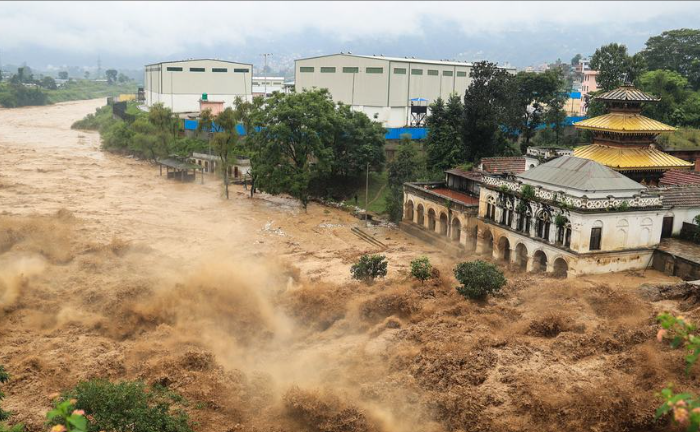
KATHMANDU, Sep 2: Nepal’s death toll from last week’s devastating flash floods rose to 1,204 on Wednesday, with thousands still missing as security forces and rescue teams continued searching through debris, tunnels and damaged hydropower facilities.
The National Disaster Risk Reduction and Management Authority said 4,216 people remain unaccounted for across eight affected districts. Among those missing are 583 foreign nationals.
The disaster has prompted renewed concern over the vulnerability of Himalayan communities to climate-related extreme events. Prime Minister Balendra Shah told the House of Representatives that Nepal must highlight the connection between the disaster and climate change before the international community.
Shah said experts had attributed the Bhotekoshi flash floods in Rasuwa district to an ice-rock avalanche in the Himalayas. He stressed that the increasing frequency and severity of such events posed growing risks to mountain communities.
The prime minister also argued that because climate change has global causes, the international community has a shared responsibility to help countries manage and reduce its consequences.
Rescue operations face major challenges
Nepal’s security forces have rescued 11,993 people so far using helicopters and ground routes, with around 21,314 personnel deployed for search, rescue and relief operations.
However, operations have been particularly difficult around hydropower projects along the Bhotekoshi and Trishuli rivers. Rescue personnel, including the Nepal Army, Armed Police Force, foreign technical experts and project workers, are searching underground powerhouses and tunnels for people believed to be trapped.
Officials have struggled to locate tunnel entrances because huge quantities of debris and material carried by the river have covered access points.
Data from the Independent Power Producers’ Association, Nepal showed that 947 people associated with various hydropower projects remained unaccounted for. It remains unclear how many are trapped underground and how many were swept away.
More than 557 people are reportedly missing from the 216-MW Upper Trishuli-1 Hydropower Project alone. At Upper Trishuli-3A, 42 people are feared trapped inside the underground powerhouse, while 191 remain unaccounted for at Upper Trishuli-3B.
Another 93 people are missing from the Rasuwagadhi Hydropower Project and 41 are feared trapped at the Langtang Khola Hydropower Project.
Families perform final rites
The scale of the disaster has left many families without confirmed information about their relatives. Some have resorted to creating funeral effigies and conducting final rites for those who remain missing.
Dozens of such effigies were cremated during a mass funeral at Pashupati Aryaghat in Kathmandu on Wednesday.
Nepal Police said postmortem and legal identification procedures had been completed for 1,113 bodies, while 95 had been handed over to relatives. Details of 911 unidentified bodies have been uploaded to the police website to assist families searching for missing loved ones.
Nearly 100 Chinese nationals also remain unaccounted for in Nepal, according to Chinese Foreign Ministry spokesperson Guo Jiakun.
Rain hampers search efforts
Continuing rainfall is adding to the difficulties faced by rescue teams in Rasuwa and Nuwakot. Authorities warned that moderate rain could occur in flood-hit areas, while heavier showers were possible in parts of the mountainous regions of Koshi, Bagmati and Gandaki provinces.
The Department of Hydrology and Meteorology recorded 60.2 mm of rainfall at Nosyam Pati in Sindhupalchok over a 12-hour period, the highest amount recorded during that period.
The adverse weather has complicated efforts to reach people who may still be trapped inside hydropower tunnels and underground facilities.
Infrastructure and power sector badly hit
The floods have disrupted around 400 MW of hydropower capacity and caused extensive damage to transportation infrastructure.
Around 40 km of blacktopped roads in the Rasuwa-Nuwakot region have been destroyed, while another 16 km have suffered partial damage. Authorities also reported damage to 42 suspension bridges and 31 motorable bridges.
Prime Minister Shah said Nepal had mobilised its security forces immediately after receiving information about the disaster and kept helicopters ready for rescue and relief operations.
He said the government remained open to international assistance given the scale of the crisis. India, China, Pakistan, Bangladesh, Sri Lanka, the United States, Australia, Qatar, Switzerland, the United Kingdom, Japan and Singapore are among the countries that have provided assistance.
International organisations and development partners, including the Asian Development Bank, World Bank, European Union and United Nations, have also pledged support. Technical teams from India, China and South Korea are being mobilised to assist rescue operations at affected hydropower sites.
More than NPR 7 billion has so far been collected in the Prime Minister’s Relief Fund, Shah said.

