


US Chip Restrictions Threaten to Slow China’s Next-Generation AI Development
Chinese AI developers Z.AI and Moonshot AI face potential delays in flagship model launches as tighter US semiconductor export controls and restrictions on AI model distillation limit access to advanced computing resources.
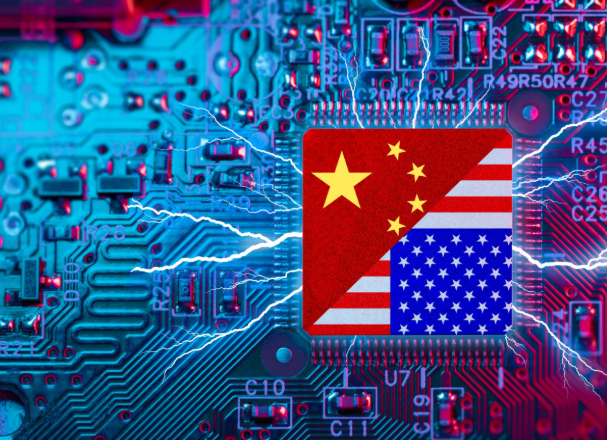
BEIJING, Nov 27: China’s efforts to strengthen its artificial intelligence capabilities are facing fresh challenges as tighter US restrictions on advanced semiconductor technology threaten to disrupt the development schedules of some of the country’s leading AI companies.
Two prominent Chinese artificial intelligence developers, Z.AI and Moonshot AI, are reportedly experiencing difficulties in maintaining their planned timelines for launching next-generation AI models, according to people familiar with the matter.
Z.AI, formerly known as Zhipu AI, has fallen behind schedule on its next flagship artificial intelligence model, while rival Moonshot AI Technology expects the gap between major model releases could double from approximately six months to a year or longer if access to overseas computing resources becomes more restricted.
The developments highlight the growing influence of semiconductor supply chains on the global AI industry, where access to advanced processors and high-performance computing infrastructure has become essential for training increasingly sophisticated models.
The situation also underscores the technological competition between Washington and Beijing, with restrictions on advanced chips emerging as a major obstacle for Chinese companies seeking to compete with leading American AI developers.
The United States has introduced multiple measures aimed at limiting China’s access to advanced semiconductor technology, particularly processors capable of supporting high-performance computing and sophisticated artificial intelligence applications.
These restrictions have increased pressure on Chinese technology companies, which must find alternative sources of computing power while attempting to maintain their research and development programmes.
Advanced chips remain critical to AI development
Training modern artificial intelligence models requires enormous computing resources. Developers use specialised semiconductor processors to analyse large datasets, adjust model parameters and improve the ability of systems to understand and generate information.
Advanced graphics processing units (GPUs) are particularly important because they can perform numerous mathematical operations simultaneously, making them suitable for the complex calculations involved in AI training.
Leading American technology companies have invested heavily in acquiring such processors and constructing large data centres to support the development of increasingly capable AI systems.
Chinese developers, meanwhile, have been working to build competitive models despite restrictions on access to some of the most advanced chips available internationally.
The latest difficulties facing Z.AI and Moonshot AI demonstrate how semiconductor availability can influence the pace of innovation.
When companies cannot obtain sufficient computing capacity, they may need to extend training schedules, reduce the scale of experiments or allocate resources more selectively between research projects.
This can affect not only the launch dates of new products but also the ability of developers to compete with international rivals introducing upgraded models at increasingly short intervals.
The challenge is particularly significant for companies seeking to develop large-scale foundation models, which require substantial computing infrastructure during the training process.
Model distillation faces additional scrutiny
Apart from restrictions on semiconductor exports, Chinese AI developers are facing growing scrutiny over model distillation.
Distillation is a technique through which a smaller AI model learns from the outputs of a larger, more capable model. Developers can use the approach to create systems that require fewer computing resources while retaining some of the capabilities of their larger counterparts.
The technique has become increasingly relevant across the AI industry because it can reduce the cost of developing and operating advanced models.
A smaller model trained through distillation may be easier to deploy on limited computing infrastructure, making it attractive for startups and companies seeking to provide AI services at lower costs.
However, the practice has also raised concerns among major AI developers about the unauthorised use of their systems to generate training data for competing models.
Leading American AI companies have increasingly focused on preventing their models from being used in ways that could allow competitors to reproduce their capabilities through large-scale automated queries.
Such concerns have placed model distillation at the centre of a wider debate over intellectual property, access to AI services and competition in the global technology industry.
For Chinese developers, tighter controls on access to overseas computing resources combined with restrictions on model distillation could make it more difficult to maintain the development pace achieved in recent years.
The impact could be especially significant for companies that rely on a combination of imported computing resources and externally available AI systems to support their research.
Chinese AI companies seek alternative computing solutions
China has been attempting to reduce its dependence on foreign semiconductor technology by expanding domestic chip production and encouraging the development of locally manufactured AI processors.
The country’s semiconductor industry has made progress in developing alternative hardware, while technology companies are exploring ways to improve computing efficiency through software optimisation and specialised chip architectures.
Domestic processors could help Chinese AI developers maintain their research programmes despite restrictions on overseas suppliers.
However, replacing advanced imported processors is not simply a matter of manufacturing alternative chips. AI training infrastructure also depends on software compatibility, memory capacity, networking technology and the ability to connect thousands of processors into large computing clusters.
Developers must ensure that different hardware components work together efficiently to support demanding training operations.
The availability of suitable software tools and technical support is equally important because AI researchers depend on specialised programming frameworks to develop, test and optimise their models.
Consequently, building a competitive domestic AI ecosystem requires investment across the entire semiconductor and computing supply chain.
Chinese companies are also exploring methods to make AI training more efficient by reducing unnecessary calculations and improving the utilisation of available hardware.
Such techniques could help offset some of the disadvantages created by restricted access to advanced processors, although their effectiveness will depend on the scale and complexity of individual projects.
Global AI competition enters a new phase
The developments involving Z.AI and Moonshot AI come at a time when the global artificial intelligence industry is experiencing intense competition.
American companies have invested billions of dollars in advanced chips, data centres and research programmes, while Chinese developers have been working to improve the performance and affordability of their AI systems.
The competition is no longer limited to the development of sophisticated language models. It also involves access to computing infrastructure, semiconductor manufacturing, research talent, energy supplies and international markets.
Companies that can secure reliable access to advanced processors and operate large-scale computing facilities are likely to have an advantage in training more complex models.
At the same time, the industry is increasingly recognising that model efficiency can be as important as raw computing capacity.
Developers are experimenting with smaller models, specialised architectures and techniques that allow AI systems to perform specific tasks without requiring the resources associated with the largest models.
For Chinese companies, these approaches could provide opportunities to remain competitive even as access to some international technology becomes more difficult.
However, delays in releasing flagship models could affect their ability to attract customers, secure commercial partnerships and maintain momentum in a rapidly changing market.
Implications for businesses and AI users
The restrictions could also have wider consequences for businesses that depend on Chinese AI platforms.
Companies developing applications around large language models generally require predictable access to updated systems, stable performance and long-term technical support.
If major model releases are delayed, businesses may need to reconsider their technology plans or continue using existing versions for longer periods.
Startups could face additional uncertainty when selecting AI providers, particularly if they require advanced capabilities that are not available through older models.
The situation may also influence the cost of AI services.
Limited access to computing resources can increase operating expenses, potentially affecting the pricing of services offered to businesses and individual users.
However, the actual impact will depend on how companies manage their computing capacity and whether domestic semiconductor alternatives become more widely available.
For developers, the immediate priority will be to maintain product development while improving the efficiency of existing infrastructure.
Semiconductor controls reshape technology supply chains
The growing restrictions on advanced chips have also encouraged technology companies to reassess their supply-chain strategies.
Semiconductors used in AI systems are manufactured through complex international networks involving chip designers, fabrication facilities, equipment manufacturers and specialised suppliers.
Restrictions affecting one part of this network can have consequences for companies operating in other countries.
The United States remains a major player in advanced chip design and semiconductor equipment, while manufacturing capabilities are distributed across several economies, including Taiwan, South Korea and Japan.
China’s efforts to strengthen domestic production are therefore taking place within a highly interconnected global industry.
The latest developments suggest that access to advanced computing technology will remain a central issue in the US-China technology relationship.
For Chinese AI developers, the challenge will be to maintain research momentum while adapting to a more restrictive international environment.
For American technology companies, limiting access to advanced processors and protecting proprietary AI systems remain important elements of their competitive strategy.
The longer-term outcome will depend on the ability of Chinese companies to develop alternative computing infrastructure, improve training efficiency and maintain access to the technical resources required for advanced AI research.
The reported delays at Z.AI and Moonshot AI demonstrate that the global AI race is increasingly shaped not only by algorithms and research breakthroughs but also by the availability of the hardware and infrastructure needed to turn those innovations into commercial products.

