


AI Boom Diverts Semiconductor Supply to Data Centres, Putting Smartphone and PC Markets Under Pressure
Strong demand from AI data centres is redirecting semiconductor manufacturing capacity towards high value customers, creating potential supply constraints for smartphone and computer makers, according to Siltronic's chief executive.
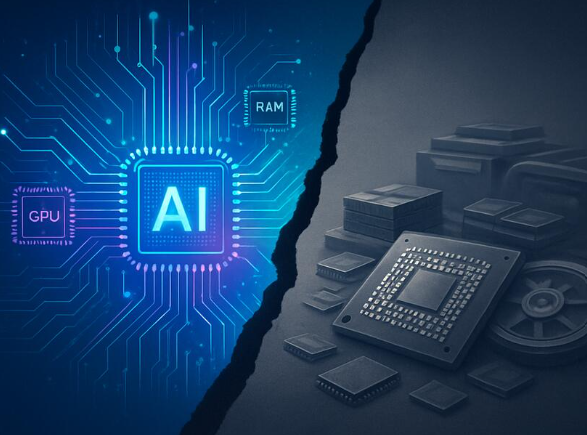
India, Nov 05 : The rapid expansion of artificial intelligence infrastructure is reshaping the global semiconductor industry, with growing demand for AI chips diverting manufacturing capacity away from traditional markets such as smartphones and personal computers.
The development has raised concerns among electronics manufacturers as semiconductor suppliers increasingly prioritise customers building large-scale artificial intelligence data centres. These customers, particularly major cloud computing companies, have greater financial resources and are placing substantial orders for advanced computing components.
Michael Heckmeier, chief executive of German semiconductor wafer manufacturer Siltronic, highlighted the growing imbalance in the industry on Wednesday, November 4, saying that the AI boom was creating supply constraints for other semiconductor markets.
According to Heckmeier, the issue is not simply that artificial intelligence is compensating for weakness in other technology segments. Instead, the enormous demand generated by AI infrastructure is drawing resources and production capacity away from businesses serving conventional electronics markets.
The comments underline a significant shift in the semiconductor supply chain, where demand from data centres is becoming a major factor influencing manufacturing priorities, component availability and investment decisions.
AI Data Centres Become the Biggest Growth Driver
Artificial intelligence has emerged as one of the strongest sources of demand for semiconductor manufacturers. Technology companies are investing heavily in specialised processors, networking equipment and supporting hardware to develop and operate increasingly sophisticated AI systems.
These systems require powerful computing infrastructure capable of processing enormous volumes of information. As a result, companies operating data centres are purchasing large quantities of semiconductor products to support AI training, cloud services and other computing applications.
Major cloud providers, commonly known as hyperscalers, have become particularly influential customers because of their ability to place large orders and pay premium prices for essential components.
Heckmeier said semiconductor manufacturers naturally direct available production towards customers offering the strongest commercial opportunities.
This has created a situation in which companies manufacturing chips and related components are giving greater attention to AI infrastructure requirements, potentially leaving fewer resources available for conventional electronic devices.
The impact is extending beyond advanced processors. Semiconductor production depends on several interconnected components, including silicon wafers, fabrication capacity and specialised manufacturing equipment. Increased demand at one end of the industry can therefore affect availability across the wider supply chain.
AI Servers Require More Silicon Than Traditional Systems
One important reason behind the growing pressure is the amount of semiconductor material required by artificial intelligence infrastructure.
According to Heckmeier, AI server farms consume approximately three to four times more silicon area than conventional server systems.
The difference reflects the intensive computing requirements of AI applications, which rely on large numbers of processors working together to handle complex calculations.
Traditional servers are generally designed to support activities such as website hosting, business applications, databases and cloud storage. AI infrastructure, however, requires significantly greater computing capacity for training and running advanced models.
As companies expand their AI capabilities, they are installing larger server clusters equipped with specialised chips and supporting components.
This increases demand for silicon wafers, which are essential materials used in semiconductor manufacturing.
The resulting pressure is particularly important for wafer manufacturers because their products form the foundation of chip production. Stronger demand from AI-related customers can influence production planning, sales expectations and the allocation of available manufacturing capacity.
Siltronic Raises Annual Sales Forecast
The growing demand for semiconductor materials has also benefited Siltronic.
The German company raised its annual sales forecast for the second time in 2026, citing stronger demand for its silicon wafers.
The revised outlook reflects the increasing importance of AI-related investment in the semiconductor industry.
Silicon wafers are used by chip manufacturers to produce integrated circuits for a wide range of applications, including artificial intelligence processors, smartphones, computers, automotive electronics and industrial equipment.
Stronger demand from data centre customers has therefore provided additional business opportunities for wafer suppliers.
However, the industry-wide benefits are not evenly distributed. While companies connected to AI infrastructure are experiencing stronger demand, manufacturers serving other segments may face constraints in obtaining sufficient semiconductor supplies.
Siltronic’s outlook illustrates how the AI investment cycle is influencing businesses operating at different stages of the technology supply chain.
Smartphone and PC Manufacturers Face Supply Challenges
Smartphones and personal computers remain important markets for semiconductor companies, but their requirements are increasingly competing with demand from AI infrastructure.
Manufacturers of consumer electronics depend on a steady supply of processors, memory chips and other semiconductor components to maintain production schedules.
When suppliers redirect capacity towards higher-paying AI customers, companies serving the smartphone and PC markets may find it more difficult to secure the components they require.
This could create challenges for electronics manufacturers, particularly those operating with tight production schedules and cost-sensitive business models.
Component availability is also important for product launches. Delays in obtaining essential chips can affect manufacturing timelines, inventory planning and the ability to meet consumer demand.
Although the latest developments do not establish that all smartphone and computer manufacturers are experiencing shortages, they highlight the possibility of supply constraints in selected semiconductor categories.
The situation may become more complicated if AI-related investment continues to expand at its current pace.
No Immediate Slowdown in AI Chip Demand
Despite concerns about the semiconductor supply chain, Heckmeier said Siltronic was not currently seeing signs of a slowdown in demand for AI-related products.
This suggests that manufacturers supplying the AI infrastructure market may continue to experience strong order requirements in the near term.
The expansion of generative AI, cloud computing and advanced data processing has encouraged technology companies to increase spending on computing infrastructure.
However, the longer-term outlook will depend on how quickly demand grows and whether semiconductor manufacturers can expand their production capabilities.
Building additional manufacturing capacity requires substantial investment, specialised equipment and technical expertise. These facilities also take time to develop and bring into commercial operation.
Consequently, supply may not respond immediately to rising demand.
The semiconductor industry will need to balance investment in AI-related production with the requirements of traditional electronics markets.
Could a Moderation in AI Demand Help Other Technology Markets?
Heckmeier indicated that even if AI demand eventually moderates, it would not necessarily damage the overall growth prospects of the semiconductor industry.
In such a situation, manufacturing capacity could gradually become available for smartphones, personal computers and other technology segments.
He suggested that these markets still have underlying demand that could support further industry expansion if sufficient semiconductor supplies become available.
This indicates that the current imbalance may partly reflect the distribution of available production capacity rather than a complete absence of demand for conventional electronics.
A shift in manufacturing priorities could therefore create opportunities for other semiconductor customers if the pace of AI infrastructure investment changes.
However, such a transition would depend on actual market conditions and the ability of manufacturers to redirect production towards different chip categories.
Semiconductor Industry Faces a Changing Business Landscape
The growing influence of artificial intelligence is changing how semiconductor manufacturers evaluate customers, production capacity and future investments.
AI infrastructure companies are becoming major buyers of chips and silicon materials, giving them considerable influence over supply-chain priorities.
For smartphone and PC manufacturers, this creates a need to strengthen procurement strategies, diversify suppliers and manage component requirements more carefully.
For semiconductor companies, the challenge will be to benefit from AI-related growth without creating excessive dependence on a single market segment.
The developments highlighted by Siltronic demonstrate that the AI boom is having consequences beyond the companies directly developing artificial intelligence systems.
As investment in data centres continues, its impact will be felt across the global electronics industry, including the availability of components used in everyday consumer devices.
The coming months will be important in determining whether semiconductor manufacturers can expand capacity sufficiently to meet demand from both AI infrastructure developers and traditional electronics producers.

