


Congress Alleges PM Modi Is Steering Great Nicobar Towards Environmental Disaster
Jairam Ramesh says multiple legal challenges, environmental concerns and alleged violations of forest, coastal and eco-sensitive zone norms have turned the Great Nicobar mega project into a test of India’s environmental conscience.
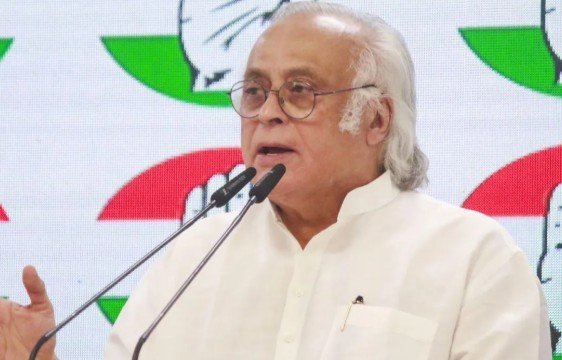
New Delhi, July 2: The Congress on Thursday sharpened its criticism of the Centre’s ambitious Great Nicobar Island development plan, with senior leader Jairam Ramesh accusing Prime Minister Narendra Modi of driving the country towards an “environmental disaster” and warning that the project has become a defining test of India’s commitment to ecological protection. Framing the issue as one that goes far beyond a single infrastructure venture, Ramesh said the nation’s “ecological conscience is on trial” as the government presses ahead with a project that environmentalists, civil society groups and opposition leaders say threatens one of India’s most fragile and biodiverse island ecosystems.
The fresh attack marks the latest escalation in a long-running political and environmental battle over the proposed mega infrastructure project in Great Nicobar, a strategically located island in the Andaman and Nicobar archipelago that is also home to rich forests, coral systems, wildlife habitats and indigenous communities. The project, which includes a transhipment port, airport, township and power infrastructure, has been pitched by the government as a transformative development initiative with strategic, economic and connectivity benefits. But critics argue that the scale and location of the plan pose severe risks to an ecologically sensitive landscape that cannot be easily restored once damaged.
Ramesh, a former environment minister who has consistently raised objections to the project, used social media on Thursday to compile what he described as his extensive public engagement on the issue over the past few years. Sharing an anthology of his interventions, he said the collection included social media posts, parliamentary interventions and correspondence with Union ministers and their responses, all centred on what he called the devastating consequences of the Great Nicobar Island Project for the island’s biodiversity-rich ecosystem.
According to Ramesh, his interventions are unlikely to stop anytime soon. He said there would be “more such public engagements” as the prime minister continued what he described as an onward march toward ecological ruin in Great Nicobar. The Congress leader linked his criticism not only to environmental concerns but also to the legal scrutiny the project is currently facing. He pointed out that five separate petitions filed by concerned citizens and civil society groups are pending before the Calcutta High Court, each challenging different aspects of the project’s approvals and implementation.
These petitions, Ramesh said, collectively underscore the breadth of legal and ecological concerns surrounding the project. Among the grounds cited in the cases are alleged violations of eco-sensitive zone notifications relating to Campbell Bay National Park and Galathea National Park, both of which lie in a highly sensitive ecological region. Other petitions challenge the project on the basis of alleged violations of the Forest Rights Act, 2006 and its associated rules, arguing that statutory safeguards for forest-dwelling and indigenous communities have not been adequately respected.
The legal objections also extend to environmental and coastal regulation. Ramesh referred to challenges based on the Coastal Regulation Zone Notification, 2019 and the Environment (Protection) Act, 1986, suggesting that the project’s clearances and planning process may not have fully complied with the safeguards required for such a large intervention in a coastal and ecologically vulnerable area. He also flagged a separate challenge to an order passed by the National Green Tribunal on February 16, 2026, indicating that the judicial contest over Great Nicobar now spans multiple legal forums and a wide array of environmental and procedural questions.
By invoking this cluster of petitions, Ramesh sought to present the Great Nicobar project not as a routine policy disagreement but as a matter of constitutional, ecological and legal significance. His phrase that “the nation’s ecological conscience is on trial” was intended to elevate the controversy into a broader debate over what kind of development model India is willing to embrace one that prioritises strategic infrastructure and economic ambition, or one that treats biodiversity, indigenous rights and ecological sustainability as non-negotiable public values.
The Congress has, over the past several months, steadily intensified its campaign against the project. Last week, Ramesh wrote to Union Shipping Minister Sarbanand Sonowal seeking clarifications on the proposed transhipment port, a central component of the broader Great Nicobar plan. The letter formed part of a larger pattern of correspondence by the Congress leader with several members of the Union Cabinet, including Environment Minister Bhupender Yadav, Tribal Affairs Minister Jual Oram and Defence Minister Rajnath Singh. In these communications, Ramesh has repeatedly questioned the assumptions, approvals and ecological implications underpinning the project.
His letters to Yadav, in particular, have focused on the environmental impact assessment carried out for the project. Ramesh has argued that the assessment is deeply questionable and has suggested that the environmental appraisal process has failed to grapple honestly with the scale of ecological damage the project could cause. By calling the assessment “dubious” in its overall character, he has sought to challenge not just individual findings but the credibility of the exercise as a whole. This line of criticism is significant because environmental impact assessments are meant to serve as the scientific and regulatory basis for granting clearances to major projects. If the assessment itself is seen as weak, incomplete or biased, the legitimacy of the approval process comes under direct scrutiny.
The Congress has been particularly vocal about the proposed transhipment port in Galathea Bay, which it says could trigger large-scale destruction of coral colonies and irreparably damage marine ecosystems. Critics of the project have argued that the bay and surrounding areas support a delicate ecological balance involving corals, nesting habitats, coastal vegetation and marine biodiversity that would be extremely vulnerable to dredging, construction and increased shipping activity. They contend that once large-scale infrastructure is inserted into such a setting, the resulting disruption is not limited to the project footprint but can spread through coastal and marine systems in ways that are difficult to predict and even harder to reverse.
The issue of defence infrastructure has added another layer to the political debate. The government and its supporters have often justified the Great Nicobar project in part on strategic grounds, pointing to the island’s location near critical sea lanes and its potential role in strengthening India’s maritime presence in the region. But Ramesh has challenged aspects of that argument as well. He has written to Defence Minister Rajnath Singh urging reconsideration of the rejection of the full expansion of the INS Baaz runway, suggesting that the strategic rationale invoked for the larger project does not automatically validate every component of the current development plan.
The Congress appears to be trying to separate legitimate national security needs from what it sees as an oversized commercial and real estate-driven project. This argument has been made even more forcefully by Rahul Gandhi, who has accused the government of using the language of defence and national interest to mask what he claims is a plan designed to benefit a private business interest. Gandhi has alleged that the real objective is not strategic development alone but the creation of hotels, casinos and commercial assets on some of India’s most ecologically irreplaceable land. His remarks have sharpened the political framing of the issue, recasting it from an environmental dispute into a critique of crony capitalism, land use and the state’s development priorities.
Last month, Rahul Gandhi released a video based on his late-April visit to the Andaman and Nicobar Islands, where he argued that the project represents a choice between ecological preservation and profit-driven destruction. In that video, he appealed to the public to sign a petition asking the government to “choose green over greed”, turning the Great Nicobar issue into a public mobilisation campaign rather than simply a parliamentary talking point. By combining site visits, social media outreach, ministerial letters and legal references, the Congress has attempted to build a sustained narrative around the project as one of the most important environmental battles currently underway in India.
The government, however, has consistently maintained that the Great Nicobar project is a strategic and developmental imperative. It sees the island’s location as crucial to India’s maritime and commercial ambitions in the Indo-Pacific, especially at a time when regional competition over ports, shipping routes and logistics infrastructure is intensifying. Supporters of the project argue that the proposed transhipment port could reduce India’s dependence on foreign ports for cargo movement, enhance trade efficiency and strengthen the country’s presence near key international sea routes. They also contend that infrastructure expansion in the islands is necessary for connectivity, security and long-term regional development.
This is precisely what makes the Great Nicobar debate so consequential. It is not a simple contest between development and conservation in the abstract. Rather, it is a clash between competing visions of national interest. One vision emphasises strategic infrastructure, maritime trade, logistics capacity and state-led transformation of a remote island territory. The other insists that ecological fragility, indigenous rights and long-term sustainability cannot be subordinated to economic or geopolitical ambition, especially in an island ecosystem where environmental damage could be permanent.
The legal challenges now pending in the Calcutta High Court could become a major test of how India’s environmental laws, tribal protections and coastal regulations are interpreted in the context of large strategic projects. Courts may eventually be called upon to examine whether due process was followed in granting clearances, whether the rights of local and indigenous communities were adequately protected, whether eco-sensitive zone restrictions were respected, and whether environmental appraisals reflected the full cumulative impact of the project rather than treating its components in isolation. These are not merely technical questions; they go to the heart of how India balances developmental ambition with environmental governance.
The controversy also reflects a broader trend in Indian politics, where ecological questions are increasingly being folded into mainstream opposition campaigns rather than remaining confined to activists and specialist environmental groups. By taking up Great Nicobar so aggressively, the Congress is signalling that environmental protection can be a political issue with national resonance, especially when linked to allegations of weak regulatory scrutiny, corporate favouritism and disregard for local rights. Whether that message gains wider traction remains to be seen, but it has already ensured that the project is being debated in far more public and adversarial terms than many large infrastructure ventures typically are.
For Jairam Ramesh, the issue is also personal and ideological. As a former environment minister, he has often positioned himself as one of the opposition’s most persistent voices on ecological regulation, forest rights and climate-linked policy concerns. His intervention on Great Nicobar fits into that broader profile. But by framing the project as an “environmental disaster” and saying India’s ecological conscience is being tested, he has gone beyond technical critique to make a moral and political argument: that some landscapes are too ecologically precious, too legally protected and too socially vulnerable to be treated as blank canvases for mega development.
As the project advances and court cases proceed, the Great Nicobar dispute is likely to remain a high-profile battleground. It brings together environmental law, strategic policy, indigenous rights, party politics and questions of regulatory credibility in a single, highly visible conflict. The coming months could determine whether the project is modified, slowed, legally constrained or pushed ahead with stronger political backing. Either way, the debate has already exposed the deep fault lines in India’s development model between growth and conservation, state ambition and local ecology, strategic planning and democratic scrutiny.
For now, Congress has made clear that it intends to keep up the pressure. By compiling years of interventions, invoking ongoing litigation and broadening the political charge against the Modi government, it is attempting to ensure that Great Nicobar does not remain a technocratic project buried in clearance documents and bureaucratic files. Instead, it wants the island to become a national symbol of the choices India makes when economic and strategic goals collide with biodiversity, law and environmental ethics. Whether that framing succeeds politically or legally, the battle over Great Nicobar has unmistakably entered a more intense phase.

