


England Crush India in Third T20I to Tighten Grip on Series and Expose Visitors’ Fragility
A dominant all-round performance at Trent Bridge powered England to a crushing win over India in the third T20I, raising serious questions over India’s balance, execution and adaptability in the ongoing white-ball tour.
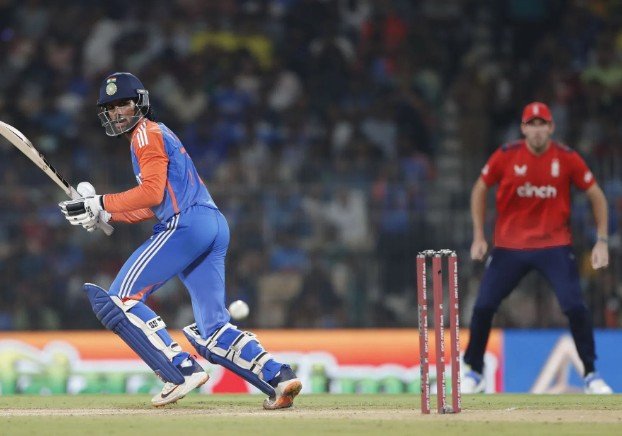
England, July 08 : England delivered a ruthless statement in the third T20I of the series on 7 July, overwhelming India at Trent Bridge with a performance of pace, precision and relentless pressure that not only secured a heavy victory but also underlined the widening gap between the two sides in the contest so far. On a night when England looked sharper in every department, India were exposed with both bat and ball, leaving the visitors to confront difficult questions about team balance, tactical clarity and their ability to respond under sustained pressure in overseas conditions.
The result carried significance beyond the scoreline. This was not merely a defeat for India; it was a match in which they appeared outplayed from the powerplay to the finish. England’s batting was more purposeful, their bowling more disciplined and their fielding markedly cleaner. India, by contrast, looked reactive and unsettled, unable to control the tempo with the ball and then incapable of mounting anything resembling a meaningful chase. In a short-format series where momentum matters enormously, the nature of this defeat may prove as damaging as the result itself.
Trent Bridge has often been a venue that rewards bold batting, quick scoring and fearless intent, and England embraced those conditions far more effectively than India. From the outset, the hosts signalled that they intended to dictate the pace rather than feel their way into the game. Their top order attacked with clarity, targeting loose deliveries and refusing to let India’s bowlers settle into a rhythm. Even when wickets fell, the momentum rarely dipped because the intent remained unchanged. England’s batting innings was not reckless slogging; it was calculated aggression backed by a clear understanding of conditions and match-ups.
India’s bowlers, on the other hand, never seemed to establish control. Lengths were inconsistent, defensive options were either poorly executed or delayed, and there were too few overs in which England were made to feel genuinely constrained. The visitors struggled particularly in the middle overs, a phase where T20 games are often shaped by variation, smart field settings and disciplined pace-off bowling. Instead of squeezing the scoring rate, India allowed England to keep finding boundaries and maintain scoreboard pressure. The cumulative effect was enormous. By the time the death overs arrived, England had both the platform and the freedom to push the total out of India’s reach.
The signs of trouble were visible early. England’s batters picked up India’s pace options quickly and showed little hesitation in taking on anything marginally off line. The powerplay, which should ideally allow a bowling side at least a chance to disrupt momentum through wickets or control, instead tilted heavily in England’s favour. India’s lengths sat up too often, and when they did attempt to go fuller or wider, the execution was inconsistent enough for the batters to adapt. There were moments when India looked caught between plans, neither fully attacking nor effectively containing.
What made England’s innings particularly impressive was its structure. The top order provided impetus, the middle order sustained it and the finishing overs transformed a strong total into a crushing one. There was no visible panic when wickets fell and no slowdown in tempo that might have allowed India to re-enter the contest. That ability to keep the scoring rate elevated through multiple phases is one of the hallmarks of a settled T20 side, and England displayed it with authority. Every Indian error was punished, and every half-opportunity was converted into pressure.
India’s fielding did little to help their cause. At this level, especially in T20 cricket, small moments accumulate rapidly: a misfield that turns a single into a boundary, a dropped chance that gives a batter ten extra balls, a slow return that allows a second run and disrupts the bowler’s next plan. England looked cleaner and more alert in the field than India, and the contrast only deepened the sense that one team was operating with conviction while the other was searching for answers.
Still, even after England had posted a formidable total, India had a route back if they could produce an exceptional batting performance. Modern T20 cricket has repeatedly shown that large chases are possible when teams start aggressively and maintain intent through the middle overs. But what India needed was clarity. What they produced instead was a muddled innings that never truly convinced. The chase was undermined by early setbacks, poor shot selection and an inability to build any sustained partnership capable of unsettling England’s bowlers.
England’s attack deserves major credit for that. They did not simply defend a large score; they hunted with the ball. Their seamers hit harder lengths effectively, changed pace intelligently and made India’s batters work for every scoring opportunity. The field placements reflected confidence, not caution. Rather than retreat into purely defensive patterns, England kept searching for wickets, aware that India’s lineup under pressure could fracture if denied early rhythm. That calculation proved correct.
Once India lost momentum in the powerplay, the chase began to unravel quickly. There were moments when a counterattack seemed possible, but England never allowed it to develop. Every boundary was followed by a tight over, every flicker of resistance by another breakthrough. The required rate climbed, the pressure mounted and India’s batting order appeared to lose faith in any coherent path to the target. The innings became fragmented—part survival, part desperation, but never a serious pursuit of the total.
For India, one of the most worrying elements of the defeat was the absence of a stabilising partnership. In high chases, teams often need one stand that serves as both scoreboard repair and psychological reset. India never found it. Batters came and went without imposing themselves, and too many players looked caught between anchor and aggressor roles. The result was an innings that lacked shape. It neither committed fully to fearless assault nor possessed the composure required for a calculated chase.
This raises a larger question about India’s T20 identity in the post-World Cup phase. Are they trying to remain an explosive, high-tempo side built around depth and flexibility, or are they slipping into a less defined structure where players are uncertain of role and tempo? The answer matters because T20 cricket punishes ambiguity. Successful teams tend to be very clear about who attacks, who bridges phases and who finishes. England looked like a side with those roles understood. India, on this evidence, did not.
Selection and squad management will inevitably come under scrutiny as well. Every defeat of this magnitude prompts debate over combinations, bench options and whether enough specialist skill sets are present in the XI. India’s bowling looked short of control outside brief phases, and the batting order did not appear optimally configured for a chase of this nature. There may be contextual explanations—rotation, experimentation, form cycles—but the scoreboard still reflects a team that was comprehensively second-best.
England, by contrast, will be encouraged not only by the result but by the manner of it. This was a complete T20 performance, one that showcased the modern strengths of their white-ball system: deep batting, versatile seam options and an attacking instinct that does not disappear under pressure. Even more importantly, they looked tactically settled. They read conditions well, adapted quickly and maintained intensity in the field. That combination makes them difficult to stop when they gain early control of a match.
The hosts also benefited from players stepping up in the right moments. While T20s are often reduced to strike rates and boundary counts, the format is still shaped by timing. A 15-ball burst at the right stage, a two-over spell that removes the opposition’s middle order, a run-saving effort in the deep—these moments change games. England stacked too many of them in their favour for India to recover. The margin of victory was the cumulative result of those repeated winning moments across all three disciplines.
For India’s think tank, the immediate challenge is not just technical correction but emotional reset. Heavy defeats can distort decision-making if teams react purely out of frustration. The smarter response is to identify what went wrong structurally. Was it an execution problem on the night, or does it reflect a deeper issue with the balance of the XI? Are the bowlers being given clear plans? Are the batters certain about the tempo expected of them in different phases? Is the team carrying enough adaptability for English conditions? These are the questions that matter more than isolated blame.
The bowling unit, in particular, may require close examination. In T20 cricket, taking pace off, changing angles and defending square boundaries intelligently are essential, especially on batting-friendly surfaces. India’s attack looked too predictable too often. When yorkers were attempted, they missed. When back-of-a-length plans were used, they sometimes sat up invitingly. When England targeted one side of the ground, India were slow to force them elsewhere. None of these are fatal in isolation, but together they create the kind of innings control that England enjoyed.
There is also a broader psychological dimension to India’s defeat. Overseas white-ball tours are as much about adaptability as skill. Teams that win consistently away from home tend to embrace local conditions quickly rather than trying to impose a familiar template regardless of context. England played as though they understood exactly how to use Trent Bridge. India looked like a side still searching for the right operating model in those conditions. That does not mean the talent gap is large; it means the situational execution gap was.
For England, the series now carries the feel of an opportunity not just to win but to make a statement against one of the strongest teams in world cricket. Dominating India in a bilateral T20 series still carries weight, regardless of broader scheduling or experimental line-ups. It sends a message about squad depth, tactical confidence and the ability to perform under scrutiny. If England can maintain the standards they showed in this third T20I, they will believe they can close out the series emphatically.
For India, the remaining matches become about response, pride and evidence of adjustment. Great teams are not defined by avoiding bad nights altogether; they are defined by how quickly they learn from them. India still possess the talent to hit back, but talent alone will not be enough. They need a clearer bowling strategy, sharper fielding and a batting approach that is both more decisive and more situationally aware. The challenge is to find those corrections without overcorrecting and creating fresh instability.
The defeat also offers a reminder of how unforgiving T20 cricket can be when momentum swings heavily one way. Unlike longer formats, there is often no time to repair a poor first half. If a team bowls badly for ten overs and then loses early wickets in the chase, the match can disappear before tactical adjustments take effect. India experienced that reality in full at Trent Bridge. England seized control early and never loosened their grip.
In the wider context of India’s 2026 white-ball season, the result may be treated as either an aberration or a warning sign depending on what follows. If India respond strongly in the next match, tighten their plans and compete at a much higher level, this game will be remembered as a brutal but useful jolt. If the same issues recur uncertain batting roles, lack of bowling control, patchy fielding then this defeat will look more significant, the night when deeper concerns became impossible to ignore.
England will not concern themselves with that narrative just yet. Their focus will be on the quality of a performance that ticked almost every box. They batted with authority, bowled with intelligence and fielded with energy. They controlled the key phases and denied India any route back into the contest. In T20 cricket, comprehensive wins over elite opposition do not come by accident. They come from execution, and England had far more of it.
By the end of the night, the contrast between the two teams was stark. England looked like a side comfortable in its method, willing to attack and disciplined enough to sustain that aggression without losing shape. India looked like a team still searching for answers under pressure. The series is not over, but the third T20I shifted its tone decisively.
For England, it was a night of dominance and momentum. For India, it was a bruising lesson in how quickly modern T20 cricket can punish imprecision. The margin may sting, but the bigger issue for the visitors is what it revealed: a side with undeniable talent, but one that currently lacks the cohesion and clarity needed to withstand a high-quality opponent playing at full tilt.
The next match will show whether India can absorb that lesson quickly enough. What is certain is that Trent Bridge belonged entirely to England a venue, a night and a result that underlined just how dangerous they are when their batting clicks and their plans with the ball hold firm.

