


Experimental Gene Therapy Offers Hope for People With Advanced Retinal Blindness
An early clinical trial found that an optogenetic treatment helped several patients with retinitis pigmentosa detect objects and locate them, although researchers say larger studies are needed to establish its effectiveness.
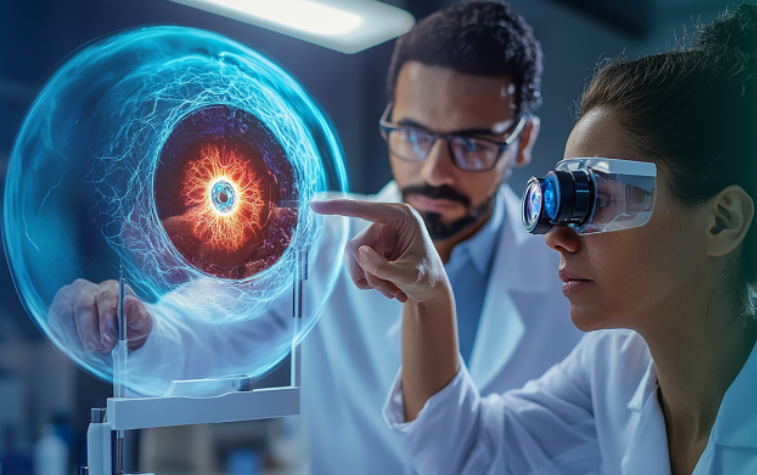
NEW YORK, Oct 9: An experimental treatment based on research recognised by the 2026 Nobel Prize in Physiology or Medicine has shown encouraging early results in people with advanced blindness caused by retinitis pigmentosa, offering a potential new direction for treating certain forms of severe vision loss.
The experimental approach combines gene therapy with specialised goggles to make surviving retinal cells responsive to light. In a small clinical trial involving 10 participants, seven showed increased light sensitivity after treatment, while six achieved clinically meaningful improvements in tasks such as detecting an object, determining its position and reaching towards it accurately.
The findings, reported by Reuters on October 9, highlight the potential of optogenetics, a technique that uses light-sensitive proteins to control the activity of cells. However, researchers have cautioned that the results are preliminary and that larger studies will be necessary to establish the treatment’s benefits, limitations and long-term safety.
The therapy does not restore normal eyesight. Instead, it seeks to recover a degree of visual function by using retinal cells that remain alive even when the cells normally responsible for detecting light have been severely damaged.
Understanding retinitis pigmentosa
Retinitis pigmentosa is a group of inherited eye disorders that progressively damage the retina, the light-sensitive tissue at the back of the eye. The condition can cause difficulty seeing in low light, loss of peripheral vision and, in advanced cases, profound visual impairment.
The retina normally converts incoming light into electrical signals that travel through the optic nerve to the brain, where they are interpreted as visual information. In retinitis pigmentosa, the photoreceptor cells responsible for this process gradually deteriorate.
As the disease progresses, conventional visual function can become severely limited. Treatment options depend on the underlying genetic cause, the stage of the disease and the condition of the remaining retinal tissue.
The experimental therapy explores whether some visual information can still reach the brain by using other cells within the retina, even when the original light-detecting cells have been lost.
How the experimental treatment works
The approach uses optogenetic technology to introduce genetic instructions for a light-sensitive protein called ChrimsonR into surviving retinal ganglion cells.
Researchers administered an injection carrying these instructions into one eye of each of the 10 participants. The treatment was designed to make the modified cells responsive to particular wavelengths of light.
Patients subsequently used specialised goggles that capture visual information from their surroundings. The device converts that information into patterns of light intended to activate the modified retinal cells.
Those cells can then transmit signals through the visual system, allowing the brain to process limited information about the environment.
The method differs from conventional approaches that attempt to preserve or repair the retina’s original photoreceptor cells. Instead, it seeks to bypass some of the damage by enabling surviving cells to take on a new light-detection role.
The goggles are an essential component of the technique because they deliver the light patterns needed to stimulate the genetically modified cells. The resulting visual information remains limited compared with ordinary vision, and patients must learn how to use the system.
Trial participants demonstrate measurable improvements
According to the trial results reported by Reuters, seven of the 10 participants became more sensitive to light following treatment.
Six experienced improvements considered clinically meaningful, including the ability to recognise the presence of an object, establish where it was located and reach towards it with greater accuracy.
These outcomes are important because even basic visual information can help people distinguish objects and navigate certain everyday situations. For someone with profound vision loss, being able to identify the location of an object may represent a meaningful functional improvement.
However, the small number of participants means the findings cannot establish how consistently the treatment will work across a broader population.
The results also do not show that every person with retinitis pigmentosa would benefit. The condition involves different genetic changes and varying degrees of retinal damage, and individual responses to treatment may differ.
Researchers will need to examine whether improvements can be reproduced in larger groups, how long they persist and which patients are most likely to respond.
Safety remains an important consideration
The study also recorded one severe adverse event immediately following the injection, which resolved within minutes, Reuters reported.
Although the reported event was short-lived, a larger body of safety data will be needed before the treatment’s risks can be fully understood. Researchers must assess potential complications associated with the injection, the gene-delivery process and continued use of the specialised visual equipment.
Gene therapies require careful evaluation because their effects may differ according to the target cells, the delivery method and the patient’s underlying condition. Long-term monitoring is therefore important when determining whether an experimental treatment can become a reliable clinical option.
The trial’s early findings should not be interpreted as proof that the treatment is a cure for blindness. Rather, they provide preliminary evidence that surviving retinal cells may be used to recover some visual responses in people whose photoreceptors have been extensively damaged.
Research builds on optogenetics
Optogenetics has become an important research tool because it allows scientists to influence cellular activity using light-sensitive proteins. The approach has been investigated in neuroscience and other fields to better understand how cells communicate and how biological systems respond to stimulation.
The research behind the 2026 Nobel Prize in Physiology or Medicine recognised advances in this area. The blindness treatment illustrates one potential medical application: using genetic instructions to introduce light sensitivity into cells that do not normally perform that function.
The approach is particularly relevant to conditions in which the original cells responsible for a biological process have been damaged, but other parts of the system remain capable of functioning.
In the eye, the central challenge is not simply to detect light but to deliver useful signals to the brain. A treatment must therefore account for the remaining retinal cells, the pathways that transmit information and the brain’s ability to interpret the signals.
The experimental therapy attempts to address these issues by combining genetic modification with a device that translates visual scenes into suitable light patterns.
What the findings mean for patients
For people living with advanced retinal disease, research into alternative ways of restoring visual function is significant because established treatments may not reverse extensive photoreceptor loss.
The new approach suggests that the visual system may retain some capacity to process information even after severe damage to the cells normally responsible for detecting light.
Nevertheless, the practical benefits remain uncertain. Detecting an object under controlled conditions does not necessarily mean that a patient can read, recognise faces, travel independently or perform all the tasks associated with everyday sight.
Further research will need to determine which activities can realistically improve, whether patients can learn to use the system effectively and how the results compare with existing assistive technologies.
The treatment is also specific to the biological mechanism being studied. It should not be assumed to work for every form of blindness, including vision loss caused by optic nerve damage, brain injury or other diseases affecting different parts of the visual system.
Patients should continue to consult qualified eye specialists about their condition and available treatment options rather than viewing an experimental intervention as an established alternative to clinical care.
Larger studies needed before wider use
Researchers have emphasised the need for additional studies to confirm the initial findings. Larger clinical trials can provide more reliable information about treatment effectiveness, safety and differences in patient response.
Future research will also need to evaluate the durability of the improvements and the extent to which the therapy can support practical visual tasks outside controlled testing environments.
The use of specialised goggles raises additional questions about accessibility, training and the ability of patients to incorporate the equipment into daily life. The overall benefit will depend not only on the biological response to gene therapy but also on whether users can obtain meaningful and sustained visual information from the system.
The findings mark a promising step in research into blindness, but the technology remains under investigation. Its eventual role in clinical practice will depend on the results of further testing and regulatory assessment.
For now, the trial provides evidence that optogenetic therapy may help some people with advanced retinitis pigmentosa recover limited visual abilities. It also offers researchers a new avenue for investigating whether damaged sensory systems can regain selected functions by using cells that remain intact.

