


Google Introduces New AI Chips to Challenge Nvidia as Cloud Computing Demand Surges
Alphabet's Google expands its Tensor Processing Unit portfolio with two specialised processors designed for confidential computing and demanding AI applications, strengthening its push to attract enterprise customers and compete in the global artificial intelligence infrastructure market.
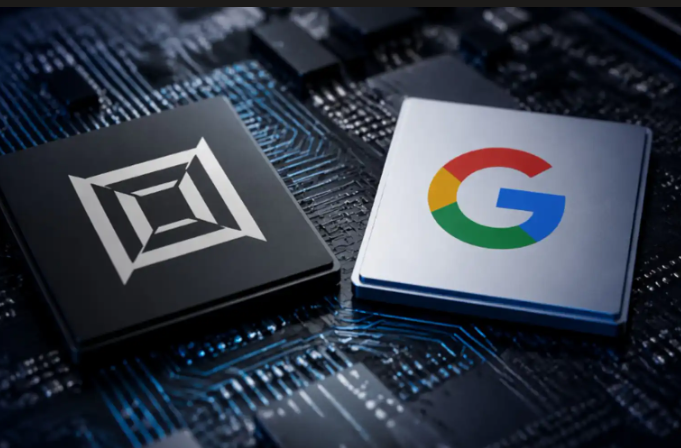
SAN FRANCISCO, Nov 9: Google has unveiled two new versions of its in house artificial intelligence processors, intensifying its efforts to compete with Nvidia in the rapidly expanding global AI chip market as demand for advanced computing infrastructure continues to grow.
The technology company, owned by Alphabet, introduced two specialised Tensor Processing Units (TPUs), named 8tx and 8i Max, on Monday. The new processors have been designed to address different requirements of enterprise customers, including organisations handling sensitive information and businesses developing computationally demanding artificial intelligence applications.
The announcement represents another important step in Google’s strategy to expand the commercial use of its internally developed semiconductor technology. While the company has traditionally relied on its TPUs to power its own services, including Google Search, YouTube and its Gemini artificial intelligence platform, it has increasingly made these processors available through Google Cloud.
The expansion is intended to attract businesses and government organisations looking for alternatives to conventional graphics processing units used in AI development and deployment.
The launch comes at a time when major technology companies are investing heavily in data centres, specialised processors and cloud infrastructure to support increasingly sophisticated AI systems. The growing popularity of generative AI, automated software development tools and advanced research applications has increased the requirement for powerful computing systems capable of handling enormous quantities of information.
Google’s latest processors are designed to address two important aspects of this changing market: protecting confidential information during processing and improving computing capacity for complex workloads.
The TPU 8tx is particularly aimed at government agencies and companies operating in regulated sectors where information security and data protection are essential requirements.
According to Google, the processor combines its proprietary chip technology with processors developed by Advanced Micro Devices (AMD). It also incorporates hardware-level encryption intended to protect sensitive information while it is being processed.
The company said the new configuration could deliver up to twice the speed of its predecessor without a significant compromise in performance.
Confidential computing has become an increasingly important consideration as organisations move sensitive operations and information from traditional internal systems to cloud-based platforms.
Government departments, financial institutions, healthcare organisations and other regulated businesses frequently handle information that must remain protected even while applications are actively using it.
Traditional encryption methods generally protect information when it is stored or transferred between systems. However, additional safeguards are required when data is actively being processed. Hardware-based security mechanisms are designed to address this requirement by creating protected computing environments.
Google’s TPU 8tx is intended to provide customers with additional confidence when deploying AI applications involving sensitive information.
The second processor, the TPU 8i Max, has been developed for artificial intelligence workloads that require substantial computing power and the ability to process large volumes of information simultaneously.
Unlike the 8tx, which emphasises confidential processing, the 8i Max focuses on memory capacity and computational performance.
Google said the new processor combines two chips within a single package, providing additional memory and computing resources. This architecture is intended to support applications that need to work with extensive datasets and complicated calculations.
The company identified coding assistants, mathematical reasoning and drug discovery among the areas where the processor could prove useful.
Advanced AI applications often require systems to retain and analyse large amounts of information while performing multiple computational operations. The availability of additional memory and processing resources can help developers build applications capable of handling more demanding tasks.
For example, AI-powered coding assistants need to examine extensive software projects, understand relationships between different components and generate or modify code based on user instructions.
Similarly, scientific research applications may require sophisticated calculations and the analysis of large datasets. Drug discovery can involve computationally intensive processes in which researchers examine molecular structures and evaluate possible biological interactions.
Google’s latest hardware development reflects the increasing importance of specialised computing infrastructure in supporting these applications.
The company is also seeking to strengthen its position in the cloud computing market, where competition among major technology providers has intensified because of growing demand for AI services.
Google Cloud has become an increasingly important part of Alphabet’s business, supported by companies adopting cloud platforms to operate digital services, store information and develop artificial intelligence applications.
Alphabet reported that Google Cloud revenue more than doubled to $30.71 billion in the September quarter. The company also indicated that sales of its TPUs had made a meaningful contribution to quarterly financial results.
These developments highlight how Google’s internally developed semiconductor technology is becoming an important commercial offering rather than remaining limited to its own digital ecosystem.
The company’s strategy also reflects a broader shift in the semiconductor industry. Technology providers are increasingly designing specialised processors to meet the requirements of particular applications instead of depending entirely on general-purpose computing hardware.
Nvidia continues to hold a prominent position in the AI accelerator market, with its processors widely used by cloud providers, technology companies and research organisations.
However, Google’s investment in custom-designed chips demonstrates that major cloud companies are interested in developing their own hardware platforms to improve control over computing resources and expand their service offerings.
The availability of alternative processors could give enterprise customers more choices when selecting infrastructure for AI development.
Businesses evaluating different computing platforms are increasingly considering factors such as processing speed, memory capacity, security, software compatibility, energy consumption and overall operating costs.
Google’s two new processors address different parts of this demand. The 8tx focuses on protected computing environments, while the 8i Max is intended for applications requiring greater memory and processing capabilities.
Their introduction also comes amid growing concerns about the cost of building and operating large-scale AI infrastructure.
Data centres require substantial investment in processors, networking equipment, cooling systems and electricity. As AI models become more complex, technology companies must find ways to improve computing efficiency while managing the financial and environmental costs associated with expanding infrastructure.
Custom-designed processors can potentially help cloud providers optimise hardware for particular workloads and reduce dependence on external suppliers.
However, their commercial success will depend on factors beyond technical specifications. Customers must also consider the availability of development tools, compatibility with existing applications, reliability and the ease of moving workloads between different computing environments.
For organisations already using Nvidia-based systems, adopting an alternative platform may require adjustments to software development processes and infrastructure management.
Google will therefore need to demonstrate that its processors can provide practical advantages for customers across different industries.
The company’s growing cloud business provides an established distribution channel for bringing its semiconductor products to enterprise users. It also gives customers the opportunity to access computing infrastructure without independently purchasing and maintaining specialised hardware.
The latest announcement further strengthens Google’s efforts to connect its chip development, cloud services and artificial intelligence research into a broader commercial ecosystem.
As competition in the AI industry expands beyond software models to the underlying infrastructure, the ability to provide reliable and specialised computing systems is becoming an increasingly important advantage.
The introduction of the TPU 8tx and 8i Max indicates that Google intends to compete more directly for enterprise AI workloads by offering processors designed around specific business and technical requirements.
Although Nvidia remains a major force in the sector, the expansion of Google’s TPU portfolio adds another dimension to the competition for the hardware powering the next generation of artificial intelligence applications.
The coming months will provide a clearer indication of how quickly businesses adopt the new processors and whether Google’s specialised approach can translate into a larger share of the expanding AI infrastructure market.

