


India Reworks Teesta Strategy Amid Bangladesh-China Proximity, Reaffirms Mutually Agreed Roadmap
New Delhi says its assistance to Bangladesh projects follows a mutually agreed roadmap, while keeping a close watch on Chinese involvement in the Teesta project, Mongla Port plans and other strategic developments in the neighbourhood.
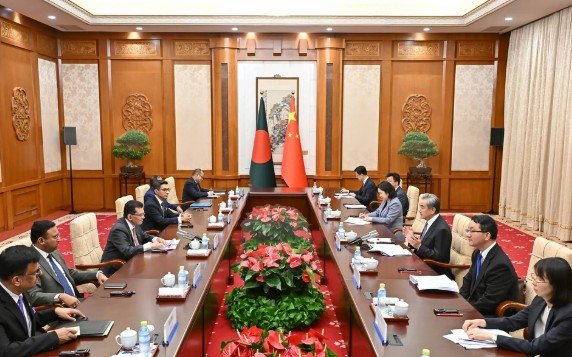
India, July 04 : India on Friday indicated that it is reassessing its broader approach to the Teesta river issue amid Bangladesh’s growing engagement with China, while underlining that New Delhi’s development cooperation with Dhaka remains guided by a “mutually agreed roadmap” reviewed from time to time.
The Ministry of External Affairs (MEA) said India has already conveyed its position on the Teesta river project to Bangladesh and would take into account all recent developments linked to the matter while shaping its future course. The remarks came at a time when Dhaka and Beijing have moved closer on the proposed Teesta River Comprehensive Management and Restoration Project (TRCMRP), a development being watched carefully in New Delhi because of the project’s geographical and strategic implications.
Addressing a media briefing, MEA spokesperson Randhir Jaiswal said India’s development assistance for projects in Bangladesh is based on a mutually agreed framework and remains under regular review. He added that India’s views on the Teesta project had already been shared with the Bangladeshi side and that all related developments would be factored into New Delhi’s overall approach to the issue.
The statement is significant because the Teesta is not merely a river-water matter between India and Bangladesh; it is also tied to regional connectivity, border security, local livelihoods and the evolving strategic balance in South Asia. The Teesta originates in the eastern Himalayas and flows through Sikkim and West Bengal before entering Bangladesh, where it plays a crucial role in irrigation, agriculture and the rural economy. For Bangladesh, better management of the river is directly linked to water access, flood control, farming productivity and livelihood support for millions of people living in its northern districts.
For India, the issue carries additional sensitivity because the Teesta basin lies close to the Siliguri Corridor, often described as the “Chicken’s Neck” — a narrow stretch of land that connects mainland India to the northeastern states. This corridor is one of India’s most strategically important zones, and any major infrastructure or foreign-backed activity in adjoining areas naturally attracts close scrutiny from the Indian security establishment. It is in this context that China’s interest in the Teesta river management project assumes significance.
The immediate trigger for the latest Indian remarks was a question on the Teesta issue following Bangladesh Prime Minister Tarique Rahman’s recent visit to China. During the visit, Dhaka and Beijing reportedly discussed the Teesta River Comprehensive Management and Restoration Project and agreed to move forward on its feasibility study. Bangladeshi officials later suggested that China had reaffirmed support for the project, adding fresh momentum to an initiative that has been under discussion for some time.
The possibility of Chinese participation in a river management and restoration project so close to a strategically sensitive Indian zone has added a geopolitical dimension to what is otherwise also a developmental and ecological matter. Chinese involvement in infrastructure and connectivity projects in South Asia has long been a subject of concern for India, especially when such projects emerge in countries that share land and river boundaries with it. In the Bangladesh context, India has historically viewed its ties with Dhaka through the lens of connectivity, border management, security cooperation, trade and regional stability. Any shift that gives Beijing a larger strategic footprint in Bangladesh’s critical infrastructure landscape is therefore likely to be assessed carefully in New Delhi.
India’s measured formulation on Friday reflected that caution. Rather than directly criticising Bangladesh’s engagement with China, the MEA chose to underline that New Delhi would consider all developments before taking a broader view on the Teesta issue. This language suggests India is seeking to avoid a public confrontation with Dhaka while keeping its diplomatic and strategic options open.
The Teesta dispute itself has a long and complex history. India and Bangladesh have for years discussed a water-sharing arrangement for the river, but a final agreement has remained elusive. The issue has often involved not just bilateral diplomacy between New Delhi and Dhaka but also the concerns of West Bengal, through which the river flows before entering Bangladesh. Water allocation, seasonal shortages, irrigation needs and local political sensitivities have all shaped the pace of progress. As a result, the Teesta has periodically emerged as one of the most delicate subjects in India-Bangladesh relations, even though the two countries have otherwise maintained a broad and cooperative partnership across multiple sectors.
Against that backdrop, the emergence of the Teesta restoration project as a possible area of China-Bangladesh cooperation has sharpened the strategic stakes. While Bangladesh has every reason to seek support for river restoration, embankment protection, flood management and infrastructure creation, India’s concerns are likely to revolve around the nature of the project, the scale of Chinese involvement, the location of proposed works and the long-term strategic implications of foreign presence in a river basin close to the Siliguri Corridor.
The MEA’s comments also came amid wider questions about Bangladesh’s deepening strategic and economic engagement with China. During the same media briefing, Jaiswal was asked about reports related to Bangladesh’s strategically located Mongla Port and plans to procure fighter aircraft from China. Without elaborating in detail, he said India keeps an eye on all such developments and takes whatever steps it deems appropriate.
That brief response was revealing in itself. It signalled that India is not viewing the Teesta matter in isolation, but as part of a broader set of developments involving Bangladesh’s engagement with China in infrastructure, maritime and defence sectors. Mongla Port, located in southwestern Bangladesh, has gained strategic attention because of its proximity to important sea lanes and its relevance to regional trade and logistics. If China becomes deeply involved in the modernisation or expansion of such a port, it could carry implications beyond commerce, particularly in the context of Beijing’s growing maritime footprint in the Indian Ocean region.
Similarly, any move by Bangladesh to buy fighter jets from China would be read in New Delhi not merely as a defence procurement decision, but as another marker of Dhaka’s expanding strategic relationship with Beijing. South Asian governments routinely engage multiple partners for economic and military cooperation, but India remains sensitive to any trend that could alter the regional balance or create long-term security challenges in its immediate neighbourhood.
Bangladesh itself has openly signalled the strengthening of its ties with China. On June 27, Bangladesh Foreign Minister Khalilur Rahman said relations between Dhaka and Beijing had reached their “highest level” after Prime Minister Tarique Rahman’s visit to China. According to him, substantial progress had been made on the Teesta River Comprehensive Management and Restoration Project, with China expressing support and both sides agreeing to speed up the feasibility study.
Bangladesh also said progress was made on two other important projects — the Mongla Port Modernisation and Expansion Project, and the Chinese Economic and Industrial Zone Development Project in Chattogram. Taken together, these initiatives suggest a widening Chinese role in Bangladesh’s infrastructure and economic planning. From Dhaka’s perspective, such partnerships can bring investment, technical expertise and financing for large-scale projects. But from New Delhi’s perspective, the cumulative strategic effect of these projects is likely to be watched with increasing care.
India and Bangladesh share one of the closest and most multifaceted relationships in the region. Over the past decade, ties have expanded significantly in areas such as power trade, connectivity, border infrastructure, security cooperation, transport links and economic engagement. India has supported several development projects in Bangladesh, and both countries have repeatedly underlined the importance of mutual trust and people-centric cooperation. Yet the relationship has also had its areas of friction, and the Teesta remains one of the most politically sensitive among them.
What makes the current moment particularly important is the overlap of three parallel trends: the unresolved Teesta question, Bangladesh’s increasing willingness to work with China on strategic infrastructure, and India’s broader concern over Chinese activity in its neighbourhood. New Delhi appears to be signalling that it is prepared to adjust its own calculations on the Teesta project in light of these changing realities, while still publicly emphasising bilateral dialogue and an agreed framework with Dhaka.
The MEA briefing also touched on a number of other issues, reflecting the wide range of diplomatic matters currently before India. On a query regarding consular services in Australia, Kuwait and the United Arab Emirates, Jaiswal said Indian missions in those countries continue to provide limited consular services. He explained that the operations of outsourcing agencies assisting Indian missions have been put on hold because the matter is currently sub judice. India, he said, is awaiting directions from the relevant high court.
The comment suggests that while basic consular support remains available, some services in these countries may continue to face procedural or logistical constraints until the legal process is resolved. This is a significant issue for Indian expatriates and travellers who rely on outsourced agencies for passport, visa, attestation and related documentation services.
The MEA spokesperson was also asked about reports that UNESCO had asked Pakistan to reverse reconstruction work that allegedly undermined the integrity of parts of Taxila, the ancient World Heritage Site in Punjab province. Responding cautiously, Jaiswal said that cultural heritage, especially sites recognised by UNESCO, does not belong to one person or one country alone but to the entire world, and that it is a shared responsibility to preserve and protect such heritage.
His remarks came amid reports in Pakistani media that UNESCO had warned Pakistan of possible delisting action if the contentious reconstruction measures at Taxila were not reversed. Taxila is one of South Asia’s most important archaeological and civilisational sites, containing remains from multiple historical eras, including ancient settlement zones, Buddhist monastic complexes and later Islamic structures. Any dispute involving the conservation of such a site naturally draws international attention because of its historical value and its place in the shared cultural heritage of the region.
Even so, it was the Teesta-related comments that carried the strongest strategic undertone at the MEA briefing. By saying India would factor “all related developments” into its overall approach, the government signalled that the Teesta project is no longer being viewed only through the prism of bilateral river cooperation. It is increasingly linked to the larger strategic environment around Bangladesh, including Chinese infrastructure participation, port expansion, industrial projects and defence ties.
At the same time, India’s formulation was calibrated. There was no public warning to Bangladesh, no overt criticism of China by name in relation to the Teesta project, and no indication of any immediate policy shift. Instead, New Delhi appeared to be sending a message on multiple levels: to Dhaka, that India remains attentive to changes on the ground; to Beijing, that strategic activity near sensitive zones will not go unnoticed; and to domestic stakeholders, that the government is treating the Teesta issue as part of a wider regional security picture.
For Bangladesh, the challenge will be to balance its development needs, its growing engagement with China, and its important relationship with India. Dhaka has often sought to pursue a multi-vector foreign policy that maximises economic opportunities without becoming trapped in major power rivalries. Whether it can maintain that balance as competition between India and China intensifies in the region remains an open question.
For India, the next steps may involve a mix of diplomacy, project-level engagement and strategic assessment. It may seek more clarity from Bangladesh on the scope of the Teesta restoration plan, the nature of Chinese participation and the implications for local hydrology and infrastructure. It may also weigh whether to revive or recalibrate its own developmental or river-management proposals in a way that addresses Bangladesh’s needs while safeguarding Indian interests.
In the coming months, the Teesta issue could once again become a key test of India-Bangladesh diplomacy. If managed carefully, it may still remain within the framework of bilateral consultation and regional cooperation. But if strategic mistrust deepens around Chinese involvement, the river could turn into a sharper point of friction in an otherwise important partnership.
For now, India’s message is one of watchful recalibration: its roadmap with Bangladesh remains in place, but the regional context around the Teesta is changing, and New Delhi is clearly preparing to respond accordingly.

