


Jamia Forms Panel to Draft Students’ Union Constitution Amid Campus Protests
Five member committee tasked with preparing a draft by December 20 as students continue to demand restoration of an elected representative body.
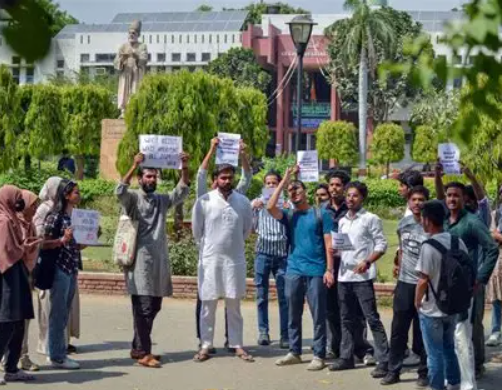
NEW DELHI, Oct 22: Jamia Millia Islamia has constituted a five-member committee to prepare a constitution for its students’ union, marking a significant development amid an ongoing student agitation seeking the restoration of an elected representative body that was dissolved in 2006.
The university administration announced the decision on Wednesday following discussions between officials and protesting students. The move comes after a group of students began a hunger strike and intensified demands for the revival of the Jamia Millia Islamia Students’ Union (JMISU), which has remained inactive for nearly two decades.
The committee has been constituted under the provisions of the Jamia Millia Islamia Act, 1988, and will examine the legal and institutional requirements for drafting a new constitution. According to the university’s notification, the panel will also review the circumstances that led to the dissolution of the union and consider relevant judicial rulings and recommendations concerning student elections.
Professor Zubair Meenai will chair the five-member committee. The other members are professors Luqman Ahmed Khan, Aslam Khan, M Amarjeet Singh and Neelofar Afzal.
The panel has been asked to consult stakeholders, including students, and submit its draft by December 20, 2026. Its mandate includes studying the circumstances surrounding the union’s dissolution and examining the recommendations of the Lyngdoh Committee, which laid down guidelines for student elections in educational institutions.
The university’s decision follows several rounds of discussions between student representatives and a seven-member high-level committee formed on October 18 to consider the protesters’ demands. Vice-Chancellor Professor Mazhar Asif chaired the meeting at which the decision to establish the drafting panel was taken.
However, the announcement has not brought the agitation to an end. Protesters have maintained that the university must announce a clear timeline for holding student union elections rather than limiting its response to the formation of another committee.
Students have also sought the creation of an election commission comprising student representatives, withdrawal of disciplinary action linked to the protests, and assurances concerning the safety and well-being of those participating in the hunger strike.
Their demands additionally include medical monitoring, access to ambulance services and protection against alleged intimidation. The protesters have called for written assurances from the administration before considering the withdrawal of their agitation.
The university has separately announced a review of disciplinary action taken against students involved in protests between October 12 and 21. Three students had been suspended in connection with the agitation, according to reports.
The dispute highlights the wider question of student representation in universities and the mechanisms through which elected bodies can function within established institutional rules.
Student unions generally provide a platform for learners to raise academic and administrative concerns, organise campus activities and participate in discussions affecting university life. They can also serve as a channel for communication between students and administrators.
At the same time, the process of restoring such bodies requires universities to address questions involving election procedures, eligibility, institutional regulations and compliance with applicable legal requirements.
The Lyngdoh Committee recommendations, introduced following a Supreme Court-directed review of student elections, provide a framework covering issues such as election expenditure, candidate eligibility and the conduct of polls. Jamia’s committee is expected to consider these recommendations alongside relevant judicial decisions and the university’s governing legislation.
The immediate challenge for the administration will be to develop a draft that satisfies statutory requirements while addressing concerns raised by students seeking a representative institution.
The deadline of December 20 gives the committee a defined period to complete its work. However, the drafting of a constitution and the subsequent steps required to conduct elections are separate stages. The university’s announcement does not, by itself, establish a date for polling.
The continuing protest indicates that students are seeking a more specific commitment on the restoration process. Their response suggests that the drafting exercise will need to be accompanied by communication about the next steps if the administration hopes to secure an agreement with the protesters.
For the university, the committee’s work provides an opportunity to examine the historical circumstances behind the union’s dissolution and establish a framework for future student representation.
The outcome will depend on the panel’s findings, the applicable legal framework and the decisions taken by the university administration after receiving the draft.
For now, the constitution-drafting exercise represents a formal step towards addressing the long-standing demand, while the question of when students will be able to elect their representatives remains unresolved.

