


J&K Govt Hails Saffron Revival Success, Faces Scrutiny Over Irrigation and Land Encroachments
J&K Saffron Prices Soar to ₹2.2 Lakh/Kg as Govt Pushes Modern Farming Techniques
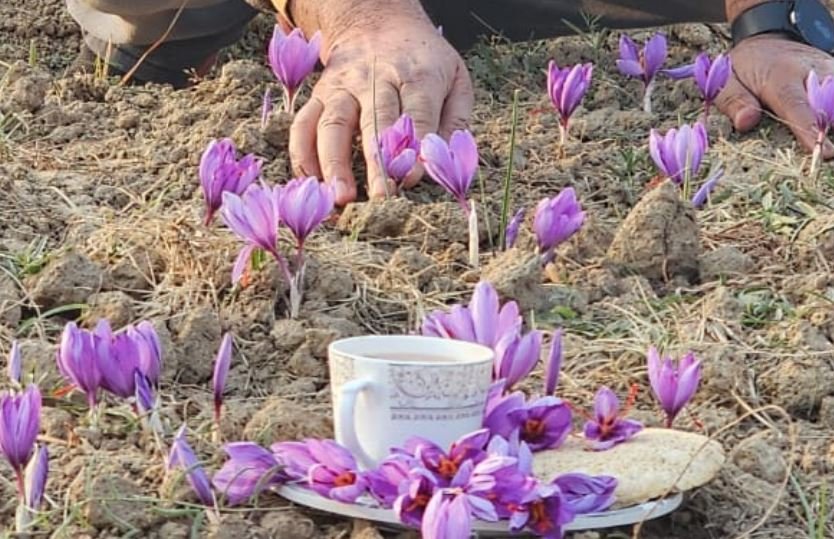
Jammu,04-03-2025: The Jammu and Kashmir government has asserted that it has successfully halted the decline in saffron cultivation and is now focusing on expanding production. During the Question Hour in the J&K Assembly on Monday, Agriculture Minister Javed Ahmed Dar stated that the saffron-growing area in the Union Territory remains stable at 3,715 hectares, with new areas identified for further cultivation.
Minister Dar emphasized that since 2010-11, the saffron cultivation area has remained at 3,665 hectares in the Kashmir division and 50 hectares in Kishtwar. He credited the National Mission on Saffron (NMS) for revitalizing the sector, improving productivity, and boosting farmers’ income.
In response to a question from National Conference member Justice Hasnain Masoodi, Dar detailed the financial and infrastructural support provided under the mission. The initiative, launched in 2010-11 under a flagship scheme devised by SKUAST-K, had a financial outlay of Rs 400.11 crore, of which Rs 315.99 crore was contributed by the Government of India and Rs 84.12 crore by farmers. So far, Rs 269.91 crore has been released, with Rs 259.67 crore spent.
Highlighting the impact of modern techniques, Dar reported that saffron productivity has risen from 2.50 kilograms per hectare in 2009-10 to a peak of 4.42 kilograms per hectare in 2023. The establishment of the Indian Institute of Kashmir Saffron and Technology Centre (IIKSTC) and the adoption of scientific post-harvest methods have significantly enhanced quality and market value.
The minister also pointed out a substantial price increase for Kashmiri saffron. The price per kilogram surged from Rs 80,000 to Rs 2,20,000 in 2021-22, while the saffron stigma recovery rate improved from 22 grams per kilo to 28 grams per kilo.
Providing figures on production and export trends, Dar noted that saffron output increased from 14.87 metric tonnes in 2022 to 14.94 metric tonnes in 2023. The value of production rose from Rs 261.38 crore in 2022 to Rs 291.33 crore in 2023. To eliminate middlemen and ensure fair pricing, the government introduced an e-auction system, making transactions more transparent and securing fair farm-gate prices for saffron growers across India.
Despite these achievements, the minister acknowledged severe challenges, particularly in irrigation infrastructure. Under the National Mission on Saffron, 124 community bore-wells were planned, each meant to serve 30 hectares and provide sprinkler irrigation for 3,665 hectares of saffron fields. However, operational issues persist, with only eight bore-wells functional—four each in Srinagar and Budgam—while 77 remain non-functional.
Another major concern is the high operational cost of bore-wells, which many farmers are reluctant to bear. “Many farmers find maintenance expenses excessive, delaying full irrigation coverage,” Dar admitted.
Encroachments by real estate developers and land grabbers also threaten saffron cultivation. “There have been instances where sprinkler irrigation systems and bore-wells have been damaged. Complaints have been lodged with revenue officials regarding these encroachments,” he added.
During the session, several legislators raised supplementary questions regarding expansion plans and accountability in spending. BJP’s Sunil Sharma alleged discrepancies in the minister’s response and demanded rectification. Some members called for a probe into the expenditure under the saffron mission program, prompting Speaker Abdul Rahim Rather to intervene and address their concerns.
In reply to further queries, Dar assured the House that quality improvements in saffron processing have enhanced the final product. “The colour quality of saffron has improved from 8% (traditional drying) to 16% (scientific drying) due to advanced processing techniques at IIKSTC.”
Minister Dar reaffirmed that despite persistent challenges, the National Mission on Saffron has achieved most of its objectives. He reiterated the government’s commitment to addressing irrigation gaps, preventing land encroachments, and ensuring continued farmer participation in policymaking.
“To ensure greater farmer involvement, the government has formed committees of saffron growers, traders, and civil society members to incorporate their views into future policy decisions,” Dar said. “The success of the saffron mission depends on continued farmer engagement, improved irrigation systems, and protection from land encroachments. The government remains dedicated to overcoming these hurdles and ensuring that saffron cultivation in Jammu and Kashmir reaches its full potential.”
The statement from the government marks a significant milestone in its long-term strategy to make saffron farming more profitable and sustainable, even as concerns remain regarding its implementation and infrastructure support.

