


Kush Maini Breaks Through at Silverstone with First Formula 2 Feature Race Podium of 2026
Indian racer Kush Maini delivered one of the standout performances of his season at Silverstone, converting a strong weekend into a third-place finish and a timely boost in the Formula 2 championship battle.
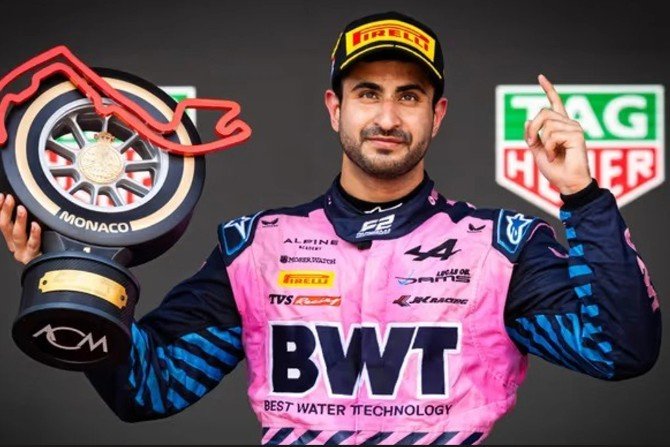
Silverstone/New Delhi, July 6: Indian racing driver Kush Maini produced a breakthrough performance at Silverstone by securing his first Formula 2 feature race podium of the 2026 season, finishing third in a result that could mark a turning point in his campaign and provide a significant lift to India’s growing presence in international motorsport.
The podium finish, achieved at one of the most iconic circuits in the world, was not merely a statistical milestone for Maini. It represented the reward for a weekend in which pace, tyre management, tactical discipline and composure came together at the right moment. For an Indian driver competing in the unforgiving ecosystem of the Formula ladder, every podium matters. At Silverstone, Maini’s result carried added weight because it came in the feature race the longer, strategically more demanding contest that often reveals a driver’s full racecraft rather than just raw speed.
Maini’s third-place finish was his first feature race podium of the current Formula 2 season and one of the most encouraging signs yet that his campaign may be entering a stronger phase after a mixed opening stretch. Formula 2, widely seen as the final proving ground before Formula 1, demands not only speed over a single lap but also the ability to execute race strategy under pressure, manage tyres across changing track conditions, defend against experienced rivals and seize opportunities created by pit cycles and safety car phases. Maini’s run at Silverstone suggested he is steadily assembling those ingredients.
For Indian motorsport followers, the achievement was significant because it added another high-profile international result to a season in which Indian drivers are trying to build credibility and momentum in a sport still dominated by European pathways and budgets. Maini has long been regarded as one of the country’s most promising single-seater talents, but like many drivers outside the traditional motorsport power centres, his progress has had to navigate a difficult mix of financial pressures, team competitiveness, consistency demands and the brutal margins that define feeder-series racing.
Silverstone offered a timely statement. The circuit, rich with Formula 1 history and revered by drivers for its high-speed corners and technical complexity, is not a venue where podiums come cheaply. To finish in the top three there requires confidence through fast sections, precise car placement, and the ability to keep pace without overworking tyres. It also demands mental control, especially when racing against a field packed with drivers who are themselves chasing F1 seats and are willing to fight aggressively for every point.
Maini’s podium therefore resonated on multiple levels. At the most immediate level, it was a points-scoring success and a morale boost. At a broader level, it reaffirmed his standing as one of the few Indian drivers operating consistently in the top tiers of global single-seater racing. And at a symbolic level, it offered another reminder that India’s motorsport story is not confined to occasional appearances on international grids; it is increasingly about drivers trying to compete, adapt and win in elite developmental categories.
The path to such a result is rarely straightforward. Formula 2 weekends compress intense pressure into a short window. Drivers have limited practice time to understand car balance, tyre degradation, braking references and race pace. Qualifying becomes crucial because grid position shapes the strategic options available in both the sprint and feature races. A small error in setup or traffic management can compromise the entire weekend. Against that backdrop, a feature race podium usually reflects more than a good getaway or a lucky safety car. It reflects a weekend in which the driver and team were able to piece together a coherent performance across sessions.
Maini’s result at Silverstone appears to fit that pattern. The podium did not emerge in isolation; it was the culmination of a weekend in which he remained in contention, handled the demands of the circuit, and executed strongly when the decisive phases of the race arrived. That is particularly valuable in Formula 2, where momentum often shifts rapidly and where drivers must learn to capitalise on narrow windows of opportunity.
The significance of the Silverstone finish also lies in timing. Mid-season podiums can alter the narrative of a campaign. A driver who begins the year inconsistently but finds rhythm in the European leg of the season can suddenly move from merely surviving the championship to shaping it. Confidence is a major currency in junior formula racing. Once a driver proves to himself and to his team that a podium is within reach on merit, race weekends can begin to unfold differently. Decision making becomes sharper, overtakes more decisive, and setbacks easier to absorb.
For Maini, the Silverstone podium may do exactly that. It gives him a concrete result around which to build the second half of the season. It also strengthens his case in the broader ecosystem of driver development, where results are not just celebrated but evaluated for what they say about a driver’s readiness for higher responsibilities. Every Formula 2 podium is observed by team managers, academies, sponsors and paddock insiders looking for signs of maturity, consistency and adaptability.
Indian motorsport has long struggled with the absence of a deep structural pipeline capable of routinely producing drivers for Formula 1-adjacent categories. Karting ecosystems remain uneven, sponsorship remains difficult, and the jump from national racing to European competition is financially and logistically daunting. Against that backdrop, drivers like Maini carry a dual burden: they are not only racing for themselves, but also serving as proof of concept for the next generation. When they succeed, the effect travels beyond the points table. It gives younger Indian drivers a reference point and gives sponsors and stakeholders a reason to stay invested.
Maini’s rise has been built over years across junior categories, where the challenge is as much about resilience as it is about outright pace. Young drivers moving through Formula 3 and Formula 2 often face seasons in which they are expected to learn new cars, new tyres, new engineering environments and new circuits almost simultaneously. Results can be heavily influenced by team strength and technical package, making it difficult to assess a driver solely on finishing positions. In such a landscape, podiums at major venues matter because they cut through the noise. They show that, regardless of the variables, the driver was able to put together a race weekend at a genuinely high level.
Silverstone is also a place where the pressure is amplified by atmosphere. The British Grand Prix weekend environment, even in support categories, is intense. Crowds are larger, scrutiny is greater, and the paddock is alive with senior team personnel. To perform under those conditions is a valuable marker. Maini’s podium was therefore not just about points, but about execution on one of the sport’s biggest stages outside Formula 1 itself.
The result may also have practical consequences for his season objectives. A strong finish can influence how teams approach subsequent weekends, how strategy is framed, and how much confidence engineers place in aggressive setups or flexible race plans. When a driver has demonstrated he can convert pace into silverware, the entire operation often becomes more assertive. That can matter enormously in Formula 2, where the difference between fighting for seventh and fighting for third is often the willingness to take the right strategic call at the right moment.
From India’s perspective, the podium is a welcome sporting story at a time when the country is trying to widen its footprint in disciplines beyond its traditional strongholds. Motorsport remains a niche sport in terms of participation and infrastructure, but Indian interest has grown steadily thanks to the visibility of drivers competing abroad and the increasing accessibility of racing coverage. Results like Maini’s help sustain that interest because they provide a tangible narrative of progress rather than abstract potential.
There is also an important cultural dimension to such performances. Indian athletes competing in global systems that are expensive, insular and historically dominated by a few geographies often have to work harder for the same visibility. A podium at Silverstone commands attention precisely because it is impossible to dismiss. It places the driver in the central frame of one of the world’s most competitive feeder series and forces the paddock to take notice.
Of course, one podium does not transform a season on its own. Formula 2 championships are shaped by consistency across multiple rounds, by avoiding damage and penalties, by extracting points even on imperfect weekends, and by converting front running pace into repeated finishes. Maini will know that the real value of Silverstone lies in what follows. If he can use the result as a launchpad for a run of strong weekends, it could significantly change the complexion of his campaign. If not, it will still remain a notable achievement, but one that sits as an isolated high point rather than the start of a sustained climb.
The next few rounds will therefore be critical. They will test whether the balance, confidence and execution seen at Silverstone can be reproduced elsewhere. Different circuits ask different questions of drivers some reward bravery under braking, others reward traction and tyre preservation, still others expose weaknesses in qualifying pace. To emerge as a genuine contender in Formula 2, a driver must show he can adapt across all of them. Maini’s challenge now is to turn a breakthrough weekend into a trend.
Yet even with that caveat, the Silverstone podium deserves to be viewed as more than a passing footnote. It is a reminder that Indian talent in global motorsport continues to push for space in one of the toughest sporting ecosystems in the world. It is also a timely confidence boost for a driver whose journey has included flashes of speed, difficult spells and the constant pressure of proving that he belongs at the front.
By finishing third in the feature race at Silverstone, Kush Maini has delivered one of India’s standout motorsport performances of the season so far. The result gives him points, momentum and renewed belief. It also gives Indian motorsport another moment of visibility on an international stage that rarely offers easy openings.
Whether this podium becomes a springboard to something bigger will be known only over the coming rounds. But for now, Silverstone belongs to Maini as a weekend where preparation met execution, and where an Indian driver announced that his 2026 Formula 2 campaign still has meaningful chapters left to write.

