


NC’s 42 Seats Redefine Political Landscape in J&K, But BJP Stays Strong with 29 in Jammu Region
Victory for National Conference in J&K: 42 Seats Against BJP's 29; A Clear Signal of Public Sentiment
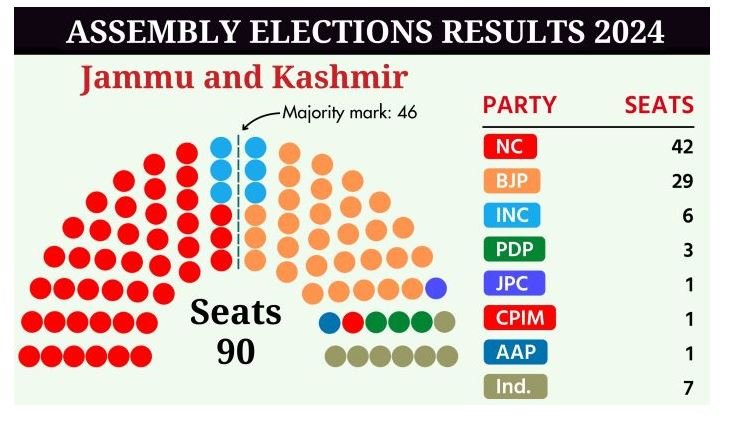
JAMMU, Oct 8: In a significant political development following the Jammu and Kashmir assembly elections, the National Conference (NC) has emerged as the single largest party, winning 42 out of 90 seats in the union territory’s assembly. This victory highlights the party’s robust electoral support amid a politically charged environment. Conversely, the Bharatiya Janata Party (BJP) successfully retained its dominance in the Jammu region, securing 29 seats.
While the NC celebrated its electoral success, its coalition partner, the Congress party, faced a disappointing outcome, managing to win only six seats—five from the Kashmir Valley and a solitary seat from the Jammu province. This underperformance is particularly noteworthy given that Congress had fielded candidates for 32 seats as part of a seat-sharing arrangement with the NC.
Omar Abdullah, vice-president of the National Conference and a prominent figure in the party, interpreted the election results as a decisive mandate from the people of Jammu and Kashmir. He stated, “This mandate is a rejection of the steps taken by the BJP on August 5, 2019, in Jammu and Kashmir, when Article 370 was abrogated. We have performed significantly better than anticipated, while the BJP remains far from achieving the half-mark.” Abdullah secured victories in the twin constituencies of Ganderbal and Budgam, underscoring his political influence and stature in the region.
The results position Omar Abdullah as a strong candidate for the Chief Minister’s role, with party sources indicating that a final decision regarding the leadership will be announced in the coming days after consultations between NC and Congress officials in Srinagar. Farooq Abdullah, the NC president, expressed confidence in his son assuming the Chief Ministership of Jammu and Kashmir, further solidifying the Abdullah family’s legacy in the region’s politics.
This electoral outcome reflects a complex political landscape in Jammu and Kashmir, marked by shifting voter allegiances and the enduring influence of traditional parties like the National Conference. The implications of this election are likely to reverberate throughout the region, influencing both governance and the ongoing dialogue surrounding the contentious issues that have historically defined Jammu and Kashmir’s political narrative.

