


‘Ramayana’ Tops IMDb’s Most-Anticipated Films of 2026, Signalling Bollywood’s High-Stakes Return to Event Cinema
The Ranbir Kapoor led mythological epic has emerged as the most-awaited film of 2026 on IMDb, with Shah Rukh Khan’s King and Alia Bhatt’s Alpha also making the top five amid growing excitement around big-screen franchise and spectacle-driven releases.
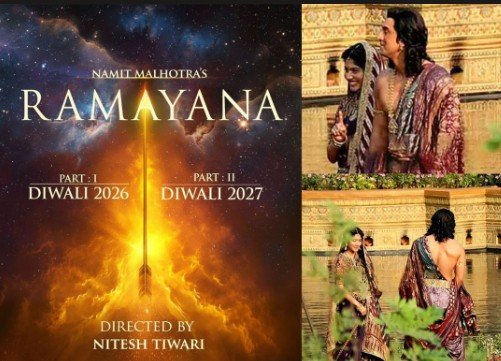
Mumbai, July 1: Bollywood’s upcoming mythological spectacle Ramayana has been named the most-anticipated film of 2026 on IMDb, underlining the enormous expectations surrounding what is already being seen as one of the biggest Hindi film events in recent years. The development has added fresh momentum to the conversation around the future of theatrical entertainment in India, with the list also featuring major titles such as Shah Rukh Khan’s King and Alia Bhatt’s Alpha, signalling that the Hindi film industry is betting heavily on scale, franchises, star power and cinematic universes to draw audiences back to theatres.
At one level, the ranking is a measure of fan curiosity and digital interest. At another, it is a revealing snapshot of where Hindi cinema stands in 2026: at a point where the industry is trying to reclaim the idea of the “event film” through mythological adaptation, action franchises, star-led thrillers and crossover spectacles designed to dominate both box office and online conversation. That Ramayana has claimed the top spot is therefore not merely a popularity marker; it is also a sign of how strongly audiences are responding to films that promise ambition, scale and cultural familiarity wrapped in blockbuster storytelling.
Few films in recent memory have generated the kind of early attention that Ramayana has commanded. Even before its release, the project has become a magnet for discussion because of the source material it draws upon, the cast associated with it and the enormous expectations attached to any modern retelling of one of India’s most enduring epics. Mythology has always occupied a unique place in Indian popular culture, but adapting it for the contemporary big screen carries a different level of scrutiny. Every casting decision, visual reveal, production update and rumour surrounding Ramayana has fed public curiosity, turning the film into a sustained topic of speculation long before audiences have seen a full trailer.
That anticipation also reflects a broader shift in Bollywood’s strategy. In the post-pandemic theatrical landscape, films increasingly need to offer audiences something they cannot replicate at home: spectacle, urgency, scale, conversation value and a sense of occasion. Mid-budget dramas still exist, but the centre of industry ambition has moved decisively toward films that can command nationwide attention across language and platform boundaries. Ramayana fits that model perfectly. It is not being sold simply as a movie, but as an event—something to be awaited, debated, consumed and remembered collectively.
The IMDb list places King and Alpha among the top five most-awaited films of the year, and that in itself says a great deal about the shape of Hindi cinema’s upcoming slate. King, fronted by Shah Rukh Khan, carries the aura of a major star vehicle at a time when Khan remains one of the few actors capable of turning a film into a national event almost by presence alone. Alpha, meanwhile, benefits from Alia Bhatt’s current stature as one of Bollywood’s most bankable and closely watched performers, with audiences increasingly tracking not just her films but the larger creative and commercial universe around them.
Together, these titles represent a strategic pattern. Bollywood is not merely releasing films; it is constructing anticipation ecosystems around them. These ecosystems are fuelled by teaser drops, fan theories, casting announcements, behind-the-scenes images, soundtrack speculation, social media chatter and a constant stream of entertainment journalism that keeps films alive in public imagination months in advance. In that environment, being “most awaited” is not just a vanity metric—it is part of the commercial architecture of contemporary filmmaking.
The success of that architecture depends on emotion as much as marketing. Ramayana benefits from a built-in emotional connection because it draws from a story embedded deeply in India’s cultural memory. For many viewers, the film is not just another release but a test of whether Bollywood can reinterpret sacred and familiar narratives with cinematic grandeur while retaining emotional and moral resonance. This is a difficult balancing act. A project of this nature has to satisfy multiple audiences at once: devotees of mythology, fans of mainstream spectacle, cinephiles curious about scale and craft, and younger viewers encountering the epic through a contemporary visual lens.
That challenge is precisely why the film’s top placement on IMDb matters. It suggests that curiosity about Ramayana cuts across categories. It is not limited to mythology enthusiasts or fans of a particular actor; it has become a cross-demographic cultural event in waiting. The attention surrounding it reveals how Bollywood still relies on stories with civilisational familiarity when trying to mount truly large-scale cinematic experiences. Mythological and historical subjects offer an immediate recognisability that can be translated into visual grandeur, and Ramayana appears poised to exploit that possibility fully.
But the story here is not just about one film. The IMDb ranking offers a useful lens into how Bollywood is rebuilding momentum in 2026 after a period of volatility, experimentation and uneven box office performance. Over the past few years, Hindi cinema has oscillated between theatrical triumphs, streaming-first experiments, franchise fatigue, surprise sleeper hits and a constant anxiety about whether audiences have permanently changed their viewing habits. In that uncertain environment, anticipation has become one of the industry’s most valuable currencies. A film that can generate months of genuine excitement enters the market with a clear advantage.
That is where King and Alpha also become significant. Their presence alongside Ramayana in the top tier of anticipated films suggests that audiences are still willing to invest emotionally in big-banner Hindi cinema—provided it offers either scale, novelty or a compelling star proposition. Shah Rukh Khan’s projects continue to command attention because of his unmatched fan base and the event-like aura surrounding his releases. Alia Bhatt, on the other hand, represents a different kind of star power: one rooted not just in celebrity, but in the perception that her projects are carefully curated and creatively ambitious.
The renewed emphasis on anticipation is also changing how films are discussed before release. Instead of waiting for trailers or first-day collections, audiences now begin forming relationships with films at the announcement stage. Fan communities dissect casting, track release calendars, compare first-look posters and debate whether a project can “deliver” on the promise of its scale. Entertainment journalism and social media accelerate this cycle, creating a climate in which films are constantly judged against the weight of their own hype. The IMDb ranking is a product of that climate, but it also reinforces it, giving films like Ramayana another headline to build upon in the long march toward release.
For Bollywood, this is both opportunity and risk. High anticipation can translate into extraordinary opening numbers and broad cultural impact, but it can also produce impossible expectations. A film like Ramayana will not be judged simply on whether it is entertaining; it will be judged on visual ambition, fidelity to source material, emotional force, performances, scale, music and ideological tone. The margin for disappointment narrows as the hype grows. In that sense, being the most awaited film of 2026 is as much a burden as it is an honour.
Yet the industry would rather have that burden than irrelevance. In recent years, one of Bollywood’s biggest struggles has been fragmentation of attention. Viewers have more entertainment options than ever, from global streaming shows and regional cinema to short-form video and gaming. To command national focus in that environment, a film needs to become bigger than its runtime. It must become a conversation, a spectacle and a cultural marker. The films dominating anticipation lists are precisely those trying to do that.
Another striking element of the current moment is how event films are increasingly expected to travel beyond language and geography. A major Hindi film is no longer imagined solely as a Bollywood release for the Hindi-speaking belt. It is packaged as a pan-Indian and often global entertainment product, with dubbed versions, multilingual campaigns, international distribution strategies and fandoms that stretch across digital borders. A title like Ramayana is especially suited to this approach because its source material already has resonance across regions and generations.
The prominence of Alpha and King on the same list further suggests that Bollywood’s 2026 slate is trying to cover multiple modes of excitement at once: mythology, espionage, action, star-led thrillers and cinematic universes. This diversification matters because the industry can no longer depend on one dominant formula. Audiences are fragmented, and their expectations are shaped by exposure to everything from Korean dramas and Hollywood tentpoles to Telugu mass entertainers and prestige streaming series. To compete in that landscape, Hindi cinema must offer different kinds of scale and emotional hooks.
Still, Ramayana occupies a special place because it carries symbolic weight beyond box office arithmetic. If successful, it could reinforce the viability of mythological mega-productions in a new cinematic language. If it falters, it may trigger a more cautious approach to large-scale adaptations of culturally loaded material. That is one reason every update related to the film has attracted such close scrutiny. It is being watched not just as a movie but as an indicator of what Bollywood believes audiences want from its grandest productions.
The IMDb ranking arrives at a time when the Hindi film industry is also trying to restore confidence in theatrical viewing as a premium experience. Big-ticket films are central to that effort because they can create the sense of urgency that streaming often cannot. Viewers may postpone watching a smaller drama, but a high-profile release with spectacle, stars and social buzz becomes harder to ignore. In this ecosystem, anticipation is almost as important as the film itself. A project that wins the attention battle early can shape release calendars, media cycles and audience mood months in advance.
For fans, of course, the list is simpler: it is a scoreboard of excitement. For the industry, it is a barometer of where attention is accumulating. And right now, attention is flowing strongly toward Ramayana. Whether that anticipation ultimately converts into critical acclaim and commercial success will only become clear once the film arrives. But the fact that it has already overtaken the field in terms of pre-release curiosity tells its own story about the hunger for scale, mythology and cinematic spectacle in 2026.
In many ways, the ranking captures a Bollywood at a crossroads yet still deeply ambitious. It is an industry trying to balance commerce and mythology, celebrity and storytelling, streaming-era habits and big-screen aspiration. The names on the list suggest that Hindi cinema’s answer to uncertainty is not retreat but escalation: bigger worlds, bigger stars, bigger visual ambition and bigger claims on audience imagination.
That is why the rise of Ramayana to the top of IMDb’s most-anticipated films list matters beyond fan chatter. It confirms that even in an age of fragmented viewing, the promise of a grand cinematic retelling can still command attention on a national scale. It also suggests that Bollywood’s biggest battle in 2026 may not be against a rival industry or platform, but against indifference. And if anticipation is any indication, Ramayana has already won the first round.

