


Venezuela Quake Fallout Sparks Political Storm as Maria Corina Machado Demands Return
With the death toll climbing after the twin earthquakes, acting President Delcy Rodriguez faces mounting criticism over relief delays while opposition leader Maria Corina Machado seeks to re-enter Venezuela, turning a humanitarian emergency into a fresh political confrontation.
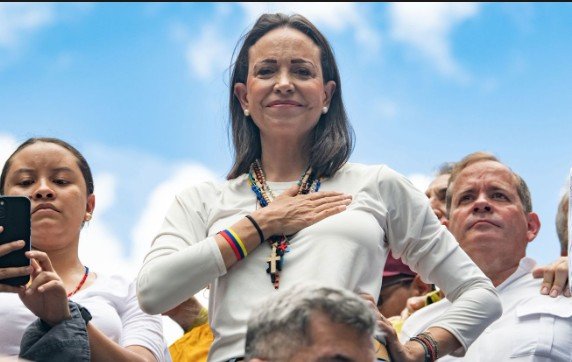
Venezula, July 04 : The devastating twin earthquakes that struck Venezuela on June 24 have triggered not only a humanitarian catastrophe but also a volatile political confrontation, as the disaster’s fallout places acting President Delcy Rodriguez under intense pressure and opens a new chapter in the country’s prolonged power struggle.
With thousands dead, tens of thousands injured and rescue operations still underway, the political stakes rose sharply on Friday after opposition leader Maria Corina Machado called for her return to Venezuela, arguing that the government’s handling of the tragedy had exposed the collapse of state capacity and the urgent need for a broader political transition.
The call has thrust Venezuela’s post-earthquake recovery into the center of a political battle, with Rodriguez trying to preserve authority as her 180-day interim mandate expires and Machado positioning herself as a credible alternative at a moment of national trauma.
Quake tragedy turns into leadership test
The earthquakes have left a trail of destruction across parts of Venezuela, flattening homes, damaging public infrastructure and overwhelming local hospitals and emergency services. According to official figures released Friday, at least 2,645 people have died and more than 12,500 have been injured in one of the deadliest disasters in the country’s recent history.
As rescue workers continue to search through collapsed buildings, thousands of families remain displaced and many others are still waiting for news of missing relatives. Opposition volunteers have created an online registry to help trace the missing, with the database listing around 36,000 people as of Friday. The effort has quickly become a parallel relief mechanism, highlighting the scale of public desperation and the lack of confidence in official channels.
The unfolding disaster has become the most serious test yet for Rodriguez, who has served as interim president since the dramatic removal of Nicolas Maduro earlier this year. What began as an emergency response challenge has now become a defining moment for her fragile administration, with critics accusing the government of reacting too slowly in the critical first hours after the quakes.
Residents in several affected areas have complained that state rescue teams and heavy equipment failed to arrive quickly enough, forcing ordinary people to dig through rubble with their bare hands in search of trapped survivors. Those accusations have fueled public anger and given the opposition a powerful argument that the government is unable to manage a crisis of this scale.
Machado uses crisis to press for comeback
Maria Corina Machado, the exiled opposition figure and Nobel Peace Prize laureate, used the moment to sharpen her criticism of the government and renew her demand to return to Venezuela.
Speaking from Panama on Friday, Machado said the government’s earthquake response had revealed deep institutional weakness and the “total absence of the state” at a time when Venezuelans needed leadership they could trust. She argued that her return would help stabilize the country and support what she described as a necessary transition process in the aftermath of the tragedy.
Machado’s comments marked a dramatic escalation in Venezuela’s political tensions. Since leaving the country in December after receiving the Nobel Peace Prize in Norway, she has remained a central figure in opposition politics from abroad. Her return, if it happens, would likely transform the political atmosphere in Caracas and beyond, especially given the fragile condition of the interim administration.
The opposition leader has long argued that Venezuela needs democratic renewal after years of political repression, disputed elections and economic collapse. Her latest intervention suggests she sees the earthquake crisis as a moment when public frustration with the government could translate into wider calls for political change.
Machado remains a deeply influential figure among anti-government voters despite being barred from running in the 2024 presidential election. That contest ended in controversy after Nicolas Maduro claimed victory, even as opposition-released vote tallies from electronic machines indicated that Edmundo Gonzalez, the candidate backed by Machado, had defeated Maduro by a margin of more than two to one.
For Machado and her allies, the earthquake response has become further evidence that Venezuela’s political system remains broken and unable to protect its citizens in moments of extreme need.
Rodriguez defends relief operations amid rising criticism
Facing mounting anger over the government’s response, Rodriguez used a rare news conference on Thursday to forcefully defend the administration’s relief efforts and reject allegations of delay and disorganization.
She insisted that rescue teams were activated immediately after the earthquakes and that authorities did not wait days to intervene, as critics have alleged. Rodriguez accused her opponents of spreading false narratives for political gain and described the criticism as part of a propaganda campaign aimed at undermining the state during a national emergency.
According to Rodriguez, thousands of civilian and military rescue workers were dispatched to affected areas and 11 international field hospitals were set up to assist the injured. She also announced the creation of a reconstruction fund to receive donations for rebuilding devastated communities.
But her assurances have done little to calm public concern. Survivors in several disaster-hit zones have continued to report shortages of equipment, delayed evacuations and limited medical support. Aid workers have also warned that the damage to roads, communications networks and water systems has complicated efforts to deliver food, medicine and emergency shelter.
The Rodriguez administration is now trying to contain both the humanitarian emergency and the political backlash. Every new image of families waiting for help, every report of missing persons and every story of delayed rescue operations risks deepening the perception that the government is not in control.
U.S. support for Rodriguez complicates opposition strategy
Machado’s effort to return to Venezuela has also exposed growing tension between the opposition leader and the United States, which had once been one of the most vocal international backers of democratic change in Venezuela.
Since Maduro’s ouster in January, the Trump administration has backed Rodriguez as the country’s acting leader and has praised her efforts to introduce market-oriented reforms, particularly in the oil sector. That support has given Rodriguez a measure of international legitimacy at a time when Venezuela is still struggling to rebuild institutions and restore economic confidence.
But according to U.S. officials cited by international media, Washington has become increasingly frustrated with Machado and has discouraged her from returning to Venezuela in the immediate aftermath of the earthquakes. The concern, according to those officials, is that Machado’s return could trigger mass protests and intensify political instability just as the country should be focused on relief and reconstruction.
One official reportedly said Machado had sought assistance from the United States to facilitate travel to Venezuela from Curacao and Panama. Another suggested that Washington suspected she wanted to use the crisis to challenge Rodriguez’s authority and reignite a broader political push for change.
The U.S. position reflects a difficult balancing act. On one hand, Washington has long criticized authoritarian rule in Venezuela and supported opposition movements. On the other, it now appears to view Rodriguez as a necessary transitional figure whose government must be stabilized to avoid a total collapse in the aftermath of the earthquakes.
That calculation has created an unusual split between the opposition’s most prominent leader and an international ally that once strongly championed her cause.
Flights halted as tensions rise over possible return
The political drama intensified further with reports that Venezuelan authorities shut down commercial air traffic into Caracas after learning of Machado’s plans to return. According to one U.S. official, the canceled flights were expected to carry hundreds of relief personnel who were due to assist in earthquake recovery operations.
If confirmed, the move would show how deeply political considerations are shaping state decisions even during a national emergency. It would also reinforce opposition accusations that the government is more concerned about protecting its political position than accelerating humanitarian relief.
The episode has become symbolic of the broader crisis engulfing Venezuela: a country struggling to recover from one of the worst natural disasters in its history while simultaneously battling mistrust, institutional weakness and a leadership vacuum.
Machado’s supporters argue that preventing her return only proves the government fears public scrutiny and popular mobilization. Rodriguez’s allies, however, are likely to frame any attempt by Machado to re-enter the country at such a sensitive moment as reckless and destabilizing.
Mandate expiry adds to uncertainty
Friday also marked another critical political deadline: the expiration of Rodriguez’s 180-day interim mandate under Venezuela’s constitutional framework for temporary presidential absence.
Rodriguez initially stepped into the acting presidency following Maduro’s removal, and the constitution allows the vice president to fill such a vacancy for up to 90 days, extendable by another 90 days with approval from the National Assembly. That period has now ended, raising urgent questions about the legal and political future of the presidency.
As of Friday, authorities had not clearly indicated how they planned to respond to the expiration of Rodriguez’s mandate. The uncertainty has fueled speculation over whether the National Assembly, which is controlled by Rodriguez’s political camp, will seek to extend her authority through other mechanisms or move toward a snap presidential election.
Under the constitution, lawmakers can declare the office permanently vacant and trigger a new vote. But in the current climate — with the country reeling from disaster, large sections of infrastructure damaged and millions focused on survival rather than politics — organizing an election would be extraordinarily difficult.
Still, the expiry of Rodriguez’s mandate weakens her standing at a moment when she can least afford instability. Her critics are likely to argue that the end of the constitutional window leaves her authority in question just as Venezuela needs a government capable of commanding national confidence.
Humanitarian emergency grows more severe
While political tensions dominate headlines, the humanitarian dimensions of the crisis continue to worsen. Aid organizations warn that Venezuela is still in the early stages of understanding the full scale of destruction.
Entire neighborhoods remain in ruins, and in many areas rescue teams are still searching for bodies under collapsed buildings. Damaged sewer networks, disrupted clean water supplies and overcrowded shelters are increasing fears of disease outbreaks in the days ahead. Medical services in affected regions are stretched thin, and access to fuel, food and basic medicines remains inconsistent.
International governments and relief agencies have pledged hundreds of millions of dollars in emergency assistance, hoping to prevent the earthquake disaster from spiraling into a much wider public health and displacement crisis. But aid workers say that the challenge is immense and that recovery will require not just money, but also functioning logistics, political coordination and public trust.
Andreas Spaett, the Venezuela country coordinator for Doctors Without Borders, warned that the suffering on the ground remains difficult to fully measure and that many victims are still buried beneath the debris. His remarks underscored the fear that the official death toll may continue to rise significantly in the days ahead.
For ordinary Venezuelans, the disaster has laid bare years of institutional erosion. Even before the earthquakes, the country had struggled with political conflict, weakened public services, economic instability and mass migration. The quakes have now pushed those vulnerabilities into a full-blown emergency.
A defining moment for Venezuela’s transition
The twin earthquakes may ultimately be remembered not only for their human cost but also for the way they reshaped Venezuela’s political trajectory.
For Rodriguez, the disaster is a brutal test of whether her interim government can demonstrate competence, maintain order and retain international backing long enough to steer the country through an extraordinarily dangerous moment. Her success or failure in the coming days could determine whether she remains at the center of Venezuela’s post-Maduro transition or becomes another casualty of the country’s unstable politics.
For Machado, the crisis presents both an opportunity and a risk. It gives her a powerful platform to argue that Venezuela needs trusted leadership and democratic renewal, but it also places her in tension with international actors who fear renewed confrontation could derail relief efforts. Whether she returns soon or continues to press her case from abroad, her intervention has ensured that she remains a central force in Venezuela’s political future.
For the Venezuelan people, however, the immediate reality is far more urgent than constitutional maneuvering or elite rivalries. Families are still searching for the missing. Survivors are waiting for shelter, medicine and clean water. Entire communities are trying to understand how to rebuild from devastation.
That is why the next phase of the crisis will matter so much. If the state cannot respond effectively, public anger will deepen. If political infighting obstructs aid delivery, the human toll will rise. And if uncertainty over leadership continues, Venezuela could find itself facing not just the aftermath of a natural disaster, but the collapse of a fragile political transition at the very moment it is needed most.
What began as an earthquake emergency has now become a struggle over legitimacy, leadership and the future of Venezuela itself.

