


CAG Report 2023 Highlights 13% Growth in J&K’s Revenue Receipts: CM Omar Abdullah
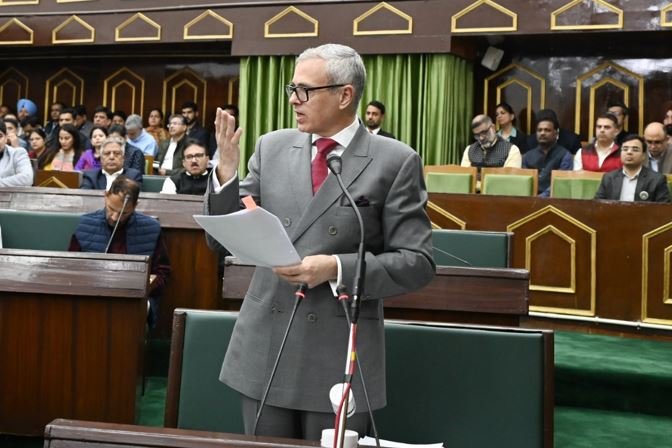
Jammu, March 19: Chief Minister Omar Abdullah asserted on Wednesday that Jammu and Kashmir’s revenue receipts witnessed a significant 13 percent increase in 2021-22 compared to the previous fiscal year. He emphasized that despite fiscal challenges, the Union Territory successfully managed its finances while keeping the deficit lower than anticipated.
The Chief Minister made these remarks while detailing the positive initiatives and achievements of the J&K government, as highlighted in the Comptroller and Auditor General (CAG) Finances Audit Report for J&K (Report No. 1 of 2023), which was presented in Parliament on March 28, 2023.
CM Omar Abdullah, who also holds the Finance portfolio, explained that the understatement of the revenue deficit was rectified in consultation with the Principal Accountant General (PAG). Addressing queries in the Legislative Assembly, he dismissed concerns regarding financial irregularities, affirming that corrective measures had already been taken.
In response to a question by former minister and Congress MLA Tariq Hameed Karra regarding the CAG’s observations on fiscal mismanagement, outstanding liabilities of Rs 29,335.41 crore, additional borrowings of Rs 2,122.77 crore (JKIDFC) and Rs 10,321.83 crore (JKPCL), as well as misclassification of Rs 158.76 crore in revenue expenditure under capital expenditure (capex), the CM clarified that the misclassification was rectified in consultation with PAG. He added that the unutilized funds amounting to Rs 5,092.25 crore across 123 schemes were due to various administrative and technical reasons, including land acquisition challenges and procedural encumbrances.
The CM elaborated that off-budget loans were raised to expedite the completion of stalled infrastructure projects and settle pending power purchase liabilities, particularly during the COVID-19 pandemic, in accordance with schemes introduced by the Ministry of Power. Regarding the classification of Grant-in-Aid, he explained that certain expenditures were initially categorized as capital due to their nature but were later reclassified as revenue expenditure following consultation with PAG.
Highlighting key financial reforms, the Chief Minister stated that budget estimates are prepared based on advance assessments from various departments. Unutilized funds from savings at the revised estimate stage are reallocated to fast-moving projects to ensure optimal utilization of resources.
Since assuming control of the capex budget in FY 2019-20, the Finance Department has implemented IT-enabled platforms such as BEAMS, PAYSYS, PROOF, and Treasury Net. These systems facilitate real-time tracking of fund allocation and expenditure, enhancing transparency and accountability in public financial management.
The CAG report outlined several key achievements in J&K’s financial performance. CM Omar Abdullah emphasized that own tax revenue surged by 31.88 percent, with State GST collections rising by 32.13 percent and Excise Revenue increasing by 32.31 percent. Non-tax revenue also showed a robust growth of 18.74 percent, reflecting improved revenue collection mechanisms and fiscal discipline.
The CM further underscored that J&K maintained a minimum cash balance for 62 days without resorting to borrowing, a testament to the government’s prudent financial planning and resource management.
Apart from fiscal improvements, the Chief Minister highlighted notable investments in infrastructure development. Capital expenditure (capex) increased by 5.51 percent in 2021-22 compared to the previous year. He pointed to progress in urban development projects, advancements in water supply and sanitation, healthcare infrastructure enhancements, road transport improvements, and power sector upgrades.
He also referenced the successful implementation of various government schemes, investments in the public sector, and the overall economic trajectory of Jammu and Kashmir as reflected in the CAG report.
Reiterating the government’s commitment to financial transparency and effective governance, CM Omar Abdullah assured that all reforms and corrective measures are aligned with best practices and regulatory frameworks. The administration remains focused on maintaining fiscal discipline, accelerating developmental projects, and ensuring sustainable economic growth in Jammu and Kashmir.

