


Centre Extends Foreign Secretary Vikram Misri’s Tenure by One Year Amid Diplomatic Flux
The government’s decision to retain Vikram Misri till July 2027 signals a preference for continuity in foreign policy as India navigates an increasingly volatile global environment shaped by regional conflicts, strategic realignments and high-stakes diplomatic negotiations.
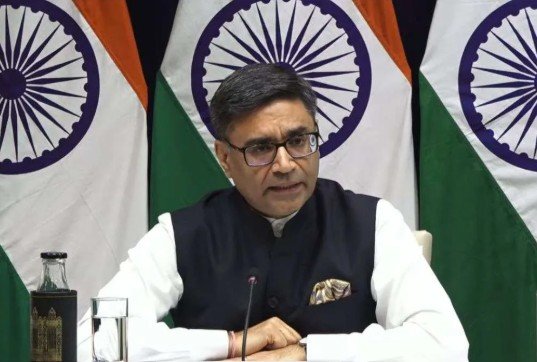
New Delhi, July 2: In a move underlining the government’s preference for continuity in a period of international turbulence, the Centre on Wednesday extended the tenure of Foreign Secretary Vikram Misri by one year, allowing him to remain in office until July 14, 2027. The extension, approved by the Appointments Committee of the Cabinet, comes at a time when India’s foreign policy establishment is navigating a demanding mix of geopolitical instability, strategic balancing, regional crises and intensifying global competition.
Misri, a senior Indian Foreign Service officer with decades of diplomatic experience, was due to retire in mid-July this year. Instead, the government has chosen to keep him at the helm of the Ministry of External Affairs at a moment when India’s diplomatic engagements are widening across multiple theatres from managing relations with immediate neighbours and major powers to sustaining momentum in trade, security and multilateral negotiations.
The official notification confirming the extension may have been brief, but its implications are far reaching. At a time when India is trying to preserve strategic autonomy while deepening ties with key global partners, continuity in the top diplomatic office is seen as an important stabilising factor. Misri’s extension suggests that the government wants an experienced hand to steer its foreign policy bureaucracy through a period marked by uncertainty in West Asia, the sharpening rivalry between major powers, and the need to safeguard India’s economic and strategic interests across regions.
The decision also reflects the growing importance of bureaucratic continuity in India’s foreign policy apparatus. In recent years, diplomacy has become increasingly central to India’s domestic and global positioning. Whether it is energy security, supply chain resilience, defence partnerships, diaspora engagement, technology cooperation or crisis management, the role of the foreign secretary has expanded beyond traditional diplomacy into a more complex field involving coordination across ministries, agencies and strategic stakeholders. By extending Misri’s term, the Centre appears to be signalling that it values institutional memory and policy consistency at a time when foreign policy outcomes are deeply intertwined with national security and economic planning.
Misri has held the post of foreign secretary during a period of exceptionally dense diplomatic activity. His tenure has overlapped with shifting equations in India’s neighbourhood, the continuing fallout of conflicts in Europe and West Asia, the reconfiguration of supply chains, and India’s efforts to position itself as a credible voice of the Global South while also expanding strategic cooperation with the United States, Europe, Japan and other partners. His extension suggests the government believes that replacing him at this juncture could create avoidable disruption in ongoing negotiations and diplomatic processes.
The timing of the decision is significant. The international landscape remains unsettled, with conflict-related uncertainties affecting energy prices, trade routes and regional security calculations. India has had to calibrate its responses carefully balancing principle with pragmatism, preserving its national interests while maintaining working relations with countries on opposite sides of global fault lines. Such balancing acts require not only political direction from the top leadership but also sustained bureaucratic execution. A foreign secretary with established relationships across capitals and within the Indian system can provide that continuity.
Officials and observers alike are likely to read the extension as a sign that several key diplomatic tracks remain in active motion. India is currently engaged in complex conversations on trade and investment, maritime security, technology partnerships, migration, defence cooperation and regional connectivity. It also continues to navigate delicate bilateral equations in South Asia while keeping an eye on developments in the Indo-Pacific, West Asia and the broader global order. In such a setting, a change in the foreign secretary’s office could have required a transition period; extending Misri’s tenure avoids that and allows the bureaucracy to stay aligned with the political leadership’s priorities.
Misri’s career profile has made him one of the more closely watched figures in India’s diplomatic establishment. Over the years, he has held several important assignments, building a reputation as a seasoned negotiator and a trusted bureaucrat. His experience has spanned major capitals and sensitive policy roles, equipping him with both strategic exposure and operational familiarity. That background likely weighed in favour of the extension, especially at a time when the Ministry of External Affairs is dealing with multiple simultaneous challenges rather than a single dominant diplomatic crisis.
The Centre’s move also raises broader questions about how India is structuring its top bureaucracy in an era of long-duration geopolitical stress. Traditionally, retirements and appointments in the civil services have followed fixed timelines, with extensions granted sparingly and usually under exceptional circumstances. But in sectors where continuity can directly affect national strategy—such as defence, intelligence, economic management and diplomacy the government has in recent years shown a willingness to retain senior officials if it believes the institutional costs of transition outweigh the benefits of change. Misri’s extension fits into that pattern.
From the government’s perspective, there are obvious advantages to retaining a foreign secretary who is already familiar with ongoing negotiations, confidential assessments and evolving diplomatic priorities. International diplomacy often depends on personal rapport, continuity of messaging and the ability to move quickly across sensitive issues without a steep learning curve. Whether the matter involves bilateral summits, back-channel communications, multilateral positioning or crisis response, the foreign secretary serves as one of the principal executors of the political leadership’s strategic choices. A one-year extension therefore gives the government a wider runway to pursue continuity in foreign policy execution.
The move may also be read in the context of India’s external economic agenda. Diplomacy is no longer limited to statecraft in the traditional sense; it now includes active pursuit of trade opportunities, technology partnerships, manufacturing investment, logistics linkages and energy arrangements. The foreign secretary’s office increasingly works at the intersection of diplomacy and development, especially as India seeks to attract investment, diversify supply chains and deepen engagement with emerging and advanced economies alike. Continuity in leadership can help maintain momentum in such efforts.
Equally important is the consular and crisis-management dimension of the foreign secretary’s role. In recent years, India has had to respond to evacuations, regional conflicts, visa and migration issues, safety concerns involving the diaspora and emergency situations affecting Indian nationals abroad. The foreign secretary’s office becomes central in coordinating such responses. In a world where conflicts can erupt quickly and spill across borders, retaining a tested hand at the top of the system can be viewed as a hedge against uncertainty.
Politically, the extension is unlikely to generate major controversy in itself, but it does reveal how the government is reading the strategic environment. Instead of ushering in a new top diplomat with a fresh tenure, it has chosen stability. That suggests a judgment that the coming year may be too important, or too unpredictable, for an avoidable transition at the apex of the diplomatic bureaucracy. It also indicates confidence in Misri’s stewardship and in the foreign policy direction pursued under his watch.
At the same time, the extension may invite discussion within bureaucratic circles about succession planning and the message such decisions send to the wider civil service. Senior appointments in the diplomatic corps are closely watched because they shape not only policy execution but also institutional morale and career progression. While the government clearly has the authority to retain an official in the national interest, such decisions are often interpreted as indicators of which qualities and policy approaches are being rewarded at the highest levels.
For India’s partners abroad, the extension offers predictability. Diplomatic systems value stable interlocutors, especially in periods of rapid change. Countries dealing with India on security, trade, regional issues or multilateral coordination may see the decision as a sign that New Delhi wants to minimise uncertainty in its external engagement. Misri’s continuation means foreign governments and institutions will not need to recalibrate immediately to a new bureaucratic leadership at South Block, at least for the next year.
The extension also comes at a moment when India is trying to sustain its image as a confident and reliable actor on the world stage. In recent years, New Delhi has worked to project itself as both a strategic power and a development partner—assertive when necessary, flexible when useful and independent in judgment. Maintaining continuity in the foreign secretary’s office helps support that projection by ensuring that India’s diplomatic messaging remains coherent even as the global environment becomes more fragmented.
There is also a practical governance dimension to the move. Senior bureaucratic transitions, especially at the top of a ministry as consequential as External Affairs, involve not just a change of personnel but a transfer of files, relationships, negotiating positions and tacit knowledge. During calm periods, such transitions may be routine. During moments of geopolitical stress, they can become costly. Extending Misri by one year allows the government to postpone that disruption until a potentially more stable phase or at least until a more suitable transition point.
The coming year is likely to test Indian diplomacy on several fronts. Relations with major powers will continue to require careful calibration; tensions and alignments in India’s neighbourhood will remain fluid; global trade and technology disputes will keep evolving; and regional security crises may continue to affect India’s energy, shipping and diaspora interests. In all of these areas, the foreign secretary’s office functions as a central node connecting political direction, bureaucratic execution and diplomatic messaging. By retaining Vikram Misri, the government has chosen to preserve that node’s continuity rather than reset it.
Ultimately, the extension is more than a personnel decision. It is a statement about the government’s reading of the international moment and its belief that foreign policy continuity matters at a time when the world is becoming less predictable. Whether measured through bilateral negotiations, strategic partnerships, multilateral positioning or crisis response, the coming year will likely demand agility as well as steadiness from India’s diplomatic machinery. The Centre’s decision indicates that it sees Vikram Misri as the person best placed to provide both.
For now, the one-year extension ensures that India’s top diplomat will continue to guide the foreign policy establishment through another crucial phase. As the country navigates geopolitical churn, economic diplomacy, regional uncertainty and strategic competition, the government has made clear that it wants continuity at the centre of its external engagement architecture. In a world defined increasingly by flux, New Delhi has opted for familiarity, experience and institutional steadiness at the top of South Block.

