


Monsoon Session From July 20: Government Sets Stage for High-Stakes Parliament Showdown
With the Monsoon Session of Parliament scheduled from July 20 to August 13, the political temperature is set to rise as the government prepares its legislative agenda and the Opposition readies a coordinated attack on electoral rolls, inflation, federal issues and institutional accountability.
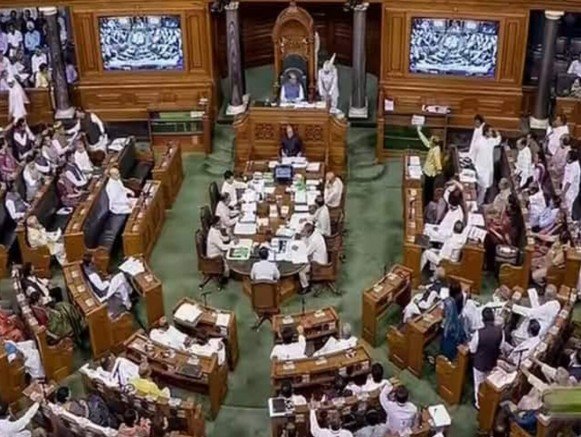
New Delhi, July 7: ] charged sessions of the year, with the ruling alliance looking to push key legislative business while the Opposition prepares to turn the floor of the House into a battleground over elections, governance, inflation, statehood demands, institutional functioning and alleged democratic backsliding.
The notification of the session calendar may appear routine in constitutional terms, but in the current political climate it carries much wider significance. The Monsoon Session comes at a moment when several fault lines in national politics are simultaneously active: opposition parties have sharpened their criticism of the Special Intensive Revision of electoral rolls, multiple court-linked and policy controversies are simmering, Jammu and Kashmir statehood has returned to the centre of political debate, and questions around economic stress, unemployment and prices continue to animate public discourse. Against that backdrop, Parliament is expected to become the principal arena in which competing political narratives are tested before the country.
Parliamentary Affairs Minister Kiren Rijiju’s announcement that President Droupadi Murmu had approved the government’s recommendation to convene both Houses from July 20 gives the ruling side a formal timeline to organise legislative priorities and political messaging. But it also gives the Opposition a target date around which to build pressure campaigns. Already, signals from opposition leaders suggest that the session will not be treated as a narrow lawmaking exercise; rather, it will be used to demand debate, accountability and ministerial responses on a range of issues that the government may prefer to manage outside Parliament.
One of the most prominent flashpoints likely to dominate the session is the controversy surrounding the Special Intensive Revision of electoral rolls in states such as Bihar and Karnataka. Opposition parties have framed the exercise as a matter that goes beyond administrative housekeeping and instead touches the core of democratic fairness, voter inclusion and the autonomy of the Election Commission. Their recent political messaging suggests that they will seek a detailed debate on the rationale, methodology and safeguards associated with the revision process, especially where it intersects with concerns about disenfranchisement, selective scrutiny or procedural opacity.
This issue matters because electoral roll revision, while technical in appearance, can become politically explosive when it is linked to voter identity, migration, documentation burdens or suspicions of partisan intent. Opposition leaders are expected to demand that the government clarify its position, explain its engagement with the Election Commission and address fears that large-scale revision exercises could be weaponised in the run-up to future elections. The government, for its part, is likely to insist that electoral processes remain within the domain of the independent constitutional authority and that attempts to politicise administrative exercises are unwarranted. That clash alone could consume substantial parliamentary time.
Another likely fault line is Jammu and Kashmir, where demands for restoration of full statehood have gained renewed political traction. The National Conference has already announced plans to stage a protest at Jantar Mantar on July 20 the very first day of the session to press for statehood. That timing is no accident. It is designed to bring the constitutional and political future of Jammu and Kashmir directly into the national legislative spotlight just as Parliament reconvenes. Opposition parties, especially those with a federalist plank, may use the moment to question the Centre’s timeline, intentions and roadmap on restoring statehood, even if the government continues to argue that security, administrative consolidation and developmental priorities remain central to its approach.
The Monsoon Session will also unfold amid continuing scrutiny of inflation and cost-of-living pressures. While the macroeconomic narrative promoted by the government focuses on growth, infrastructure, digitalisation and India’s expanding international profile, the Opposition is likely to foreground the everyday economy: food prices, household budgets, fuel-linked costs, employment concerns and the uneven distribution of growth gains. These issues resonate politically because they translate abstract economic data into lived public experience. Parliament offers the Opposition a platform to turn that contrast into a sustained critique of the government’s economic management.
Unemployment and youth distress may emerge as a parallel thread in those attacks. Over the past year, recruitment delays, examination controversies and anxieties around secure employment have repeatedly triggered public anger. Even when not formally listed as headline legislative issues, such matters often enter parliamentary debate through adjournment notices, Zero Hour interventions, calling attention motions and broader discussions on governance. The Opposition is likely to argue that the government’s economic claims ring hollow unless they are matched by credible job creation, transparent recruitment and relief from rising costs.
The government, however, will enter the session with its own strategic objectives. Monsoon sessions are often used to move a substantial legislative agenda because they arrive after the Budget Session and before the political churn of the winter calendar. Ministries are expected to line up bills and policy business that can be tabled, debated or referred during the session. Although the final legislative list will determine the exact scope of the agenda, the government will likely seek to use its parliamentary majority and floor management capacity to ensure that business proceeds even amid disruptions.
That task may not be easy. The present Opposition, though fragmented across parties and states, has increasingly learned to coordinate around a limited set of common themes: electoral integrity, federal balance, misuse of institutions, unemployment, inflation and constitutional accountability. It does not always need numerical strength to shape the political tone of a session; sustained disruption, symbolic walkouts, joint protests and coordinated messaging can be enough to keep the government on the defensive, especially when parallel court cases, media coverage and street protests reinforce the same issues outside Parliament.
This is why the Monsoon Session is likely to be as much about optics as about legislation. Every floor intervention, adjournment, slogan, suspension threat or all-party meeting will be read through a broader political lens. The government will want to project stability, productivity and seriousness. The Opposition will want to project vigilance, resistance and public representation. Parliamentary theatre in such sessions is not merely noise around lawmaking; it is part of how parties communicate priorities to voters, shape media narratives and test coalition discipline.
The session’s timing also matters in relation to the broader political calendar. With several states moving closer to important electoral cycles and national politics already in a semi-campaign mode, parties will use Parliament to sharpen narratives that can travel beyond Delhi. If the Opposition manages to frame the session around democratic institutions, federal concerns and economic hardship, it could consolidate a line of attack that extends into future state and national contests. If the government succeeds in keeping the focus on development, foreign policy, welfare delivery and legislative progress, it may blunt some of that pressure.
Another undercurrent likely to surface is the growing use of courts as arenas for politically consequential disputes. From election-related controversies and statehood demands to sports governance and regulatory challenges, a range of issues with political resonance are increasingly moving between the judiciary and the political sphere. Parliament, in turn, becomes the place where those disputes are politically interpreted and reframed. Opposition parties may cite recent judicial observations or pending cases to attack the government, while ministers may counter that legal matters should not be prejudged on the floor of the House. The friction between judicial developments and parliamentary debate is therefore likely to remain visible.
There is also the question of productivity. In recent years, parliamentary sessions have often been measured not only by the number of bills passed but by the amount of time lost to disruptions, the extent of debate allowed on contentious issues and the quality of legislative scrutiny. Critics argue that Parliament is increasingly being used to ratify executive decisions rather than meaningfully examine them. The government rejects that characterisation and points to the volume of legislative work completed. The Monsoon Session will revive that debate, particularly if major bills are introduced amid acrimony and without extensive discussion.
For regional parties, the session provides an opportunity to bring state-specific issues into the national frame. Whether it is statehood for Jammu and Kashmir, resource-sharing disputes, central funding concerns, language and education questions, or regional infrastructure demands, the Monsoon Session allows such parties to tie local grievances to national accountability. This often complicates floor management for the ruling side because it multiplies the number of pressure points beyond the main national Opposition agenda.
At the same time, the government may use the session to showcase policy achievements and international diplomacy. Prime Minister Narendra Modi’s overseas engagements, India’s trade and strategic partnerships, welfare rollout, infrastructure expansion and digital governance reforms could all be projected as evidence of effective governance. Ministers may seek to contrast these achievements with what they describe as obstructionist politics by the Opposition. Such a strategy works best when the House functions smoothly enough to allow structured statements and legislative business, which is why the government will likely push hard for orderly proceedings.
The first few days of the session will therefore be especially crucial. They often establish the tone for everything that follows. If the Opposition succeeds in forcing an early debate on electoral rolls, inflation or statehood, it will gain momentum. If the government is able to isolate those demands, proceed with listed business and prevent repeated adjournments, it will claim control of the agenda. Either way, the July 20 opening now carries unusual symbolic weight because it coincides with visible opposition mobilisation outside Parliament as well.
The Monsoon Session is thus shaping up not as a routine legislative calendar entry but as a political stress test. It will measure the government’s ability to manage dissent while moving its agenda, the Opposition’s capacity to remain coordinated across issues, and Parliament’s own role as a forum for accountability in a period of heightened political contestation. The formal session dates are now fixed. The real question is what story the House will tell between July 20 and August 13: one of legislation and governance, or one of confrontation over the direction of Indian democracy.
In all likelihood, it will be both. That is what makes this session important. It arrives at a time when national politics is unusually layered
shaped simultaneously by electoral anxieties, federal demands, economic pressures, court-linked controversies and competing visions of institutional legitimacy. Parliament will be where those tensions are aired most visibly, and the Monsoon Session of 2026 may well become one of the defining political stages of the season.

