


UN Chief Warns AI Is Outpacing Global Rules, Calls for Urgent International Safeguards
At the first government-level global dialogue on artificial intelligence in Geneva, UN Secretary General António Guterres says AI is advancing faster than regulation, raising concerns over jobs, elections, security and children’s safety.
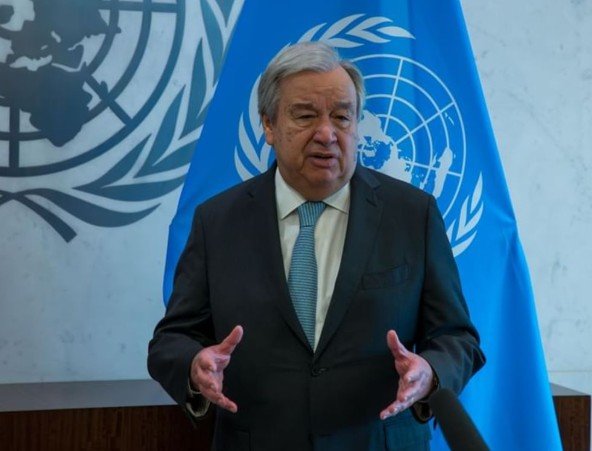
Geneva, July 6: The global race to harness artificial intelligence has entered a phase where technological progress is moving faster than governments’ ability to regulate it, United Nations Secretary-General António Guterres warned on Monday, urging countries to work toward harmonised international safeguards before the consequences become harder to contain.
Addressing the first government-level global dialogue on artificial intelligence in Geneva, Guterres said AI is no longer a future challenge but a present force reshaping economies, workplaces, politics and security structures. He cautioned that while the technology promises enormous gains in productivity, medicine, education and scientific discovery, its unchecked expansion also carries profound risks, especially when rules, accountability systems and public oversight are still lagging behind.
The UN chief’s remarks came at a time when governments across the world are struggling to keep pace with rapid advances in generative AI, autonomous systems, large language models and algorithmic decision-making tools that are increasingly embedded in finance, defence, education, media and public administration. Guterres said the gap between innovation and regulation is widening dangerously and could deepen inequality, distort democratic systems and expose vulnerable populations to new forms of harm if not addressed through collective action.
He described artificial intelligence as a transformative force capable of changing the world of work, influencing public opinion, affecting election ecosystems and altering the balance of security among nations. According to him, the speed of deployment is such that even the companies and developers building these systems are not fully in control of how they will be used once they are scaled globally. That, he indicated, is precisely why public institutions cannot afford to react slowly or in fragmented ways.
The Geneva dialogue was convened against the backdrop of intensifying global debate over who should set the rules for AI, what guardrails should apply to advanced systems and how the benefits of the technology can be distributed more fairly. While many countries are drafting domestic AI laws or voluntary codes of conduct, the absence of a common global framework has led to growing concern that companies may operate across jurisdictions with very different standards on privacy, transparency, data use, child safety, misinformation and liability.
Guterres stressed that children deserve particular attention in any AI governance framework. He warned that minors are increasingly exposed to algorithmically amplified harms ranging from manipulation and disinformation to deepfakes, online exploitation and the shaping of behavioural patterns by opaque recommendation systems. In his view, child protection cannot be treated as an afterthought in the digital age; it must be built into the design, regulation and oversight of AI tools from the outset.
The UN chief’s intervention also reflected mounting anxiety about the labour market impact of AI. Across sectors, companies are automating routine tasks, integrating AI copilots into workflows and using machine learning systems to manage hiring, evaluation and service delivery. Supporters argue this can improve efficiency and free workers from repetitive work, but critics fear it could intensify job displacement, weaken bargaining power, increase surveillance at workplaces and deepen inequalities between workers who can adapt to AI-driven systems and those who cannot.
Guterres acknowledged the enormous promise of AI in healthcare diagnostics, climate modelling, disaster prediction, precision agriculture and scientific research. However, he argued that the debate cannot be reduced to a choice between innovation and regulation. The real challenge, he suggested, is building a governance architecture that enables innovation while preventing abuse, discrimination, opacity and concentration of power in the hands of a few corporations or states.
That concern is especially relevant as AI systems increasingly influence access to loans, insurance, jobs, public services and even legal outcomes. Human rights groups and digital governance experts have repeatedly warned that biased or poorly audited AI models can reinforce racial, social, linguistic and economic discrimination, particularly when deployed in high-stakes sectors without meaningful transparency. Guterres signalled that the world should not wait for a cascade of harms before acting.
One of the central themes of the Geneva gathering was the need for globally harmonised standards. At present, the international AI landscape is marked by a patchwork of national approaches. The European Union has moved toward a risk-based regulatory structure through its AI Act. The United States has largely leaned on executive guidance, sectoral regulation and voluntary commitments from technology companies. China has developed rules around generative AI, recommendation algorithms and platform obligations, though with a governance philosophy very different from that of Western democracies. Many developing countries, meanwhile, are still building the institutional capacity to engage meaningfully with AI governance at all.
This divergence has fuelled fears of regulatory fragmentation. Companies operating across borders may face conflicting compliance requirements, while countries with weaker safeguards may become testing grounds for risky deployments. Guterres suggested that, much like climate governance or nuclear risk reduction, AI may require a global baseline of norms that all states can commit to, even if national legal systems differ in implementation.
The secretary-general’s warning also intersects with a deeper geopolitical competition around AI. The technology is now central not only to economic strategy but also to national security, military planning and geopolitical influence. Advanced AI capabilities are increasingly linked to semiconductor supply chains, cloud infrastructure, cybersecurity, satellite systems and defence applications. As a result, major powers are racing to secure technological leadership while also seeking to shape the rules of the road in their favour.
That competition has made international coordination more difficult. Governments are often reluctant to impose strict limits on domestic AI champions if they believe rivals may gain a strategic edge. At the same time, the absence of common standards heightens the risk of AI misuse in warfare, espionage, cyberattacks, surveillance and disinformation campaigns. Guterres’ remarks appeared aimed at pushing governments beyond narrow national calculations toward a broader understanding that unregulated AI risks could destabilise everyone.
The discussion in Geneva is part of a wider UN effort to shape global digital governance. Over the past year, the organisation has amplified calls for guardrails on frontier technologies, greater representation of developing countries in rule-making and stronger links between digital policy and human rights principles. Guterres has repeatedly argued that digital governance cannot be left solely to market incentives or geopolitical rivalry because the societal consequences are too large and too unevenly distributed.
A major issue confronting policymakers is enforcement. Even where rules exist, regulators often lack the technical capacity, data access or legal tools to audit complex AI models and the ecosystems built around them. The opacity of many systems—especially those trained on vast datasets and deployed through proprietary infrastructures—makes accountability difficult. If a model spreads harmful misinformation, discriminates in a hiring process, manipulates a child user or contributes to a security breach, tracing responsibility can be legally and technically challenging.
This is why experts increasingly call for layered accountability: safety testing before deployment, disclosure obligations, independent audits, incident reporting, red-teaming, watermarking or provenance tools for synthetic media, and clear liability for harmful uses. Guterres did not prescribe a single blueprint, but his remarks reinforced the view that voluntary self-regulation by technology firms will not be enough to manage the scale of risk now emerging.
The timing of the warning is also notable because public awareness of AI has grown sharply in the last two years. Tools that generate text, images, code, video and voice have moved from specialist labs into mass consumer use, business software and public administration. Governments are experimenting with AI in public services, militaries are integrating AI into decision-support systems, and election officials are confronting new threats from AI-generated misinformation and impersonation. Each of these developments raises different policy questions, yet all are linked by the broader challenge of governance lag.
For developing countries, the debate carries additional stakes. Many fear being left behind in AI adoption while simultaneously being exposed to imported systems that are poorly suited to local languages, laws and social contexts. There are also concerns about data extraction, digital dependency and the concentration of AI infrastructure in a handful of countries and firms. Guterres’ call for harmonised rules implicitly includes the need for more inclusive participation, so that global governance is not designed only by the countries with the deepest technological and financial resources.
Another concern is democratic integrity. AI-generated deepfakes, synthetic audio, targeted persuasion and automated content systems have already changed the information environment. In election years across multiple countries, regulators and civil society groups are increasingly worried that AI could supercharge misinformation campaigns, suppress voter confidence or be used to impersonate political figures and institutions. Guterres’ reference to elections underscored the fact that AI governance is no longer a niche technology issue; it has become central to democratic resilience.
Business leaders and investors, too, are watching the regulatory debate closely. Companies want clarity on compliance expectations, liability exposure and the boundaries of acceptable AI use. Some technology firms have publicly supported baseline regulation, partly to reduce uncertainty and partly to shape the rules in ways that preserve their business models. But many civil society groups warn that governance frameworks must not be written primarily by the firms they are meant to regulate.
The UN secretary-general’s message from Geneva was ultimately one of urgency rather than alarmism. He did not argue for halting innovation or imposing a blanket restriction on AI development. Instead, he framed the issue as a test of whether governments can match technological speed with political responsibility. The challenge, in his view, is to ensure that AI serves humanity rather than deepens existing fractures in power, wealth and security.
Whether the Geneva dialogue translates into concrete global mechanisms remains uncertain. International digital governance has historically moved slowly, and AI regulation is entangled with trade, national security, industrial policy and ideological differences over state power. Yet the significance of the moment lies in the fact that AI has now moved firmly onto the agenda of high-level multilateral diplomacy.
For the United Nations, the task ahead is not only to keep the conversation alive but to push it toward institutional outcomes: shared principles, interoperable standards, stronger safeguards for children and vulnerable groups, and mechanisms to prevent the most dangerous uses of AI before they become entrenched. For national governments, the message is that waiting for perfect consensus is no longer an option.
As AI systems spread across every major domain of modern life from schools and hospitals to markets, militaries and election campaigns the cost of regulatory delay is rising. Guterres’ warning in Geneva was a reminder that the world is entering a period in which the rules written now, or not written now, may shape the social and political order for decades. The contest over artificial intelligence is no longer only about innovation. It is also about power, accountability and the kind of global digital future governments are willing to build.

