


CJP Founder Dipke Launches Indefinite Hunger Strike, Party Confirms Parliament March Will Continue
Sonam Wangchuk shifted to Safdarjung Hospital after health concerns, while the Cockroach Janta Party intensifies its agitation with fresh hunger strikes and a renewed call for nationwide participation in the July 20 Parliament march.
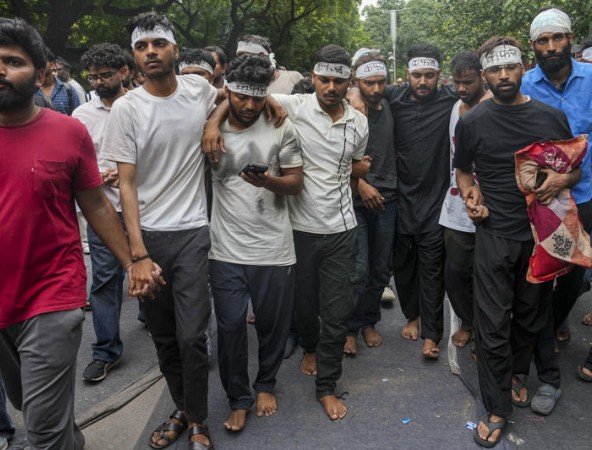
New Delhi, July 18: The protest over the alleged irregularities in the NEET examination entered a more intense phase on Saturday after Cockroach Janta Party (CJP) founder Abhijeet Dipke announced the start of an indefinite hunger strike following the transfer of activist Sonam Wangchuk from Jantar Mantar to Safdarjung Hospital. The development has further heightened political attention around the ongoing movement, with organisers confirming that the planned Parliament march on July 20 will proceed as scheduled despite the police action.
The youth led organisation described the hospitalisation of Wangchuk as an attempt to weaken the protest but insisted that the agitation would continue until its demands receive a satisfactory response from the Central Government.
Dipke Announces Hunger Strike
Soon after Wangchuk was shifted to the hospital, Dipke declared that he would begin an indefinite fast in solidarity with the movement and to sustain public pressure over the alleged examination irregularities.
Through a message shared on social media, he announced the beginning of his fast with immediate effect, describing it as a peaceful form of democratic protest. The announcement quickly drew attention from supporters gathered at Jantar Mantar, many of whom pledged to continue the campaign despite the latest developments.
The CJP also intensified its political messaging by demanding accountability from the Central Government and urging greater public participation in the ongoing movement.
Party Stands Firm on Parliament March
Despite the change in circumstances, protest organisers reiterated that the march towards Parliament on July 20, coinciding with the beginning of the Monsoon Session, would not be cancelled.
According to party representatives, the procession is intended to highlight the concerns of students who allegedly suffered because of irregularities in competitive examinations. Organisers said volunteers from multiple states are expected to participate in the march.
The CJP appealed to students, youth groups and civil society organisations to join what it described as a peaceful democratic campaign seeking transparency and accountability.
Police Shift Wangchuk After Medical Advice
Earlier in the day, Delhi Police shifted Sonam Wangchuk to Safdarjung Hospital after his health reportedly deteriorated during the 21st day of his indefinite fast.
Officials stated that the decision followed recommendations from medical experts and directions issued by the Delhi High Court regarding his health monitoring. Authorities maintained that the transfer was carried out solely to ensure essential medical care and safeguard his well-being.
Police also appealed to demonstrators to maintain peace and cooperate with security personnel at the protest venue.
Allegations Over Police Action
The CJP, however, criticised the manner in which the transfer was conducted.
Party spokesperson Ashutosh Ranka alleged that Wangchuk was forcibly removed from the protest site during the early morning hours and claimed that several demonstrators were also manhandled during the operation.
According to the party, the action was taken while many protesters had temporarily stepped away from the main protest area, making it difficult for supporters to respond immediately.
Dipke further alleged that he too was briefly detained and assaulted during what he described as a crackdown on peaceful demonstrators.
Delhi Police has not accepted these allegations, maintaining that its personnel acted in accordance with legal and medical requirements.
Hospitalisation Sparks Fresh Debate
The transfer of Wangchuk has triggered fresh discussions over the balance between an individual’s right to protest and the responsibility of authorities to intervene when a prolonged hunger strike poses serious health risks.
Government officials have maintained that the hospitalisation was necessary after continuous medical assessments indicated a deterioration in his physical condition.
The incident has also generated widespread reactions across social media, with supporters and critics expressing differing views on the police intervention.
Family Seeks Consent Before Treatment
Meanwhile, Wangchuk’s wife Gitanjali J. Angmo urged hospital authorities to ensure that no medical treatment is administered without the consent of both the family and the doctors associated with his care.
Her appeal came amid concerns among supporters that forced medical intervention could undermine the voluntary nature of Wangchuk’s hunger strike.
The family reiterated that all medical decisions should respect his wishes while ensuring his safety.
Video Released by Protest Organisers
Adding another dimension to the controversy, the CJP released a video recorded before Wangchuk’s hospitalisation.
In the footage, government doctors are seen discussing his health and asking whether he was willing to be admitted to a hospital.
Wangchuk reportedly responded that his fast was a conscious and voluntary decision rather than the result of any illness. One of the doctors also indicated that the court had primarily directed regular medical monitoring rather than compulsory hospitalisation.
The video has since circulated widely on social media, attracting significant public attention.
Supporters Continue Indefinite Fast
Although Wangchuk has been shifted to hospital, the protest itself has not ended.
Members of the All India Students’ Association (AISA), including activists Neha, Aameen and Manish, continued their own indefinite hunger strike at Jantar Mantar in solidarity with the movement.
Supporters stated that the campaign would continue peacefully until the government responds to their demands concerning examination reforms and student welfare.
Background of the Protest
Sonam Wangchuk has been observing an indefinite hunger strike since June 28, supporting the CJP led campaign over alleged irregularities in the NEET examination and reported student deaths linked to the controversy.
The movement initially focused on demanding the resignation of Union Education Minister Dharmendra Pradhan, while also calling for greater transparency in examination processes, stricter safeguards against paper leaks and comprehensive reforms to protect the interests of students.
Over the past several weeks, the protest has attracted participation from student organisations, activists and youth groups from different parts of the country.
Political Attention Expected to Increase
With the Monsoon Session of Parliament beginning on July 20, political observers expect the issue to gain greater prominence in national discussions.
Opposition parties are likely to raise questions regarding examination reforms and the handling of student concerns, while the government’s response to the planned Parliament march will be closely watched.
For now, organisers insist that their movement will remain peaceful and democratic, even as security arrangements around central Delhi are expected to be strengthened ahead of the scheduled march.
The coming days are likely to determine whether the ongoing protests lead to further negotiations or intensify into a larger nationwide student movement centered on examination reforms and institutional accountability.

