


Amit Shah, Nabin Hold Key Talks as BJP Eyes Reset Before Cabinet Reshuffle
With a Union Cabinet reshuffle likely within days, the BJP leadership has begun fine-tuning both government and party structures, weighing ministerial changes, new organisational appointments and a broader strategy for key poll bound states.
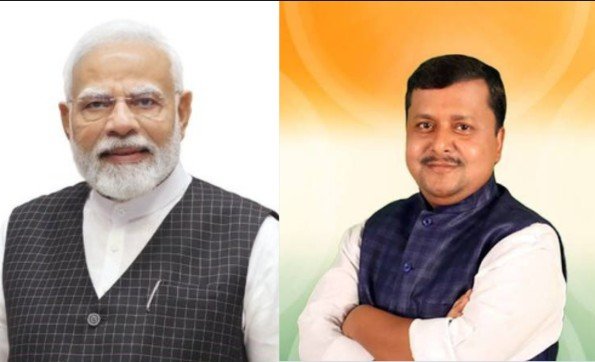
New Delhi, July 3: The Bharatiya Janata Party appears set for one of its most significant organisational and governmental exercises in recent months, with Union Home Minister Amit Shah, BJP national president Nitin Nabin and General Secretary (Organisation) B.L. Santosh holding an important strategy meeting on Thursday to finalise the contours of a long-anticipated party overhaul and a possible reshuffle of the Union Council of Ministers.
The meeting, held amid intense political speculation in the national capital, is being seen as a decisive step towards synchronising changes in the BJP’s organisation with a wider recast of the Narendra Modi government. Sources familiar with the deliberations indicated that the exercise is aimed at recalibrating both the party and the government before a fresh cycle of political battles, including key Assembly elections due over the next year.
The discussions assume added significance because they come at a time when the BJP is attempting to sharpen its political machinery after a series of major electoral contests and while the government weighs performance, representation and strategy within the Union Cabinet. Party insiders said the leadership is trying to ensure that the organisational rejig and cabinet reshuffle complement each other rather than unfold as separate processes.
In a clear indication of the seriousness of the exercise, Amit Shah cancelled his scheduled two-day visit to Odisha, where he was expected to arrive on July 3. His decision to stay back in Delhi has reinforced the view that the BJP top brass wants to wrap up consultations quickly and move towards an announcement within the next few days. Prime Minister Narendra Modi is set to travel abroad between July 6 and July 11, and political circles are therefore closely watching July 5 as the possible date for the reshuffle.
According to party sources, Thursday’s meeting centred on multiple issues at once: the formation of a new BJP central team under Nitin Nabin, a reassessment of national office bearers, redistribution of responsibilities across states and regions, and the possible movement of some leaders between the party and the government. The BJP leadership is understood to be exploring a broader restructuring model in which some ministers may be shifted to organisational assignments while a number of party office bearers or parliamentarians could be inducted into the Union government.
This dual-track approach reflects a familiar BJP strategy of treating the party and government as closely linked political instruments. Whenever the leadership senses the need for fresh energy, stronger state level coordination or more effective messaging, it often responds by moving leaders between organisational and administrative roles. The current exercise appears to be following that pattern, but on a potentially larger scale.
Sources said the leadership is especially focused on preparing the party for the next round of Assembly elections. States expected to go to the polls in the coming year are central to the ongoing review, and the BJP is keen to ensure that its organisational structure in those regions is strengthened well in advance. Discussions have reportedly included the possibility of assigning certain leaders with electoral experience or social influence to key state roles, even if that means moving them out of ministerial positions in Delhi.
One of the broad themes emerging from the consultations is the push to inject younger faces into the organisation and, potentially, the government. Senior leaders are said to be weighing the need to blend experience with generational change, particularly in states where the BJP wants to project a refreshed image or consolidate newly gained political ground. Such an exercise would also fit into the party’s long-term effort to expand its leadership pool and build second-line leaders with stronger regional appeal.
Political insiders say the review of the Union Council of Ministers is not being driven solely by political messaging. Administrative performance, public perception, communication ability and electoral utility are all believed to be part of the assessment. In other words, the reshuffle, if carried out, may not simply be about balancing factions or rewarding loyalists; it could also be used to send a message that the government is focused on efficiency and delivery as it enters a politically sensitive phase.
There is also considerable discussion within BJP circles over the possibility of reassigning ministers who may not find a place in the revised cabinet. One option under consideration, according to sources, is to accommodate some outgoing ministers in gubernatorial roles. The terms of Karnataka Governor Thawar Chand Gehlot, Madhya Pradesh Governor Mangubhai Patel and Uttarakhand Governor Lt Gen Gurmit Singh are due to end in the coming months, creating vacancies that the Centre may be able to fill as part of a wider political adjustment.
If such a formula is adopted, it would allow the BJP to manage transitions more smoothly by giving senior leaders dignified alternative roles while making room for new faces in the government. This has been a recurring feature of Indian politics across parties, but in the BJP’s case it often serves an additional purpose: retaining experienced leaders within the broader ecosystem even after they leave active ministerial office.
Another important dimension of the likely reshuffle is regional representation. Party sources indicated that the BJP is keen to strengthen the Union government’s political messaging in states where Assembly elections are approaching or where it wants to deepen its social coalition. Uttar Pradesh, Uttarakhand and Punjab are among the states being closely watched in this context. Additional representation from these regions in the cabinet could help the party craft a stronger local narrative while also signalling political attention to those states.
Uttar Pradesh, in particular, remains central to the BJP’s national calculations. As the country’s most politically consequential state, it carries enormous weight in both parliamentary and state-level strategy. Any cabinet changes involving UP are therefore likely to be read not only through the lens of governance but also through caste arithmetic, regional balancing and the party’s preparations for future electoral contests. A similar logic applies, though on a smaller scale, to Uttarakhand and Punjab, where representation can be politically symbolic as well as organisationally useful.
Sources also suggested that the BJP’s recent performance in West Bengal has given the state renewed importance in internal deliberations. If the party believes it has opened a fresh political window in Bengal, it may seek to reward or elevate MPs from the state in order to sustain momentum and expand its presence further. A cabinet berth for a Bengal MP would serve both as recognition and as a strategic investment in the state’s future political battle.
At the same time, the BJP leadership is believed to be looking beyond its own ranks. There is speculation that representatives associated with breakaway or allied factions from other parties may also find space in the Union Council of Ministers. Names from groups linked to rebel AAP leaders, the Trinamool Congress and the Shinde-led Shiv Sena camp are said to be under discussion, although no formal confirmation has emerged. If such inductions happen, they would underline the BJP’s continued effort to widen its alliance base and absorb leaders who can add political value in specific states.
Such a move would also be in line with the BJP’s broader strategy of using cabinet representation as a tool of coalition management and expansion. Bringing in figures from smaller allies, breakaway factions or regionally influential groups allows the party to project inclusiveness while simultaneously weakening rival formations. In states with fragmented opposition spaces, these inductions can have an impact beyond the immediate arithmetic of the Lok Sabha.
Nitin Nabin’s role in the current process is being watched closely. Having taken charge as BJP national president, he is now tasked with shaping the party’s organisational team at a moment when the BJP needs both cohesion and expansion. Party sources said he has already held a series of consultations, including with senior Union ministers, as part of the process of finalising appointments and responsibilities. His interactions with Defence Minister Rajnath Singh and other senior leaders are being viewed as part of a larger effort to build consensus around the upcoming changes.
The BJP’s organisational structure has been due for an update for some time, and the delay in announcing a new central team had fuelled speculation that the party wanted to align it with government changes rather than proceed in isolation. Thursday’s meeting appears to have moved that process closer to conclusion. Sources said discussions covered the appointment of office-bearers, state in-charges, regional responsibilities and possible changes in departments handling elections, communication and social outreach.
For the BJP, organisational appointments are rarely routine. Each decision carries political meaning, especially in a party that places enormous emphasis on cadre management, booth-level expansion and ideological coordination. A new office-bearers’ team can alter the balance of influence among states, communities and factions, while also revealing the leadership’s priorities for the next phase. That is why the simultaneous consideration of cabinet and party changes is being interpreted as a carefully planned political reset rather than a routine administrative exercise.
There is also a wider governance narrative at play. Sources in the BJP said a view is gaining ground within sections of the government that some ministries require “fresh blood” and stronger political communication. This does not necessarily imply dissatisfaction across the board, but it does suggest a willingness to review ministerial effectiveness more rigorously. Ministers may be judged not only by departmental performance but also by their public visibility, parliamentary interventions, handling of crises and ability to carry the government’s message to voters.
The return of Finance Minister Nirmala Sitharaman from an overseas visit on July 5 has further fuelled speculation about the timing of the exercise. With Prime Minister Modi scheduled to leave for Indonesia, Australia and New Zealand soon after, the window for a reshuffle before his departure appears narrow but workable. This has added urgency to the consultations and strengthened expectations that the BJP leadership wants to conclude the process quickly.
Even so, the final shape of the reshuffle remains uncertain. Cabinet exercises of this nature often involve multiple layers of consultation, including with the Prime Minister, the party president, the Home Minister and senior RSS-linked organisational functionaries. Balancing governance, politics, regional representation, caste equations, generational change and alliance management is a delicate task. As a result, last-minute changes are always possible.
What is clear, however, is that the BJP is treating the coming weeks as an important moment of political recalibration. The party is not only looking at who should occupy which ministerial berth, but also at how the organisation should be structured to support the government’s political agenda. The effort appears designed to sharpen administrative performance, improve electoral preparedness and ensure that the BJP enters the next round of contests with a tighter command structure.
The expected reshuffle and organisational revamp are also likely to be read as a message from the Modi-Shah leadership that the party remains in campaign mode even while in office. Unlike parties that separate government from election machinery, the BJP has consistently sought to keep both moving in tandem. A cabinet recast can energise the government; an organisational rejig can energise the cadre. Together, they can create the perception of momentum, renewal and control.
For the opposition, the BJP’s internal moves will be watched closely because they may offer clues about the ruling party’s state-level priorities and its assessment of vulnerable regions. A cabinet berth to a leader from a particular state, caste or ally can signal where the BJP sees opportunity or concern. Similarly, the appointment of a new organisational in-charge for a state can reveal where the party intends to intensify its campaign.
As of now, the strongest indicators point to an announcement sooner rather than later. Whether it comes in the form of a limited cabinet reshuffle, a broad ministerial overhaul or a combined package of government and party changes, the political significance will be substantial. The exercise has the potential to reshape the BJP’s internal hierarchy, alter the Union government’s composition and set the tone for the party’s next electoral push.
With Amit Shah, Nitin Nabin and B.L. Santosh now directly steering the process, the message from within the BJP is unmistakable: the party is preparing for the next phase of governance and politics simultaneously. The cabinet reshuffle, whenever it is formally announced, is therefore likely to be more than a routine rearrangement of portfolios. It may mark the beginning of a wider BJP reset aimed at strengthening the organisation, refreshing the government and consolidating the ruling party’s position ahead of a crucial electoral season.

