


Chinese AI Startup Spirit AI Targets ChatGPT Like Breakthrough for Humanoid Robots
Spirit AI is developing software aimed at allowing humanoid robots to understand verbal instructions and perform general-purpose tasks in real world environments.
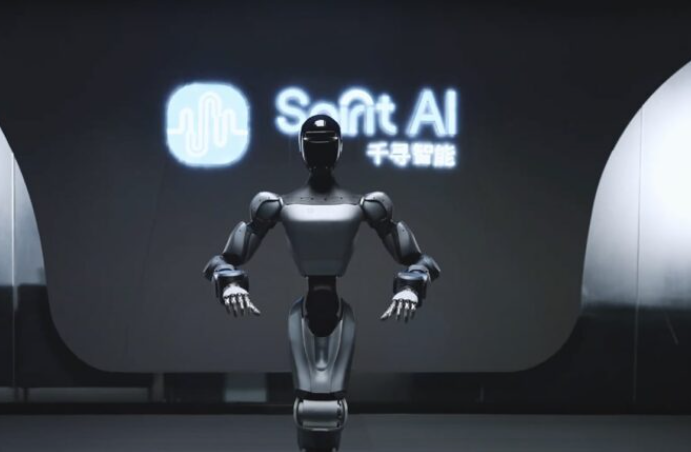
China, Sep , 21 : Chinese robotics startup Spirit AI is working toward a major advance in humanoid robot technology, with the company expecting a significant breakthrough by the middle of 2027 that could allow machines to carry out general-purpose tasks based on spoken instructions.
The development reflects a growing shift in robotics from improving mechanical movement to building artificial intelligence systems capable of understanding environments, interpreting commands and deciding how to complete physical tasks. The Indian Express
Spirit AI is focusing on what the industry describes as embodied AI, in which artificial intelligence is connected directly to physical machines. Rather than simply generating text or images, these systems are designed to perceive their surroundings and translate instructions into actions.
The company believes the next major step for humanoid robots will be comparable in importance to the emergence of conversational generative AI. If successful, robots could move beyond performing individual programmed tasks and become more flexible machines capable of responding to different instructions.
Spirit AI currently has its own Moz1 wheeled humanoid robots deployed on production lines, including at battery manufacturer CATL and retailer JD.com, which is also an investor in the startup. The real-world deployments provide the company with an opportunity to collect data and test how robots behave outside controlled laboratory demonstrations. The Indian Express
The software layer remains one of the biggest challenges in developing useful humanoid robots. Modern robotic hardware can already perform increasingly complex movements, including walking, balancing and manipulating objects. However, turning those physical capabilities into reliable responses to natural-language instructions requires much more sophisticated AI systems.
Spirit AI is therefore concentrating on robot intelligence rather than relying solely on improvements in mechanical design. The objective is to create systems that can connect language with physical actions and understand what is happening in the environment around them.
The approach represents an important change in the robotics industry. Earlier generations of industrial robots were generally designed for highly specific tasks in controlled environments. Their movements were carefully programmed, and changing the job could require substantial engineering work.
Embodied AI aims to make robots more adaptable. A user could potentially give a machine a verbal instruction and expect it to interpret the objective, identify relevant objects, plan a sequence of movements and execute the task.
However, such flexibility also creates technical challenges. A robot operating in a real environment must deal with unexpected objects, changing lighting, people moving nearby, uneven surfaces and objects that may not behave exactly as predicted.
Training robots to deal with these situations requires large quantities of physical-world data. Unlike language models, which can learn from enormous collections of digital text, robots need information about movement, objects, forces, distances and interactions with their surroundings.
Spirit AI is reportedly using contractors to collect real-world movement data for its systems. The company has around 1,000 contractors working on data collection, according to reporting on its development programme. The Indian Express
Early testing has demonstrated progress, although the results remain limited compared with the broad ambitions for general-purpose robots. Spirit AI’s machines have achieved a 90% success rate on simple tasks in structured living-room environments, according to the report. Such controlled tests can demonstrate whether an AI system is learning basic physical skills, but they do not necessarily show how reliably the same technology would perform in unpredictable homes, factories or public spaces. The Indian Express
The company expects robots to begin performing simpler commercial service tasks within about two years. Wider household adoption is expected to take longer because domestic environments are more varied and require robots to handle a much broader range of objects and situations.
The race to develop embodied AI is taking place alongside rapid advances in generative AI. Large technology companies and robotics startups are increasingly exploring ways to connect foundation models with machines capable of interacting with the physical world.
This convergence could eventually create robots that are not limited to one predetermined role. Instead, a single platform could potentially be trained or instructed to perform different tasks depending on the user’s needs.
The development also highlights why robotics companies are investing heavily in data. Hardware improvements can provide robots with stronger motors, better sensors and more precise control, but intelligent behaviour depends on software that can learn from physical experience.
For China, the expansion of embodied AI is part of a wider push to develop domestic capabilities in artificial intelligence and advanced manufacturing. Startups such as Spirit AI are attempting to combine AI research with robotics hardware and industrial deployment.
The next stage will depend on whether these systems can move successfully from controlled demonstrations to dependable real-world operations. A robot that can complete a simple task in a laboratory is very different from one that can safely and consistently work alongside people.
Spirit AI’s 2027 target therefore represents a development milestone rather than a guarantee that fully general-purpose humanoid robots will become commercially available at that time. The company’s progress will depend on improvements in perception, reasoning, physical control, training data and safety.
The push nevertheless shows how the robotics industry is increasingly treating AI intelligence as central to the future of physical machines. Instead of asking only whether a robot can move, developers are now working toward systems that can understand what a person wants and determine how to accomplish it.

