


Karnataka Wants Its Due, Not Bailouts: Priyank Kharge Seeks Fair Tax Share from Centre
State minister defends Karnataka’s flagship welfare programmes, saying the government has never sought Union funds for guarantees and is only demanding a more equitable share of tax revenues.
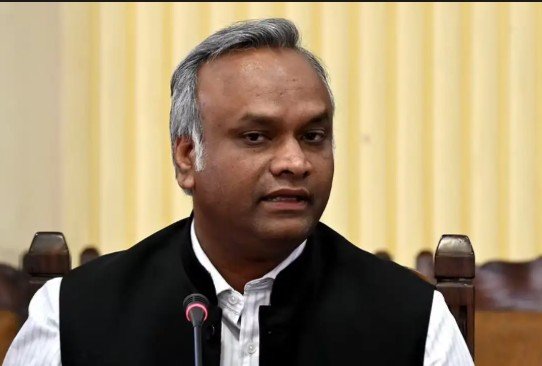
Bengaluru: Karnataka Minister Priyank Kharge on Monday strongly defended the state government’s flagship guarantee programmes, asserting that the Congress led administration has never approached the Union government for financial support to implement the welfare initiatives. Instead, he said Karnataka is merely seeking a fair share of tax revenues contributed to the national exchequer.
His remarks came in response to observations made by Union Finance Minister Nirmala Sitharaman, who recently stressed that welfare promises should be backed by adequate fiscal resources and should not become a burden on public finances.
Addressing reporters in Bengaluru, Kharge dismissed suggestions that Karnataka was depending on the Centre to sustain its welfare commitments. He maintained that the state’s demand has always been focused on receiving its rightful allocation from tax collections and centrally sponsored schemes.
Debate Over Welfare Funding Intensifies
The exchange highlights a broader debate between the Centre and opposition ruled states over fiscal federalism, tax distribution and welfare spending.
Kharge questioned whether Karnataka had ever formally sought financial assistance from New Delhi to run its social welfare programmes. According to him, neither Chief Minister Siddaramaiah nor Deputy Chief Minister D K Shivakumar had requested central funding for the guarantee schemes.
He argued that the criticism directed at Karnataka’s welfare initiatives should also be applied uniformly to states governed by the BJP and its allies, many of which operate subsidy programmes and social assistance schemes of their own.
According to the minister, welfare measures are not unique to Karnataka and have become a common feature of governance across the country. Therefore, he said, evaluating such programmes should not be influenced by political considerations.
Five Guarantees Remain a Cornerstone
The guarantee schemes introduced by the Karnataka government remain among the most ambitious welfare initiatives in the state.
The ‘Gruha Jyoti’ programme provides up to 200 units of free electricity to eligible households. Under ‘Gruha Lakshmi’, women heads of families receive monthly financial assistance. The ‘Anna Bhagya’ initiative offers food security support to economically weaker sections through subsidised grain distribution.
The government also launched ‘Yuva Nidhi’, which extends unemployment assistance to eligible graduates and diploma holders for a fixed period. Meanwhile, the ‘Shakti’ programme enables women to travel free of cost on non-luxury state-run buses within Karnataka.
Since their implementation, the schemes have emerged as key pillars of the Congress government’s social welfare agenda and continue to be widely discussed in political and economic circles.
Demand for Greater Fiscal Justice
Kharge reiterated that Karnataka’s position is not centred on seeking additional grants but on securing a more balanced return from national tax collections.
He claimed that the state contributes substantially to the country’s revenue generation yet receives a comparatively smaller share in return. According to the minister, Karnataka’s demand is rooted in principles of fairness and equitable fiscal distribution.
The minister emphasized that the state is not objecting to allocations made to other regions. Rather, he argued that Karnataka should receive a larger share corresponding to its contribution to the national economy.
Such additional resources, he said, could be invested in infrastructure expansion, industrial development, public services and employment generation.
Response to Centre’s Position
The Karnataka government’s remarks followed Sitharaman’s statement that welfare commitments should only be announced when governments possess the financial capacity to sustain them.
The Union Finance Minister had cautioned against introducing schemes without adequate budgetary support and later attributing financial challenges to the Centre.
Kharge responded by asserting that Karnataka’s welfare programmes were budgeted and funded by the state government. He maintained that the administration remains committed to implementing the schemes without interruption.
The minister further argued that criticism of Karnataka’s guarantees often ignores similar initiatives operating in other parts of the country.
No Question of Withdrawal
Addressing speculation surrounding the future of the welfare programmes, Kharge clarified that there is no proposal to discontinue any of the guarantees.
Recent discussions regarding beneficiary verification had led to questions about whether the government was considering scaling back the schemes. However, the minister explained that the exercise was intended solely to improve efficiency and prevent misuse.
According to him, the review process aims to ensure that benefits reach genuine recipients and that public funds are not diverted through irregularities.
The government, he said, had identified instances where benefits may have been issued to ineligible individuals, duplicate accounts or deceased beneficiaries, making periodic verification necessary.
Beneficiary Verification Underway
Officials have initiated a review mechanism to strengthen transparency and accountability within the welfare system.
The verification process seeks to update records, eliminate inaccuracies and ensure that assistance reaches deserving citizens. Such exercises are commonly undertaken to improve programme delivery and reduce financial leakages.
Kharge emphasized that the verification drive should not be interpreted as a reduction in welfare commitments. Instead, he described it as a corrective administrative measure designed to enhance the effectiveness of public spending.
The minister reiterated that the government’s objective remains unchanged: ensuring social support for eligible households while maintaining financial discipline.
Comments on Illegal Immigration
During the interaction, Kharge also responded to concerns regarding the presence of illegal immigrants in Karnataka.
He questioned narratives suggesting that the state was uniquely responsible for the issue, noting that Karnataka does not share an international border with Bangladesh.
His remarks appeared aimed at highlighting the complexity of migration-related challenges and the need for coordinated action across multiple states and agencies.
Political Significance
The debate over tax sharing and welfare funding is expected to remain a significant political issue ahead of future elections.
For the Congress government in Karnataka, the guarantee programmes represent a major governance achievement and a key component of its electoral promise. For the BJP-led Centre, questions regarding fiscal sustainability continue to form part of the broader discussion on welfare economics and public expenditure.
As the exchange between the two sides continues, Karnataka has maintained that its demand is not for additional financial support but for a greater share of resources generated through its contribution to the national economy.
The issue is likely to remain at the centre of discussions on federal relations, state finances and welfare governance in the months ahead.

