


SBI Report Urges India to Hold Firm in Ongoing Trade Negotiations with US
Ecowrap report argues New Delhi should stay patient in negotiations with Washington, saying the US is using strategic ambiguity and issue linking to strengthen its bargaining hand
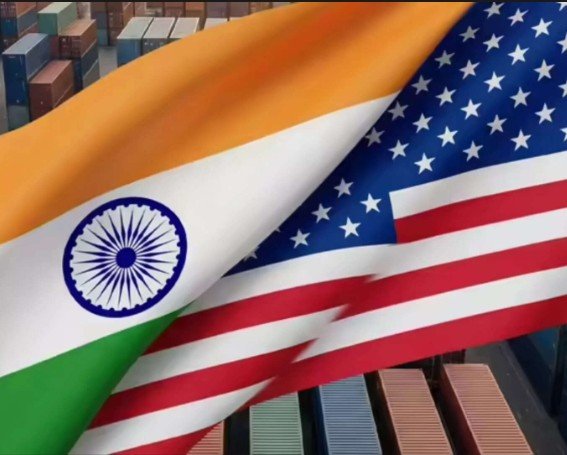
New Delhi, Jul 10: India should steer clear of premature concessions in its trade negotiations with the United States and instead adopt a calibrated, wait and watch approach, according to a new research report by SBI, which argues that Washington’s current style of bargaining is built around pressure tactics, strategic ambiguity and the linking of multiple geopolitical and economic issues into a single negotiating framework.
The assessment, released in the latest edition of SBI’s Ecowrap, suggests that New Delhi would be better served by patience rather than quick compromise as talks with the US continue. The report contends that the American negotiating posture under the present administration is designed to maximise leverage by keeping counterparts uncertain about the eventual shape of its demands, while simultaneously tying trade discussions to wider strategic and diplomatic considerations.
According to SBI Research, the United States is no longer treating trade as a standalone area of negotiation. Instead, it is increasingly folding commerce, defence, security alignments, strategic resources and broader foreign-policy objectives into one interconnected bargaining matrix. In such an environment, the report says, countries dealing with Washington need to read trade demands not in isolation but as part of a larger geopolitical strategy.
The study characterises the US approach as one that thrives on uncertainty. In its view, ambiguity itself has become a negotiating instrument, allowing Washington to maintain pressure while testing how governments, markets and allies respond to different signals. Rather than laying out a fixed end-state at the outset, the US is seen as opening with hard positions—often through tariffs, warnings or sharp policy announcements—and then adjusting the sequencing or intensity of those positions depending on the reaction they trigger.
SBI frames this as a form of strategic bargaining in which incomplete information is deliberately preserved. In practical terms, that means negotiating partners are left guessing how far Washington is willing to go, what it considers non-negotiable, and which demands are opening bids rather than final objectives. The report argues that this style is visible not only in trade but across a range of international flashpoints and alliance relationships, from NATO burden-sharing to Iran, China and other strategic theatres.
Against that backdrop, the report advises India not to respond to early pressure with sweeping concessions. Instead, it suggests New Delhi should maintain a steady negotiating posture, avoid public confrontation, keep channels of communication active, and make only limited, reversible offers while waiting for the US opening position to soften under the weight of its own domestic and strategic constraints.
The core recommendation is that India should seek to absorb the initial pressure without damaging the larger relationship. In SBI’s reading, the goal should not be to escalate tensions or stall engagement, but to allow time for Washington’s first round of demands to run into real-world limits—whether from economic costs within the US, the strategic necessity of balancing China, fatigue among allies, or market reactions to prolonged uncertainty.
The report argues that India enters these negotiations with a distinct set of strengths that differentiate it from many of America’s other partners and rivals. Unlike NATO allies that remain heavily dependent on US security guarantees, or China, which wields deep influence through manufacturing dominance and control over critical supply chains, India occupies a more hybrid strategic position. It is not merely a trade partner or a security dependent; it is a large and growing economy with multiple levers of influence across markets, diplomacy and regional strategy.
Among the assets highlighted by SBI are India’s vast domestic consumer base, its deep pool of technology and engineering talent, the global importance of its pharmaceutical sector, its role as a major defence buyer, and its expanding options in the energy sphere. The report also points to the influence of the Indian diaspora, the country’s rising profile in the Indo-Pacific, and its growing weight in global strategic calculations as factors that strengthen New Delhi’s bargaining hand.
In this reading, India does not need to negotiate from a position of urgency. Rather than rushing to secure a deal at any cost, it can afford to allow the conversation to evolve as the wider context changes. SBI suggests that over time, pressures within the US system—ranging from domestic economic interests to geopolitical priorities—could alter Washington’s stance and create more favourable space for India.
The report’s advice is therefore rooted in the idea of endurance rather than confrontation. It effectively argues that New Delhi should “hold the line” through the early phases of bargaining, avoiding the temptation to trade away leverage simply to produce a quick agreement. By doing so, India could strengthen its long-term negotiating position and ensure that any eventual understanding with the US is reached on terms that better reflect its own strategic and economic interests.
SBI also indicates that India should be prepared to test the seriousness of Washington’s demands, even if that means accepting some limited short-term costs. In its view, this would be preferable to locking in concessions too early and discovering later that the US opening posture was designed mainly to create negotiating pressure rather than define a final settlement. The report suggests that resilience at the outset could improve India’s standing in later rounds of talks.
A key theme running through the analysis is the increasing fusion of trade with strategic bargaining. SBI argues that the US is now using a broader transactional framework in which tariffs, defence expectations, alliance commitments, technology access and diplomatic alignment are all treated as interlinked components of statecraft. This means countries like India must assess trade demands alongside security calculations and geopolitical shifts, rather than assuming each file can be settled independently.
The report cites Washington’s handling of NATO as a prominent example of this style. According to SBI, the US has moved toward making alliance assurances more conditional by tying security expectations to burden-sharing, defence spending and broader political alignment. It points to recent tensions over NATO spending targets as evidence of how economic and strategic pressure can be blended to test the loyalty and responsiveness of partners.
Spain’s pushback on alliance spending targets, the report notes, has been interpreted not merely as a budget disagreement but as a broader signal of political positioning within the transatlantic relationship. In SBI’s view, this demonstrates how Washington increasingly treats even long-standing alliance structures as part of a larger negotiation over commitment, cost-sharing and strategic obedience.
The broader implication for India, the report suggests, is that the US negotiating model is no longer built on neat separations between economic and strategic domains. A trade discussion may therefore carry implications for defence cooperation, regional alignment, technology partnerships or diplomatic expectations. This makes it even more important for New Delhi to resist making isolated trade concessions without weighing the larger architecture of the relationship.
At the same time, SBI cautions that Washington’s reliance on uncertainty is not without risks for the US itself. While such tactics may deliver short-term leverage, they can also erode long-term credibility if allies, partners and markets begin to see unpredictability as a permanent feature rather than a temporary bargaining device. Over time, repeated use of ambiguity could reduce trust and complicate the very relationships Washington seeks to manage through pressure.
For India, however, the immediate policy lesson is one of discipline. The report does not advocate confrontation or disengagement; instead, it calls for a composed strategy that preserves goodwill while refusing to be rushed. That means keeping the bilateral dialogue active, avoiding rhetorical escalation, and using time as a negotiating asset rather than a liability.
This approach is especially relevant at a moment when India-US ties span far more than trade. The relationship now encompasses defence cooperation, semiconductor and technology partnerships, clean energy, critical minerals, supply-chain resilience, Indo-Pacific coordination and a broad convergence on concerns about China’s rise. In such a dense and multi-layered partnership, trade talks cannot be viewed through a narrow mercantilist lens alone.
SBI’s argument is that India’s expanding strategic importance gives it room to negotiate with confidence. As Washington recalibrates its global posture and seeks reliable partners in Asia, New Delhi’s value extends beyond tariffs or market access. That does not eliminate friction, but it does mean India has more bargaining space than a conventional trade deficit debate might suggest.
The report ultimately recommends that India use that space wisely. Rather than seeking immediate closure under pressure, it urges policymakers to preserve leverage, stay engaged and wait for a more advantageous moment—one in which American domestic costs, alliance pressures and broader geopolitical needs may soften the initial negotiating line coming from Washington.
In essence, SBI’s message is that India should not confuse patience with weakness. A measured approach, backed by confidence in India’s economic and strategic relevance, could allow New Delhi to navigate a difficult round of trade bargaining without sacrificing core interests too early. As discussions with the US continue, the report suggests, the smartest move may be not to rush toward agreement, but to shape the terms of engagement carefully and on India’s own timetable.

