


SIT Re-Questions Champat Rai in Ram Temple Donations Case, Trust Chief Hints at Exit
Ahead of the Shri Ram Janmabhoomi Teerth Kshetra Trust’s crucial July 6 meeting, former trust chief Champat Rai has reportedly indicated he may not continue amid the donation embezzlement controversy, while the SIT intensifies its investigation and political pressure mounts over the Ayodhya temple funds case.
AYODHYA, Jul 2: The controversy surrounding the alleged embezzlement of donations at the Ram temple in Ayodhya deepened on Thursday, with former Shri Ram Janmabhoomi Teerth Kshetra Trust chief Champat Rai reportedly indicating that he may step away from his role ahead of a crucial trust meeting next week. At the same time, the Special Investigation Team (SIT) probing the case returned to Ayodhya for another round of questioning, while fresh allegations surfaced from a priest who accused Rai and his associates of illegally taking control of a nearby temple through forged documents.
The developments come at a sensitive moment for the trust managing one of the country’s most high-profile religious institutions. According to sources, Rai has told close associates that his “service in Ayodhya is complete” and that he does not wish to continue under the “stigma” created by the ongoing controversy. The remarks are significant because they come just days before the July 6 meeting of the trust, where a decision is expected on the future of Rai and another trust member, Anil Mishra, both of whom have resigned from their posts in the wake of the scandal.
Sources familiar with the trust’s internal deliberations said the meeting is likely to take up multiple issues linked to the functioning of the trust and the fallout of the donation controversy. The agenda is expected to include the findings and recommendations of the SIT, which was set up by the Uttar Pradesh government last month after allegations emerged that funds and valuables offered by devotees at the Ram temple had been siphoned off over a period of time.
On Thursday, the SIT once again questioned Champat Rai, trust member Anil Mishra and temple official Gopal Rao. Unlike the earlier round of interrogation, when the three were examined separately, the SIT reportedly questioned them together in an attempt to reconstruct the sequence of events and understand how the alleged irregularities continued for so long. Investigators are believed to be trying to establish the chain of responsibility, determine whether there was any oversight failure at the trust level, and identify who knew what about the handling of donations and counting procedures.
While Rai, Mishra and Rao have not been named in the FIR registered in the case, their questioning has underscored the widening scope of the probe. Investigators are understood to be examining not only the mechanics of the alleged theft but also the administrative processes that governed the counting, storage and monitoring of cash and valuables offered by devotees.
The trust’s chairman, Mahant Nritya Gopal Das, is also central to the unfolding developments, though his participation in Monday’s meeting remains uncertain because of his health. The 89 year old leader, one of the most prominent faces of the Ram Janmabhoomi movement, is currently hospitalised with a urinary tract infection and breathing difficulties. In recent years, age related health issues have limited his active involvement, and he has attended trust meetings virtually.
The SIT had submitted its preliminary report to Additional Chief Secretary Sanjay Prasad in Lucknow on June 23. Two days later, an FIR was filed against eight individuals associated with the counting and handling of temple donations. Those arrested are linked to the process of collecting and counting cash offerings made by devotees at the temple. However, the FIR did not name Champat Rai, Anil Mishra or Gopal Rao, a fact that has become a major point of attack for opposition parties, which allege that only lower-level functionaries have been targeted while senior figures are being shielded.
Meanwhile, police continued to intensify the criminal investigation. Jailed accused Avinash Shukla was taken into custody on a 24 hour remand for further questioning. Shukla had reportedly been associated with the counting of offerings at the temple, and investigators believe his interrogation could provide more clarity on how the alleged embezzlement network operated.
The case has also taken a more complicated turn with serious allegations emerging from outside the donation probe itself. Hari Shankar Safariwala, who identified himself as the panch pramukh of the centuries-old Ram Niwas temple in Ramkot near the Ram Mandir complex, accused Champat Rai and “his gang” of illegally taking control of the shrine using forged documents. Speaking at a press conference addressed by Samajwadi Party president Akhilesh Yadav, Safariwala alleged that he had repeatedly complained to the authorities but no action had been taken.
These allegations have added a new dimension to the controversy, raising questions not only about the handling of temple donations but also about the functioning of individuals associated with the broader management ecosystem around the Ayodhya temple complex. Though the allegations regarding the Ram Niwas temple are separate from the donations case, they have further fuelled demands for a wider and more transparent investigation.
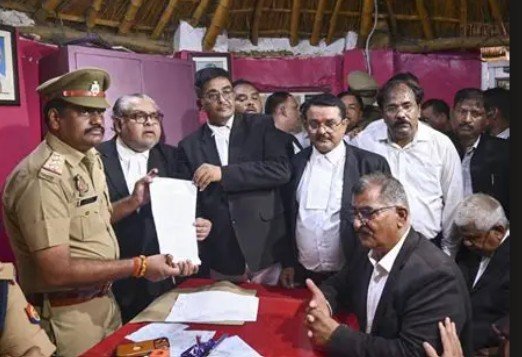
Legal pressure also mounted in Ayodhya as members of the Faizabad Bar Association took out a protest march and submitted a complaint to the police seeking registration of an FIR against Champat Rai, Anil Mishra and temple official Gopal Rao. The lawyers marched from the court premises to the Ram Janmabhoomi police station, demanding a fair and impartial investigation into all aspects of the case.
According to Faizabad Bar Association president Kalika Prasad Mishra, the complaint also names Krishna Mohan, another trustee who had earlier filed the first FIR in the case, as an accused. The lawyers argued that the investigation should not be limited to a handful of employees involved in donation counting and must examine whether there was any larger conspiracy, negligence or institutional complicity behind the alleged diversion of devotees’ offerings.
Separate official and police inputs have pointed to possible financial irregularities linked to some of the accused. Sources in the Ayodhya Development Authority (ADA) said a notice has been served to the wife of accused Lavkush Mishra over the alleged unauthorised construction of a house in Banvirpur village in Sohawal tehsil. The property is reportedly registered in the name of Mishra’s wife, Supriya Mishra, and the construction was allegedly carried out without mandatory approval from the authority.
Investigators have also recovered substantial amounts of cash and valuables during raids and searches linked to the case. Police sources said Rs 20.39 lakh was recovered from Avinash Shukla, Rs 18.07 lakh from Karunesh Pandey, Rs 16.82 lakh from Anukalp Mishra, Rs 14.25 lakh from Lavkush Mishra, Rs 7.32 lakh from Ramashankar Mishra and Rs 1 lakh from Ramashankar Yadav alias Tinnu. In addition to cash, investigators have seized around 11 grams of gold, approximately 375 grams of silver and 1,121 US dollars.
One of the most striking recoveries in the investigation has been a donation box labelled “Ramrajya Kosh” bearing a Paytm QR code, which was seized from a yoga centre in Ayodhya where accused Avinash Shukla had reportedly been staying for nearly a decade. Investigators are now trying to establish whether the box was part of an unauthorised parallel collection system and whether donations made by devotees were diverted through channels outside the trust’s official accounting system.
The alleged embezzlement first came to light on June 7, triggering a political and administrative storm in Uttar Pradesh and beyond. After the SIT was formed by the state government, it carried out a preliminary inquiry before the FIR was registered on June 25. Since then, eight people associated with the temple’s donation and counting process have been arrested, and the investigation has expanded to include financial transactions, property links, recovery of valuables and the role of officials connected to the trust.
The political reaction to the controversy has been swift and sharp. In Delhi, Aam Aadmi Party convenor Arvind Kejriwal targeted Prime Minister Narendra Modi, alleging that only “pawns” had been arrested while “powerful” people were being protected. He claimed there had been corruption not only in the handling of donations but also in land purchases and construction related to the temple. Kejriwal further alleged that the office-bearers of the Ram Mandir Trust had been handpicked by the prime minister and questioned why the top leadership had not intervened if irregularities were taking place.
The Congress also escalated its attack, accusing those who spoke of “Ram Rajya” of looting donations offered in Lord Ram’s name. Congress general secretary K C Venugopal wrote to the prime minister demanding an immediate Supreme Court-monitored investigation into what he described as a “mega scandal” involving stolen donations. The party said it would launch a wider campaign against the alleged misuse of funds collected from devotees.
Samajwadi Party chief Akhilesh Yadav, who has used the issue to intensify his criticism of the BJP government in Uttar Pradesh, claimed that news of the alleged theft had spread across villages and towns in the state and would have political consequences. He said the controversy had damaged public trust and predicted that the BJP would face anger from devotees and voters alike.
CPI MP P Sandosh also wrote to the prime minister, calling for a Comptroller and Auditor General (CAG) audit of temple donations and a judicial inquiry into the irregularities. In his letter, he accused organisations associated with the Ram temple movement of turning Lord Ram into a political project and betraying the faith of millions of devotees by allowing alleged financial misconduct.
At the centre of the controversy is the question of accountability. The Ram temple in Ayodhya is not merely a religious site; it is also one of the most emotionally and politically significant projects in recent Indian history. As a result, any allegation involving the misuse of donations offered by devotees carries enormous symbolic weight. The trust managing the temple has consistently enjoyed strong public visibility and political backing, which is why the current allegations have drawn such intense scrutiny.
For the investigators, the challenge now is to determine whether the alleged embezzlement was the work of a small group of employees manipulating the donation-counting system, or whether there were deeper structural failures and lapses in oversight. The SIT’s repeated questioning of senior trust-linked figures suggests that the probe is now moving beyond the first layer of accused individuals and into the larger framework of supervision, control and accountability.
For the trust, the July 6 meeting may prove to be a turning point. It is expected to discuss not only the future of key office-bearers such as Champat Rai and Anil Mishra, but also the credibility of the trust itself at a time when the Ram temple is meant to symbolise faith, devotion and national sentiment. If Rai indeed chooses not to continue, it would mark a major shift in the leadership structure of the trust at a moment of unprecedented crisis.
The outcome of the trust meeting, the next steps of the SIT, and the possibility of wider legal or judicial scrutiny are all likely to shape the course of the controversy in the coming days. For now, the Ayodhya donations case has evolved into more than a criminal investigation — it has become a test of transparency, accountability and institutional integrity at the heart of one of India’s most important religious institutions.

