


Venezuela Earthquake Death Toll Crosses 4,000 as Rescue Efforts Continue
Authorities end large scale rescue operations while thousands remain missing, as the United Nations appeals for urgent international assistance to support relief and reconstruction efforts.
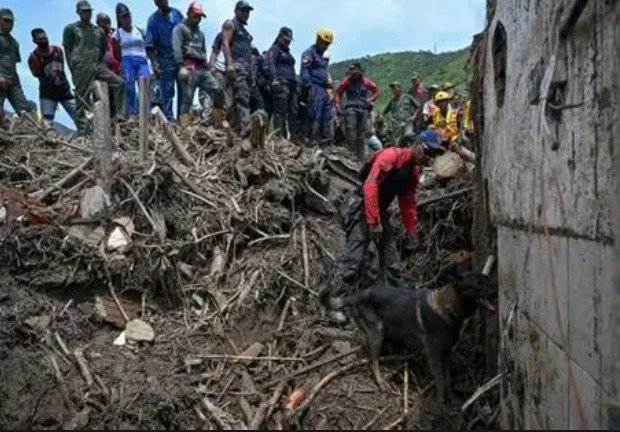
Caracas, July 11: Venezuela is facing an escalating humanitarian crisis after the official death toll from the powerful twin earthquakes that struck the country in late June climbed above 4,000. Authorities on Friday confirmed that thousands of people remain unaccounted for as relief agencies shift their focus from rescue operations to recovery and rehabilitation.
According to figures released by the Venezuelan government, at least 4,118 people have lost their lives, while 16,740 others have been injured in the back-to-back earthquakes that devastated large parts of the coastal state of La Guaira. The disaster ranks among the deadliest natural calamities in the country’s modern history.
The two powerful earthquakes struck within seconds of each other on June 24, causing catastrophic destruction across residential neighbourhoods and commercial areas. The stronger 7.5-magnitude earthquake, the most powerful recorded in Venezuela in more than a century, followed a 7.2-magnitude tremor less than a minute later, leaving little time for residents to seek safety.
Entire apartment complexes and high-rise buildings collapsed under the force of the tremors, trapping thousands beneath massive piles of concrete and twisted steel. Roads, bridges, hospitals and essential public infrastructure also suffered extensive damage, complicating emergency response efforts.
Although official search-and-rescue missions have now concluded, many families continue to gather near the ruins of collapsed buildings in the hope of locating the remains of missing relatives. For many survivors, the priority has shifted from rescue to recovering loved ones and arranging proper burials.
Officials acknowledge that thousands of people are still listed as missing, raising fears that the final death toll could increase further as recovery teams continue clearing debris across the affected districts.
Fresh concerns emerged on Friday when a 3.0-magnitude aftershock was felt in central Caracas. While the tremor caused no major damage, it triggered panic among residents and prompted precautionary evacuations from several buildings, highlighting the continued seismic uncertainty in the region.
The earthquakes have placed enormous pressure on Venezuela’s already fragile public infrastructure. Years of economic difficulties have weakened healthcare services, emergency response systems and public utilities, making relief operations significantly more challenging.
Humanitarian organisations have warned that many affected communities continue to face shortages of clean drinking water, electricity, food supplies and medical assistance. Thousands of displaced families remain in temporary shelters or makeshift camps as authorities work to restore basic services.
Recognising the scale of the disaster, the United Nations has appealed for nearly 300 million US dollars in emergency funding to support humanitarian relief, medical assistance, shelter, food distribution and long-term reconstruction programmes across the affected regions.
The Venezuelan government has also appealed for greater international cooperation to accelerate recovery efforts. Interim President Delcy Rodríguez has urged the release of Venezuelan state assets frozen overseas, arguing that the funds are urgently needed to rebuild communities destroyed by the earthquakes.
As part of these diplomatic efforts, Rodríguez said she had formally requested King Charles III to facilitate the release of approximately 30 tonnes of Venezuelan gold currently held in the United Kingdom under sanctions. According to the government, access to these assets would provide vital financial support for reconstruction and humanitarian assistance.
Experts believe rebuilding the worst-hit areas will take several years, given the widespread destruction of housing, transportation networks and public facilities. Engineers continue structural assessments of damaged buildings to determine which structures can be repaired and which must be demolished.
With thousands of families mourning their losses and many communities still struggling to recover, Venezuela faces one of the most difficult reconstruction efforts in its recent history. Authorities, aid agencies and international partners continue to coordinate relief operations as the country begins the long process of rebuilding after one of its deadliest natural disasters.

