


Article 370 Abrogation Fulfilled Syama Prasad Mookerjee’s Dream, Says PM Modi; Praises West Bengal for Honouring Jana Sangh Founder
Addressing a commemorative event via video message, Prime Minister Narendra Modi said the BJP’s governance model and the idea of “New India” continue to draw inspiration from Dr Syama Prasad Mookerjee’s ideals of national unity, ideological conviction and cultural pride.
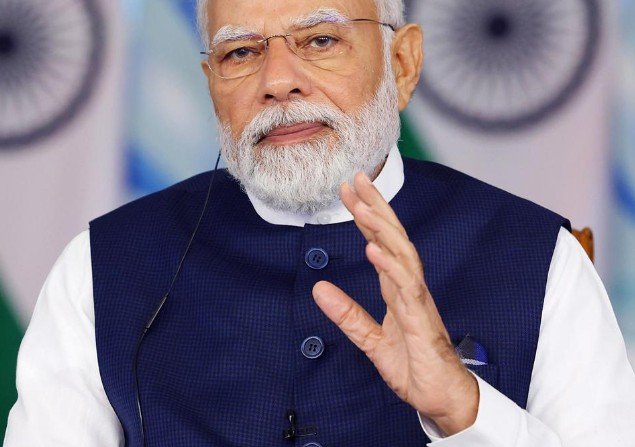
Kolkata, July 6: Prime Minister Narendra Modi on Monday said the Centre’s decision to abrogate Article 370 marked the fulfilment of Bharatiya Jana Sangh founder Dr Syama Prasad Mookerjee’s long held vision, as he paid tribute to the veteran nationalist leader on his 125th birth anniversary. In a video message delivered at a commemorative programme, Modi described Mookerjee as a towering patriot, an uncompromising advocate of national integration and a leader whose ideological legacy continues to shape the Bharatiya Janata Party’s political direction and governance priorities.
Remembering Mookerjee as one of Bengal’s most distinguished sons, the Prime Minister said the country was honouring a leader who dedicated his life to the unity and integrity of India. He said Mookerjee’s political thought, courage and clarity of purpose remain deeply relevant in the present era, particularly in the BJP’s conception of nation building and its vision for a stronger, more cohesive India.
Modi placed special emphasis on the Centre’s 2019 move to revoke Jammu and Kashmir’s special constitutional status, describing it as a landmark step that realised one of Mookerjee’s most enduring political commitments. Referring to Mookerjee’s historic opposition to the special dispensation for the erstwhile state, the Prime Minister said the Jana Sangh founder had fought resolutely against the idea of separate constitutional symbols and political arrangements within one sovereign nation.
According to Modi, the removal of Article 370 was not merely an administrative or constitutional change but the culmination of a decades-long ideological struggle rooted in the principle of “one nation, one Constitution.” He recalled that Mookerjee had strongly objected to the existence of separate constitutional arrangements in Jammu and Kashmir, including its own Constitution, a separate flag and distinct official titles for its leadership in the years following Independence.
The Prime Minister said Mookerjee’s stand on Jammu and Kashmir stemmed from his larger commitment to the idea of Akhand Bharat and his belief that the country’s unity must remain above all political calculations. He noted that Mookerjee had made immense personal sacrifices in pursuit of this cause and recalled that the Jana Sangh founder died in detention in Srinagar in 1953 after entering Jammu and Kashmir without a permit in protest against the prevailing arrangement.
Modi also used the occasion to revisit Mookerjee’s role during the turbulent years of Partition, particularly his intervention in Bengal at a time when the province’s future was uncertain. He said that during the division of the country in 1947, attempts were being made to separate the whole of Bengal from India and that Mookerjee stood firmly against such efforts. Through political mobilisation and public outreach, Modi said, Mookerjee helped ensure that Bengal remained a part of India.
Highlighting Mookerjee’s political legacy in eastern India, the Prime Minister quoted a well-known line attributed to him to underline his role during that critical period. Modi said Mookerjee’s contribution went beyond ideological speeches and was reflected in concrete political action taken at a defining moment in the nation’s history. In doing so, he projected the Jana Sangh founder not only as a nationalist icon but also as a decisive political strategist who influenced the map of post-Partition India.
The Prime Minister also praised the West Bengal government for organising the commemorative event and for taking steps to honour the legacy of the Jana Sangh founder. He referred to the recent observance of Paschimbanga Divas and said such programmes reflected a broader commitment to celebrating Bengal’s heritage and paying tribute to leaders who shaped India’s political and cultural journey.
Modi said the scale and seriousness of the celebrations indicated what a “Nation First” government looks like in practice. According to him, governments guided by national commitment make conscious efforts to preserve the memory of leaders whose work strengthened the country and inspired future generations. He said the programme dedicated to Mookerjee was part of that larger effort to reconnect people with figures who played a foundational role in shaping India’s democratic and civilisational identity.
The Prime Minister further noted that the Centre is observing Dr Syama Prasad Mookerjee’s 125th birth anniversary as a two-year national commemoration. He said the observance began on July 6 last year and will continue until July 6 next year, reflecting the significance the government attaches to Mookerjee’s contribution to national life. The extended commemoration, he suggested, is intended not merely as a ceremonial tribute but as a sustained national remembrance of a leader whose ideas still resonate in contemporary politics.
In his address, Modi portrayed Mookerjee’s life as an example of how deep conviction and ideological clarity can influence the course of public life. He said Mookerjee’s journey showed that strong resolve, principled commitment and complete dedication to a cause can ultimately turn a political idea into a mass movement. That, he said, was the essence of Mookerjee’s life and work.
Tracing the origins of the Bharatiya Jana Sangh, Modi said Mookerjee entered national politics at a time when the Congress enjoyed overwhelming dominance and alternative ideological platforms had little space to grow. He described the formation of the Jana Sangh as a major democratic intervention that introduced a new political vocabulary and widened the scope of ideological debate in India. In the Prime Minister’s telling, Mookerjee’s decision to found the Jana Sangh was not simply about creating another political party, but about offering the country a fresh ideological framework rooted in nationalism, cultural identity and democratic pluralism.
Modi said the Jana Sangh created space for a different political voice at a time when one-party dominance had become the norm. He argued that this effort helped strengthen democracy by broadening political discourse and giving expression to ideas that would later become central to the BJP’s rise. The Prime Minister used this historical narrative to draw a clear line of continuity between Mookerjee’s political thought and the BJP’s current position as India’s dominant national party.
He also paid tribute to generations of Jana Sangh and BJP workers who, he said, devoted their lives to preserving and expanding the ideological movement founded by Mookerjee. Modi observed that an ideology does not become immortal merely because it is articulated by a leader; it survives and grows only when successive generations carry it forward with dedication. He said countless workers and leaders had done precisely that, ensuring that the values and principles associated with the Jana Sangh remained alive and influential over the decades.
According to the Prime Minister, the transformation of the Jana Sangh into the Bharatiya Janata Party represents the continued evolution of the political current first shaped by Mookerjee. Though the Jana Sangh no longer exists in its original organisational form, Modi said its core ideas continue to flourish through the BJP, which he described as the world’s largest democratic political force. He said the movement that began with Mookerjee’s ideological intervention now serves the people through the BJP’s governance model and national outreach.
Modi argued that Mookerjee’s ideology is not confined to the past but remains an active force in the making of “New India.” In his view, the BJP’s political philosophy, its administrative decisions and its emphasis on national unity all reflect the continuing relevance of Mookerjee’s thought. He suggested that several major decisions taken by the present government, including the abrogation of Article 370, should be seen as extensions of the Jana Sangh founder’s worldview and political struggle.
The speech, while commemorative in tone, also carried unmistakable political messaging. By placing Article 370 at the centre of Mookerjee’s legacy and linking the BJP’s current governance agenda to the Jana Sangh founder’s principles, Modi reinforced the party’s ideological narrative ahead of future political contests. His praise for the West Bengal government’s role in honouring Mookerjee also carried significance, given the BJP’s efforts to expand its political footprint in the state and its continued emphasis on Bengal’s place in the national imagination.
At a broader level, the Prime Minister’s remarks sought to present Mookerjee as a figure whose life connected several key strands of India’s post-Independence political story — Partition, national integration, opposition politics, ideological assertion and the evolution of the BJP. By invoking these themes together, Modi framed Mookerjee not only as a historical figure to be remembered, but as a continuing source of political inspiration whose ideas remain central to the BJP’s identity.
Concluding his address, Modi expressed confidence that future generations studying the history of the Bharatiya Janata Party would inevitably return to Dr Syama Prasad Mookerjee’s contribution. He said the courage, foresight and principles demonstrated by the Jana Sangh founder would continue to inspire the party and the nation alike. In doing so, the Prime Minister positioned Mookerjee as both the ideological architect of a political tradition and a symbol of the nationalist vision that the BJP says it continues to advance in contemporary India.

