


EAM Jaishankar Reaches Kuwait, Set for Key Bilateral Engagements
External Affairs Minister S Jaishankar begins his Kuwait engagements after high-level talks in Bahrain and Qatar, signalling New Delhi’s continued push to deepen strategic, economic and people centric ties across the Gulf region.
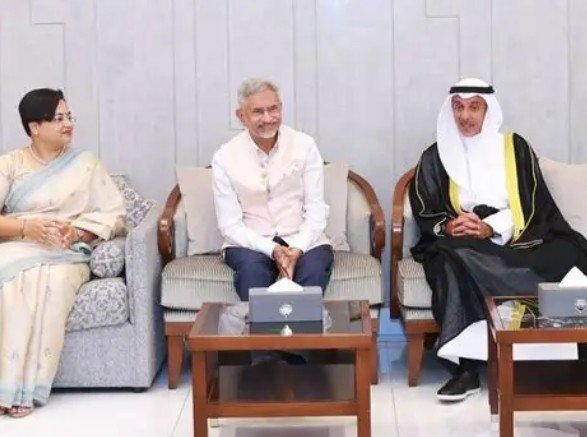
New Delhi, July 08 : External Affairs Minister S Jaishankar arrived in Kuwait City on Tuesday, marking the next leg of India’s high-level diplomatic outreach in the Gulf as New Delhi works to reinforce its political, economic and strategic partnerships with key West Asian nations.
On his arrival, Jaishankar was received by Kuwait’s Deputy Foreign Minister Hamad Suleiman Mashaan Al-Mashaan. Expressing appreciation for the welcome, the minister said he was looking forward to a series of official engagements in the country, underlining the importance India attaches to its relationship with Kuwait and the wider Gulf region.
The Kuwait visit comes at a significant moment in India’s diplomatic calendar, following Jaishankar’s recent engagements in Bahrain and Qatar. Together, the three stops reflect a broader Indian effort to consolidate ties with the Gulf, a region that remains central to India’s energy security, trade interests, diaspora welfare and strategic outreach.
Before arriving in Kuwait, Jaishankar was in Bahrain, where he held a string of high-level meetings aimed at taking forward the longstanding partnership between the two countries. According to the Ministry of External Affairs, the External Affairs Minister had an audience with Bahrain’s King Hamad bin Isa Al Khalifa in the presence of Crown Prince and Prime Minister Prince Salman bin Hamad Al Khalifa. He also met Deputy Prime Minister Khalid bin Abdullah Al Khalifa during the visit.
During these interactions, Jaishankar conveyed greetings from President Droupadi Murmu and Prime Minister Narendra Modi to the Bahraini leadership and reiterated India’s commitment to elevating bilateral cooperation. The discussions reflected the warmth and continuity in India-Bahrain relations, which have grown steadily through sustained political engagement, expanding commercial links and strong people-to-people connections.
A major theme of Jaishankar’s Bahrain visit was India’s appreciation for the support extended to the Indian community living and working there. He thanked the Bahraini leadership for ensuring the safety, security and welfare of Indian nationals, whose presence has played a major role in the social and economic fabric of the Gulf kingdom. The Indian diaspora remains one of the most important pillars of India’s ties with Gulf nations, serving as a bridge between societies and contributing to mutual prosperity.
Jaishankar also held bilateral talks with Bahrain’s Foreign Minister Abdullatif bin Rashid Al Zayani. The two sides reviewed the full spectrum of bilateral relations and explored ways to widen cooperation across multiple sectors. Their discussions covered areas of existing collaboration as well as future opportunities, while also including an exchange of views on regional and international developments of shared concern.
In a gesture reflecting India’s support for Bahrain on the global stage, Jaishankar congratulated the country on its election as a non-permanent member of the United Nations Security Council for the 2026–27 term. The message highlighted India’s intent to work closely with Bahrain in multilateral forums and to maintain close coordination on key international issues.
The External Affairs Minister also used his Bahrain visit to connect with the Indian community, acknowledging its contribution to the host country’s development and to the strengthening of bilateral ties. Such outreach has become a regular feature of India’s diplomacy in the Gulf, where expatriate Indians form one of the largest overseas communities and remain deeply linked to both India’s economy and its foreign policy priorities.
Prior to Bahrain, Jaishankar had concluded a visit to Qatar, another important partner in the Gulf. In Doha, he held extensive talks with Qatar’s Prime Minister and Minister of Foreign Affairs, Sheikh Mohammed bin Abdulrahman Al Thani. Those discussions focused on broadening cooperation in critical areas such as energy security, trade and strategic investments. The visit also reaffirmed the depth of India-Qatar ties, especially in light of longstanding economic engagement and close interpersonal links between the two countries.
The Gulf region occupies a vital place in India’s external engagement strategy. It is a major source of crude oil and liquefied natural gas, a key destination for Indian workers and professionals, and an increasingly important partner in infrastructure, investment, technology and food security. As global geopolitical equations continue to evolve, India has sought to maintain strong, balanced and mutually beneficial ties with all major Gulf partners.
Jaishankar’s ongoing tour of the region can therefore be seen as part of a wider diplomatic effort to sustain momentum in India’s relationships with West Asian nations at a time of changing global alignments. India has steadily expanded its outreach in the Gulf over the last decade, moving beyond traditional energy and diaspora links to build stronger partnerships in areas such as digital technology, defence cooperation, logistics, maritime security, renewable energy, fintech and investment.
Kuwait, the latest stop in Jaishankar’s itinerary, is an important partner for India in this regional framework. The two countries share longstanding ties rooted in trade, energy cooperation and strong people to people contact. A large Indian community lives in Kuwait and contributes significantly to its economy, while Kuwait remains a valuable energy partner for India. Diplomatic engagement at the ministerial level is expected to further strengthen this relationship and identify new opportunities for collaboration.
Although details of Jaishankar’s meetings in Kuwait were not immediately available at the time of his arrival, the visit is expected to focus on enhancing bilateral cooperation and reviewing regional developments. India and Kuwait have maintained regular contact over issues of mutual concern, and Jaishankar’s presence in the country is likely to provide another opportunity to push forward discussions in sectors such as trade, investment, labour welfare, energy and strategic coordination.
The minister’s Gulf outreach also comes against the backdrop of India’s broader foreign policy objective of strengthening partnerships with countries that play an influential role in regional stability and global energy markets. With tensions and uncertainty continuing to affect parts of West Asia, India has placed emphasis on sustained diplomatic engagement, pragmatic cooperation and protection of the interests of its citizens abroad.
Jaishankar’s meetings across Qatar, Bahrain and now Kuwait underscore this multi-layered approach. On one level, the visits are about reaffirming political trust and leadership-level communication. On another, they are aimed at expanding practical cooperation in commerce, connectivity, investment and energy. At the same time, they also reinforce India’s commitment to the welfare of its diaspora in the Gulf, whose contribution remains central to bilateral relations.
India’s engagement with Gulf countries has also gained greater strategic depth in recent years because of shared interests in maritime security, supply chain resilience and regional connectivity. Countries such as Qatar, Bahrain and Kuwait are not only energy suppliers or trade partners, but also stakeholders in a wider regional order in which India is seeking a larger and more active role. Frequent diplomatic exchanges, ministerial visits and leadership interactions have therefore become essential tools for keeping these relationships dynamic and future-oriented.
For India, the Gulf is no longer viewed only through the lens of oil imports or expatriate remittances. It is increasingly seen as a zone of strategic opportunity, economic collaboration and geopolitical relevance. Jaishankar’s current engagements reflect this shift. By visiting key Gulf capitals in succession, India is signalling that it intends to remain closely engaged with regional partners across a wide agenda that includes economic growth, energy stability, international diplomacy and community welfare.
As Jaishankar begins his engagements in Kuwait, the visit is expected to add another chapter to India’s deepening engagement with the Gulf. Coming immediately after substantive meetings in Bahrain and Qatar, it reinforces the message that New Delhi is committed to sustained, high-level diplomacy in a region that remains indispensable to its national interests.
The outcomes of the Kuwait leg of the visit will be watched closely for indications of how India plans to further expand cooperation with one of its longstanding Gulf partners. For now, the External Affairs Minister’s arrival in Kuwait highlights the continuity of India’s regional diplomacy and its intent to build stronger partnerships through dialogue, mutual trust and practical collaboration.

