


Omar Promises Industrial Support
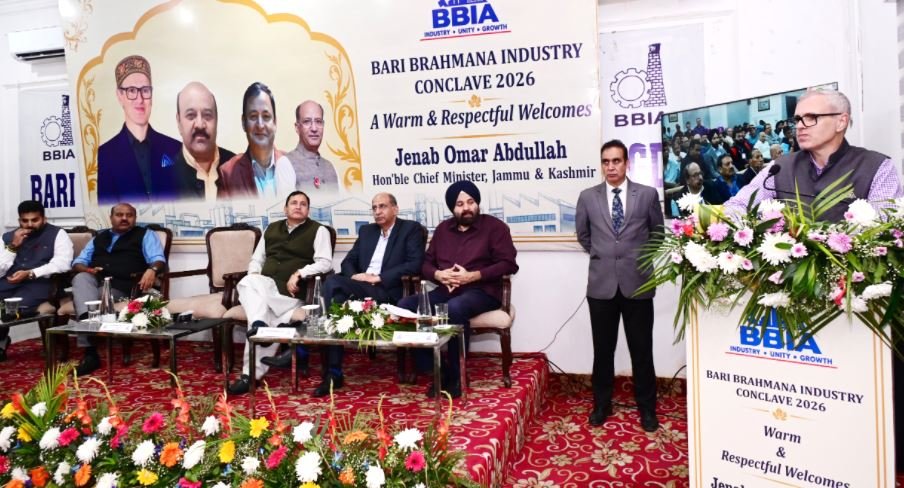
The true strength of an economy lies not merely in its ability to attract fresh investment, but in its capacity to preserve productive assets, sustain existing enterprises and create conditions in which businesses can grow with financial confidence. For Jammu and Kashmir, where industrial development has historically been constrained by geographical isolation, high transportation costs, limited market access and persistent economic uncertainties, this distinction carries particular significance. Every functioning industrial unit represents accumulated capital, entrepreneurial commitment, employment opportunities and an economic foundation built through years of perseverance. The closure or weakening of such enterprises is therefore more than an individual business setback; it represents a loss of productive capacity, established livelihoods and valuable regional investment. Viewed against these realities, Chief Minister Omar Abdullah’s announcement of a forthcoming industrial policy at the Bari Brahmana Industries Association Conclave offers a timely and encouraging opportunity to reassess the region’s development priorities. His emphasis on protecting existing industries while welcoming new investment reflects a sound economic understanding that sustainable industrialization requires both continuity and expansion. The challenge now is to translate this balanced vision into a financially realistic, equitable and forward-looking policy that strengthens investor confidence, safeguards established enterprises and places Jammu and Kashmir on a more resilient path towards economic self-reliance.
The proposed introduction of three policies covering industry, mining, and logistics and warehousing ahead of the Budget Session 2027-28 indicates an attempt to address interconnected economic challenges. Such an approach is necessary because industrial growth cannot be sustained through financial incentives alone. Reliable raw material supplies, affordable electricity, efficient transportation, access to markets and predictable administrative procedures are equally important. Jammu and Kashmir’s difficult terrain and distance from major manufacturing centres make these considerations particularly relevant. A policy that overlooks these structural disadvantages may attract investment proposals without creating enterprises capable of surviving independently. The Chief Minister’s observation that new investment must not come at the expense of existing industries reflects an important economic reality. Established manufacturing units represent accumulated capital, employment, technical experience and longstanding connections with local communities. Many have continued operating through periods when industrial expansion was far from easy. Their contribution cannot be adequately measured through investment figures alone. Protecting their competitiveness is therefore not a concession to a particular business community, but an investment in regional economic stability. Nevertheless, industrial protection should not become an argument for permanent dependence on public subsidies. The Chief Minister has appropriately questioned the sustainability of enterprises requiring indefinite government assistance. Financial support must be carefully designed to help industries overcome genuine disadvantages, modernize operations and become competitive. Equally, policymakers must distinguish between inefficient business models and unavoidable regional costs. An enterprise facing excessive freight expenditure because of geographical isolation cannot always be judged by the same standards as one operating near established industrial corridors. Another significant proposal concerns purchase and price preference for locally manufactured products. Where quality, price and supply conditions are reasonably comparable, local manufacturers deserve fair opportunities in government procurement within the applicable legal framework. Such measures could strengthen demand, improve capacity utilization and encourage further investment. However, transparent eligibility conditions and competitive standards would be essential to ensure that preferential treatment promotes efficiency rather than complacency. The proposed working group involving industrial associations offers perhaps the most practical opportunity for immediate progress. Yet committees achieve little unless their recommendations influence decisions. The Government should establish a clearly defined consultation mechanism that identifies major industrial grievances, evaluates their financial implications and recommends achievable solutions within fixed timelines. Representation should extend beyond prominent industrial organizations to include smaller manufacturers, emerging entrepreneurs and enterprises operating in less-developed districts. There is also a wider public-interest dimension. Industrial policy must ultimately be judged by its contribution to employment, particularly for educated young people seeking opportunities within Jammu and Kashmir. Greater attention to agro-processing, food industries, handicrafts, renewable energy, technology-based enterprises and locally available resources could create stronger connections between industrial investment and the regional economy. Development must reach beyond established industrial estates to generate opportunities across both Jammu and Kashmir divisions.
Finally, the Chief Minister’s assurance deserves a constructive response from industry and administration alike. What Jammu and Kashmir now requires is a policy built around continuity, competitiveness and shared responsibility. Before finalizing the framework, the Government should transparently assess existing industrial units, identify five to ten urgent reforms, set measurable implementation deadlines, and review progress through regular consultations. New investments will certainly matter, but lasting industrial confidence will emerge only when enterprises already rooted in this region find convincing reasons to remain, expand and employ. The most meaningful industrial policy will transform economic uncertainty into sustainable opportunity for both businesses and the people whose livelihoods depend on them. Further, the Government should also consider a dedicated revival package for financially stressed but viable units, alongside modernization assistance, an early procurement preference policy and easier access to institutional credit. Equally important is a permanent consultation mechanism ensuring that industrial grievances receive timely resolution. The Chief Minister’s constructive approach offers renewed hope, but its lasting value will depend on implementation. A balanced, transparent and time-bound industrial policy can restore confidence, safeguard existing livelihoods and make Jammu and Kashmir a stronger, more competitive manufacturing destination.

