


PM Modi to Embark on First Official New Zealand Visit Next Week
Auckland visit on July 10-11 comes soon after the India–New Zealand free trade agreement, with both sides expected to deepen ties in trade, agriculture, investment and strategic cooperation.
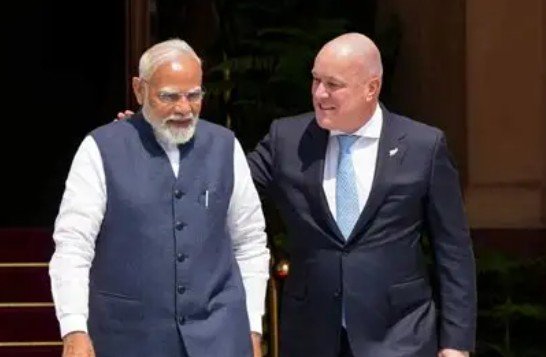
New Delhi, July 03 : Prime Minister Narendra Modi will travel to New Zealand next week on what is being described as a landmark diplomatic visit, marking the first official trip by an Indian Prime Minister to the country in four decades. The announcement was made by New Zealand Prime Minister Christopher Luxon, who called the upcoming visit “historic” and underlined its significance for the future of India–New Zealand relations.
According to Luxon’s office, Modi is scheduled to arrive in Auckland on July 10 and will depart the following day. Though brief in duration, the visit is expected to carry substantial political and economic weight, coming at a time when the two countries are moving to translate a recently concluded free trade agreement into a broader strategic partnership.
In his statement, Luxon said the visit would be a major moment in bilateral ties, noting that no Indian Prime Minister has undertaken an official visit to New Zealand in the past 40 years. The timing is particularly significant because it follows the successful conclusion of negotiations for a free trade agreement between India and New Zealand, a pact both governments have described as transformative for commerce, supply chains and sectoral cooperation.
The trade agreement, signed a little over two months ago, is already being viewed as one of the fastest trade deals negotiated by India in recent years. Talks began in March 2025 and were wrapped up within nine months, a pace that reflects the political will on both sides to strengthen economic engagement and reduce barriers to trade. Officials from both countries have projected that the agreement will open a new chapter in bilateral relations, extending beyond goods trade into agriculture, technology, manufacturing inputs and market access.
For India, one of the most significant outcomes of the pact is the promise of complete duty free access for all 8,284 of its export products in the New Zealand market from the first day of the agreement’s implementation. This is expected to benefit a wide range of Indian industries, from textiles and engineering goods to processed foods, pharmaceuticals and manufactured products. The removal of tariffs is likely to improve the competitiveness of Indian exports and create new opportunities for small and medium sized businesses looking to enter or expand in the New Zealand market.
Indian officials have also highlighted the importance of duty free access to key raw materials and industrial inputs from New Zealand. Under the agreement, India will be able to source items such as wooden logs, coking coal and metal waste and scrap at lower cost. This is expected to provide a direct boost to Indian manufacturers by reducing production expenses and easing pressure on input costs. In sectors where margins are narrow and international competition is intense, such cost advantages can have a meaningful impact on export performance and domestic industrial efficiency.
Agriculture has emerged as another important pillar of the new trade framework. The agreement includes provisions for cooperation in agri-technology and sectoral knowledge exchange, including a special plan aimed at helping Indian farmers in areas such as kiwi cultivation, apple production and honey processing. These sectors are seen as promising areas of collaboration because New Zealand has considerable expertise in horticulture, farm management and high-value agricultural systems, while India offers a large and diverse farming base with significant room for productivity gains and value addition.
Officials familiar with the discussions say the agriculture component is not limited to trade in farm products but also focuses on improving techniques, inputs and know-how that could support Indian growers. If implemented effectively, this cooperation could help farmers diversify crops, improve quality standards and tap premium domestic and export markets. It also fits with India’s broader push to modernise agriculture through technology, better post-harvest practices and stronger market linkages.
For New Zealand, the agreement is expected to unlock major export gains in the Indian market, one of the world’s fastest-growing large economies. The pact will remove tariffs on 95 per cent of goods from New Zealand, creating fresh opportunities for exporters dealing in wool, wine, wood, coal and fruits such as avocados and blueberries. Access to India’s large consumer base is seen as a major commercial prize for Wellington, especially as New Zealand seeks to diversify export destinations and deepen ties in the Indo-Pacific region.
Even so, India has maintained safeguards in sectors it considers sensitive. Nearly 30 per cent of India’s tariff lines have been kept outside the scope of the agreement to protect vulnerable domestic industries and politically sensitive product categories. These include dairy, edible oils, gems and jewellery, among others. The decision reflects New Delhi’s cautious approach to trade liberalisation, particularly in sectors where domestic producers fear import competition or where livelihoods are closely tied to price stability and local demand.
The balance struck in the agreement appears designed to maximise strategic and commercial gains while limiting domestic disruption. For India, the FTA offers access to a developed, rules-based market and a reliable supplier of industrial and agricultural inputs. For New Zealand, it provides an opening into a massive and expanding economy where consumption, urbanisation and manufacturing demand continue to grow. The Modi visit is expected to focus on how quickly these gains can be operationalised and how both governments can ensure businesses begin to benefit without delay.
Beyond trade, Modi’s trip is likely to be used to broaden the agenda of bilateral cooperation. Diplomatic observers say the two sides may discuss ways to expand collaboration in education, digital innovation, clean energy, food processing and people-to-people exchanges. New Zealand has long sought stronger engagement with India, not only because of India’s economic rise but also because of the growing role of the Indian diaspora in New Zealand’s social and political landscape.
The Indian-origin community in New Zealand has grown steadily over the years and now plays a visible role in business, healthcare, education and public life. Modi’s visit is expected to resonate strongly with this community, which has often served as a bridge between the two countries. Public outreach, interaction with community representatives and symbolic gestures recognising the Indian diaspora could become an important part of the visit’s messaging, even if the official schedule remains focused on diplomacy and trade.
Strategically, the visit also comes at a time when countries across the Indo-Pacific are recalibrating their partnerships in response to changing global trade flows, supply chain vulnerabilities and geopolitical uncertainty. India has stepped up efforts to strengthen ties with partners across the region, while New Zealand has shown interest in diversifying both its economic and strategic relationships. A high-level visit from Modi provides an opportunity to signal that the India–New Zealand relationship is entering a more active and consequential phase.
While the immediate spotlight is on the trade agreement, officials are likely to use the visit to discuss a wider framework for long-term cooperation. This could include collaboration in food security, critical minerals, renewable energy, logistics and innovation-led sectors where the two economies can complement each other. India’s interest in securing raw materials and supply chain resilience, combined with New Zealand’s strengths in agri-tech, research and niche exports, offers multiple avenues for a more substantive partnership.
The political symbolism of the trip is equally important. A gap of 40 years between prime ministerial visits reflects how underdeveloped the relationship had remained at the highest political level despite steady people to people links and growing commercial interest. By making the trip soon after the FTA, Modi appears to be signalling that New Zealand is being brought into India’s wider diplomatic and economic outreach in the Pacific and Indo-Pacific region.
For Luxon, hosting Modi also offers a chance to present New Zealand as an agile trade partner capable of building ambitious economic agreements with major global players. The speed of the FTA negotiations has already been highlighted by both governments as evidence of a shared commitment to pragmatic cooperation. The visit is expected to reinforce that narrative and could result in announcements or understandings aimed at fast-tracking implementation of the trade pact.
Business groups in both countries are likely to watch the visit closely for signs of how quickly customs procedures, tariff schedules and sectoral commitments will be rolled out. Exporters, importers and investors will be looking for clarity on timelines, compliance requirements and sector-specific opportunities. In India, industries that stand to gain from lower-cost inputs and new export openings may use the visit as a trigger to begin market planning for New Zealand. In New Zealand, producers in agriculture, forestry and premium food segments are expected to intensify outreach to Indian buyers and distributors.
The visit could also carry a broader message about India’s current trade posture. In recent years, New Delhi has taken a more selective but proactive approach to trade agreements, seeking deals that support manufacturing, improve export access and avoid exposing politically sensitive sectors to sudden shocks. The India–New Zealand pact appears to fit that template. It combines ambitious market opening in selected areas with carefully drawn exclusions for sectors that the government wants to shield. Modi’s presence in Auckland so soon after the agreement underscores the political importance attached to making such trade deals work in practice.
Although the trip will last only two days, its implications could stretch far beyond ceremonial diplomacy. If both sides use the moment effectively, the visit may become the launchpad for a more durable and diversified bilateral relationship. Trade will remain the central pillar, but the long-term success of the partnership may depend on how well India and New Zealand convert goodwill into institutional cooperation, investment flows, agricultural innovation and stronger strategic dialogue.
For now, the historic nature of the visit is its most immediate headline. Forty years after the last official trip by an Indian Prime Minister to New Zealand, Narendra Modi’s arrival in Auckland will be watched as both a symbolic reset and a practical attempt to deepen engagement with a country that is becoming increasingly important in India’s trade and Indo-Pacific outreach. With a freshly signed free trade agreement in hand and multiple sectors poised for collaboration, the visit has the potential to mark a turning point in India–New Zealand relations.

